This website uses cookies to ensure you get the best experience on our website.


- Table of Contents
Catalog number: EKC2116
1. PRODUCT AND COMPANY IDENTIFICATION
Product name C-RAF (Phospho-Ser621) Colorimetric Cell-Based ELISA Kit
Catalog number EKC2116
Recommended use Research use only
Supplier address Boster Biological Technology Co., Ltd.
3942 B Valley Ave, Pleasanton, CA 94566, USA
E-mail address support@bosterbio.com
Emergency telephone number Tel: 888-466-3604
2. HAZARDS IDENTIFICATION
OSHA/HCS Status
This material is considered hazardous by the OSHA Hazard Communication Standard (29 CFR 1910.1200).
Hazardous Ingredients
1. -target antibody, -phospho-target antibody, -GAPDH antibody: < 0.1% Sodium azide
2. 10X TBS: 0.2% Kathon CG/ICP
3. 15X Wash buffer: 0.3% Kathon CG/ICP, 1.5% Tween-20
4. HRP-conjugated antibodies: 0.2% Kathon CG/ICP, 0.1% Tween-20
5. Dye 1/2 -conjugated antibodies: 0.2% Kathon CG/ICP, 0.1% Tween-20
6. SDS solution: 1% Sodium Dodecyl Sulfate (SDS)
7. Blocking buffer: 0.5% Triton X-100, 0.1% Tween-20
8. Primary antibody diluent: 0.2% Kathon CG/ICP, 0.5% Triton X-100, 0.1% Tween-20
9. Quenching buffer: 1% Hydrogen peroxide (H2O2)
10. Crystal violet solution: 0.05% crystal violet
11. Ready-to-use substrate: < 0.02% hydrogen peroxide and < 0.1% 3,3',5,5'-Tetramethylbenzidine (TMB)
12. Stop solution: 2N Sulfuric acid (H2SO4)
Classification of the substance or mixture
Sulfuric Acid: Corrosive to Metals (Category 1), H290 Skin corrosion (Category 1A), H314 Serious eye damage (Category 1), H318
Hydrogen Peroxide (quenching buffer): Acute toxicity, Oral (Category 4), H302 Skin irritation (Category 2), H315 Serious eye damage (Category 1), H318 Specific target organ toxicity - single exposure (Category 3), Respiratory system, H335 Short-term (acute) aquatic hazard (Category 2), H401 Long-term (chronic) aquatic hazard (Category 3), H412
Kathon CG/ICP: GHS Classification in accordance with 29 CFR 1910 (OSHA HCS) Skin corrosion (Category 1C), H314 Serious eye damage (Category 1), H318 Skin sensitization (Category 1), H317 Short-term (acute) aquatic hazard (Category 1), H400 Long-term (chronic) aquatic hazard (Category 1), H410 For the full text of the H-Statements mentioned in this Section, see Section 16.
Triton X-100: Acute toxicity, Oral (Category 4), H302 Skin irritation (Category 2), H315 Serious eye damage (Category 1), H318 Short-term (acute) aquatic hazard (Category 1), H400 Long-term (chronic) aquatic hazard (Category 1), H410
SDS (Sodium dodecyl sulfate): Flammable solids (Category 2), H228 Acute toxicity, Oral (Category 4), H302 Acute toxicity, Inhalation (Category 4), H332 Skin irritation (Category 2), H315 Serious eye damage (Category 1), H318 Specific target organ toxicity - single exposure (Category 3), Respiratory system, H335 Short-term (acute) aquatic hazard (Category 2), H401 Long-term (chronic) aquatic hazard (Category 3), H412
Crystal Violet: Acute toxicity, Oral (Category 4), H302 Serious eye damage (Category 1), H318 Carcinogenicity (Category 2), H351 Short-term (acute) aquatic hazard (Category 1), H400 Long-term (chronic) aquatic hazard (Category 1), H410
Sodium azide: Acute toxicity, Oral (Category 2), H300 Acute toxicity, Inhalation (Category 2), H330 Acute toxicity, Dermal (Category 1), H310 Specific target organ toxicity - repeated exposure, Oral (Category 2), Brain, H373 Short-term (acute) aquatic hazard (Category 1), H400 Long-term (chronic) aquatic hazard (Category 1), H410
GHS label elements, including precautionary statements
Hazard pictograms |
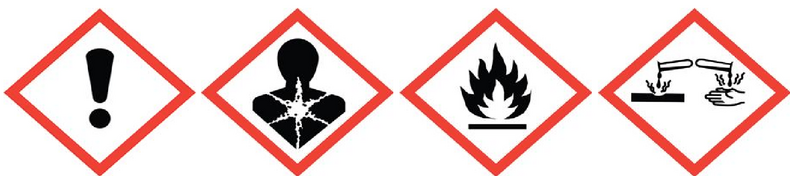
|
Signal word/s |
Warning Danger Danger Danger |
Hazard statements
Sulfuric Acid (Stop Solution): H290 May be corrosive to metals. H314 Causes severe skin burns and eye damage. P264 Wash skin thoroughly after handling.
Hydrogen Peroxide (quenching buffer): H302 Harmful if swallowed. H315 Causes skin irritation. H318 Causes serious eye damage. H335 May cause respiratory irritation. H401 Toxic to aquatic life. H412 Harmful to aquatic life with long lasting effects.
Kathon CG/ICP: H314 Causes severe skin burns and eye damage (H314). H317 May cause an allergic skin reaction. H410 Very toxic to aquatic life with long lasting effects.
Triton X-100: H302 Harmful if swallowed. H315 Causes skin irritation. H318 Causes serious eye damage. H410 Very toxic to aquatic life with long lasting effects.
SDS (Sodium dodecyl sulfate): H228 Flammable solid. H302 + H332 Harmful if swallowed or if inhaled. H315 Causes skin irritation. H318 Causes serious eye damage. H335 May cause respiratory irritation. H401 Toxic to aquatic life. H412 Harmful to aquatic life with long lasting effects.
Crystal Violet: H302 Harmful if swallowed. H318 Causes serious eye damage. H351 Suspected of causing cancer. H410 Very toxic to aquatic life with long lasting effects.
Sodium azide: H300 + H310 + H330 Fatal if swallowed, in contact with skin or if inhaled. H373 May cause damage to organs (Brain) through prolonged or repeated exposure if swallowed. H410 Very toxic to aquatic life with long lasting effects.
Response
IF SWALLOWED: Call a POISON CENTER or doctor/physician if you feel unwell. Rinse mouth. EYE CONTACT: Rinse cautiously with water for several minutes. Remove contact lenses, if present and easy to do. Continue rinsing. SKIN CONTACT: Take off immediately all contaminated clothing. Rinse skin with water/shower. INHALATION: Move to an outside area and breath fresh air. Clear the nose by blowing.
Storage Not applicable.
Disposal Not applicable.
Hazards not otherwise classified
None known.
3. COMPOSITION/INFORMATION ON INGREDIENTS
CAS numbers/other identifiers
Chemical Name |
CAS-No |
Weight % |
Sodium azide | 26628-22-8 | <0.1 |
Kathon CG/ICP | 26172-55-4 | 2.5 |
Tween-20 | 9005-64-5 | 1.8 |
Sodium Dodecyl Sulfate (SDS) | 151-21-3 | 1 |
Triton X-100 | 9002-93-1 | 1 |
Hydrogen peroxide | 7722-84-1 | 1 |
Crystal violet | 548-62-9 | 0.05 |
3,3',5,5'-Tetramethylbenzidine (TMB) | 54827-17-7 | 0.1 |
Sulfuric acid | 7664-93-9 | <20 |
4. FIRST AID MEASURES
Eye contact |
Immediately flush with plenty of water. After initial flushing, remove any contact lenses and continue flushing for at least 15 minutes. |
Skin contact |
Wash off immediately with soap and plenty of water while removing all contaminated clothes and shoes. |
Inhalation |
Move to fresh air. |
Ingestion |
Clean mouth with water. Drink plenty of water. |
Notes to physician |
Treat symptomatically. |
5. FIREFIGHTING MEASURES
Flammable properties | Not flammable |
Flash point | Not determined |
Suitable extinguishing media | Use extinguishing measures that are appropriate to local circumstances and the surrounding environment. |
Sensitivity to mechanical impact | None |
Sensitivity to static discharge | None |
Protective equipment and precautions for firefighters | As in any fire, wear self-contained breathing apparatus pressure-demand, MSHA/NIOSH (approved or equivalent) and full protective gear. |
6. ACCIDENTAL RELEASE MEASURES
Personal precautions, protective equipment and emergency procedures Ensure adequate ventilation.
Environmental precautions Try to prevent the material from entering drains or water courses.
Methods and materials for containment and cleaning up Prevent further leakage or spillage if safe to do so. Pick up and transfer to properly labeled containers.
7. HANDLING AND STORAGE
Handling Handle in accordance with good industrial hygiene and safety practice.
Storage Store the entire kit at 4°C upon arrival.
8. EXPOSURE CONTROLS/PERSONAL PROTECTION
Exposure guidelines This product does not contain any hazardous materials with occupational exposure limits established by the region specific regulatory bodies.
Engineering measures Showers. Eyewash stations. Ventilation systems.
Personal protective equipment
Eye/face protection | No special protective equipment required. |
Skin protection | No special protective equipment required. |
Body protection | No special protective equipment required. |
Respiratory protection | If exposure limits are exceeded or irritation is experienced, NIOSH/MSHA approved respiratory protection should be worn. Positive-pressure supplied air respirators may be required for high airborne contaminant concentrations. Respiratory protection must be provided in accordance with current local regulations. |
Hygiene measures | Handle in accordance with good industrial hygiene and safety practice. |
9. PHYSICAL AND CHEMICAL PROPERTIES
Appearance | Form: liquid |
Odour | No data available |
Odour threshold | No data available |
pH | No data available |
Melting point/freezing point | No data available |
Initial boiling point and boiling range | No data available |
Flash point | No data available |
Evaporation rate | No data available |
Flammability (solid, gas) | No data available |
Upper/lower flammability or explosive limits | No data available |
Vapour pressure | No data available |
Vapour density | No data available |
Relative density | No data available |
Partition coefficient: n-octanol/water | No data available |
Water solubility | No data available |
Auto-ignition temperature | No data available |
Decomposition temperature | No data available |
Viscosity | No data available |
Explosive properties | No data available |
Oxidizing properties | No data available |
10. STABILITY AND REACTIVITY
Stability | Stable under recommended storage conditions. |
Incompatible products | None known based on information supplied. |
Conditions to avoid | None known based on information supplied. |
Hazardous decomposition products | None known based on information supplied. |
Hazardous polymerization | Hazardous polymerization does not occur. |
11. TOXICOLOGICAL INFORMATION
Acute toxicity | Inhalation: No data available. Dermal: No data available. |
Skin corrosion/irritation | No data available |
Serious eye damage/eye irritation | No data available |
Respiratory or skin sensitization | No data available |
Germ cell mutagenicity | No data available |
Carcinogenicity | No data available |
Reproductive toxicity | No data available |
Aspiration hazard | No data available |
12. ECOLOGICAL INFORMATION
Ecotoxicity The environmental impact of this product has not been fully investigated.
13. DISPOSAL CONSIDERATIONS
Product Offer surplus and non-recyclable solutions to a licensed disposal company.
Contaminated packaging Dispose of as unused product.
14. TRANSPORT INFORMATION
DOT (US) | Not dangerous goods |
IMDG | Not dangerous goods |
IATA | Not dangerous goods |
15. REGULATORY INFORMATION
U.S. federal regulations
SARA 302/313 components The following components are subject to reporting levels established by SARA Title III, Section 302/313:
Chemical Name |
CAS-No |
Weight % |
Sodium azide | 26628-22-8 | <0.1 |
Kathon CG/ICP | 26172-55-4 | 2.5 |
Tween-20 | 9005-64-5 | 1.8 |
Sodium Dodecyl Sulfate (SDS) | 151-21-3 | 1 |
Triton X-100 | 9002-93-1 | 1 |
Hydrogen peroxide | 7722-84-1 | 1 |
Crystal violet | 548-62-9 | 0.05 |
3,3',5,5'-Tetramethylbenzidine (TMB) | 54827-17-7 | 0.1 |
Sulfuric acid | 7664-93-9 | <2 |
SARA 311/312 hazard categories
Acute health hazard | no |
Chronic health hazard | no |
Fire hazard | no |
Sudden release of pressure hazard | no |
Reactive hazard | no |
Clean water act
This product does not contain any substances regulated as pollutants pursuant to the Clean Water Act (40 CFR 122.21 and 40 CFR 122.42).
CERCLA
This material, as supplied, does not contain any substances regulated as hazardous substances under the Comprehensive Environmental Response Compensation and Liability Act (CERCLA) (40 CFR 302) or the Superfund Amendments and Reauthorization Act (SARA) (40 CFR 355). There may be specific reporting requirements at the local, regional, or state level pertaining to releases of this material.
California proposition 65
This product does not contain any Proposition 65 chemicals.
16. OTHER INFORMATION
Disclaimer
The information provided in this Safety Data Sheet is correct to the best of our knowledge, information, and belief at the date of its publication. The information given is designed only as a guidance for safe handling, use processing, storage, transportation, disposal and release and is not to be considered a warranty or quality specification. The information relates only to the specific material designated and may not be valid for such material used in combination with any other materials or in any process, unless specified in the text.
This Safety Data Sheet is provided by Boster Biological Technology. Questions: support@bosterbio.com.