BosterBio × Biotium ✦ BosterBio × Biotium Collaboration

Build Multiplex IF Panels Without Secondary Cross-Reactivity

Directly label your own primary antibodies with CF® Dyes. Build flexible multiplex IF panels around your research targets—without secondary-antibody cross-reactivity, buffer exchange, or post-labeling purification.

15-30 Min
Conjugation
Under 1 min
hands-on time
No Secondary
Cross-Reactivity
Directly labeled
primary antibodies
 Multiple CF® Dye Options Flexible panel design
Up to 50%
Savings
Qualifying IF
antibody bundles

Why Multiplex IF Panel Design Is Challenging

Secondary antibodies, same-species conflicts, and catalog gaps stall even well-resourced labs. Four ways the problem compounds:

  • Secondary cross-reactivity. Secondary antibodies may bind unintended primaries, causing cross-staining and false colocalization
  • Same-host primary conflict. A host-specific secondary cannot distinguish multiple primaries raised in the same species.
  • Limited direct-conjugate availability. The required conjugate may not be available, while traditional labeling often requires buffer exchange and purification.
  • Cyclic IF carryover. Earlier primaries remain bound after fluorophore bleaching, so later secondary antibodies may re-label them.
A Direct-Labeling Solution

Biotium Mix-n-Stain CF® Dye Antibody Labeling Kits

Conjugate any primary antibody to any CF® Dye in 30 minutes — no buffer exchange, no purification. In collaboration with Biotium, the CF® Dye pioneers.

Biotium's Mix-n-Stain kits provide covalent, amine-reactive conjugation of any IgG to CF Dyes in a single 30-minute incubation.

The workflow requires less than one minute of hands-on time—simply add the antibody, mix, and incubate. No purification step, buffer exchange, or dialysis is required.

Any remaining free dye becomes non-reactive by the end of the labeling reaction and is removed during routine IF blocking and washing, helping minimize background from unbound dye.


What makes Mix-n-Stain different

  • Rapid Labeling
  • Clean, Stable Conjugates

Get 10% back in BosterBio coupon credit on any Mix-n-Stain™ kit purchase. 

Biotium Mix-n-Stain: By the Numbers

Labeling Time: 15–30 min

Hands-on time: Under 1 minute

Minimum input: As little as 1 μg antibody

Optimal concentration: 0.5–1 mg/mL

Degree of labeling (DOL): Fixed ~4–6 dye molecules per IgG. For low-DOL super-resolution workflows such as STORM/PALM, use the dedicated Biotium STORM labeling kit.

Storage: −20°C, stable 12+ months

Performance claims (brightness, photostability, emission width) are reported by Biotium based on their internal characterization data.

From kits to multiplex if

Build Your Own Panel in Two Core Steps

Select IF-validated antibodies first, then assign spectrally separated CF® dyes. Use the supporting links for formulation guidance, technical considerations, published evidence, and additional kit formats.

Select Your Antibodies

Pre-validated with ICC/IF application data. Combine with Biotium Mix-n-Stain CF® Dyes for same-species multiplex panels — no secondary antibody cross-reactivity. Every antibody you add deepens your bundle discount.

Example panel: Proliferation, Tumor and Immune Microenvironment Markers
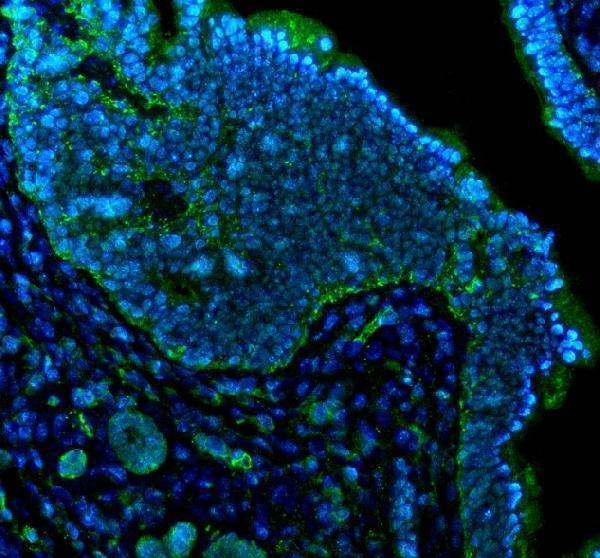
Add Ki67 IF Image Ki67 immunofluorescence staining

Anti-Ki67

IF VALIDATED
Cell Proliferation

Ki67 is widely used to identify actively proliferating cells. Its predominantly nuclear staining adds a clear proliferation dimension to the panel.

SKU: PB9026

Host: Rabbit

Reactivity: Human

mIF note: For FFPE, start with heat-mediated antigen retrieval. Validate staining specificity and working concentration before direct labeling.
View Antibody
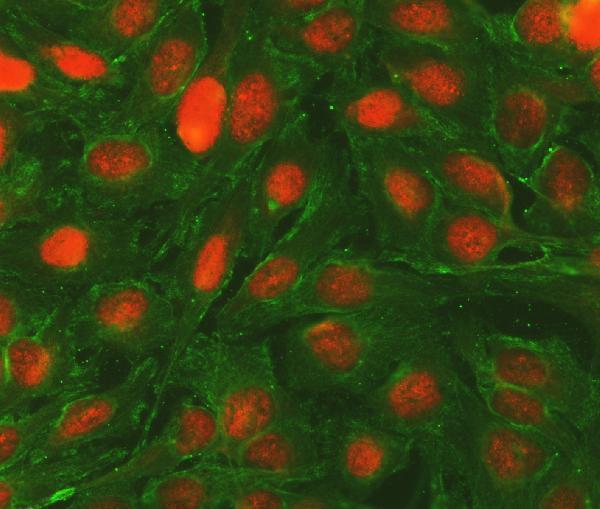
Add Bax IF Image Bax immunofluorescence staining

Anti-Bax

IF VALIDATED
Pro-Apoptotic Signaling

BAX promotes mitochondrial membrane permeabilization during intrinsic apoptosis and helps assess pro-apoptotic signaling.

SKU: A00183

Host: Rabbit

Reactivity: Human, Mouse, Rat

mIF note: FFPE validation used EDTA pH 8 retrieval. Validate staining individually before adding the conjugate to the full panel.
View Antibody
Add Bcl2 IF Image Bcl2 immunofluorescence staining

Anti-bcl2

IF VALIDATED
Cell Survival Signaling

BCL2 opposes mitochondrial apoptosis and supports cell survival. Pairing it with BAX provides context for survival–apoptosis balance.

SKU: A00040-2

Host: Rabbit

Reactivity: Human

mIF note: Validated in U2OS ICC/IF with enzyme retrieval. Optimize the conjugate concentration after labeling.
View Antibody
Add CYCS IF Image CYCS immunofluorescence staining

Anti-Cytochrome c /CYCS

IF VALIDATED
Apoptosis Marker

Cytochrome c contributes to caspase activation following mitochondrial release. Changes in its localization can indicate mitochondrial apoptotic events.

SKU: PB9334

Host: Rabbit

Reactivity: Human, Mouse, Rat

mIF note: FFPE validation used citrate pH 6 retrieval. Confirm the expected mitochondrial staining pattern before multiplexing.
View Antibody
every Multiplex IF Panel Bundle

Save Up to 50%

2 Antibodies 20% OFF
3 Antibodies 30% OFF
4 Antibodies 40% OFF

Assign CF® Dyes

Choose dyes according to the excitation lasers and detection channels available on your imaging platform, then assign channels based on target abundance and expected co-localization. Because direct IF does not use secondary-antibody amplification, assign the brightest CF® dyes to lower-abundance targets and reserve dimmer dyes for highly expressed markers.

405 nm UV / Violet
  • CF®350 Ex 347 nm · Em 448 nm
  • CF®405S Ex 404 nm · Em 431 nm
  • CF®405M / CF®405L Ex 408 / 395 nm
488 nm Green
  • CF®488A Ex 490 nm · Em 515 nm

A general-purpose green channel option in the FITC detection range.

561 nm Yellow / Orange
  • CF®555 Ex 555 nm · Em 565 nm
  • CF®568 Ex 562 nm · Em 583 nm
594–640 nm Red / Far-Red
  • CF®594 Ex 593 nm · Em 614 nm
  • CF®633 Ex 630 nm · Em 650 nm
  • CF®647 Ex 650 nm · Em 665 nm
Near-IR Panel Extension / Deep Imaging
  • CF®680 Near-IR channel option
  • CF®750 Near-IR · two-photon capable
  • CF®770 Near-IR · deep-tissue imaging

The available near-IR range extends approximately from 680 to 770 nm.

Choosing CF® Dyes for Clean Multiplex

1. Match the imaging platform Choose dyes compatible with the excitation lasers and emission filters available on your instrument.
2. Prioritize weaker targets Assign brighter or cleaner channels to low-abundance targets and weaker antibody signals.
3. Separate co-localized markers Place markers expected to overlap in spectrally distant channels to reduce bleed-through.

All listed CF® dyes are available as Mix-n-Stain™ labeling kit options for direct 30-minute conjugation.

Example Dye Assignment for the Featured Four-Marker Panel

Use this as a starting layout only. Final assignments should be confirmed against your instrument configuration, target abundance, tissue autofluorescence, and single-stain controls.

Ki67 CF®555 Nuclear marker separated from the DAPI channel
BAX CF®488A General-purpose green channel starting point
BCL2 CF®594 Red channel separated from green and yellow-orange
CYCS CF®647 Far-red channel for a distinct mitochondrial signal
Match the Kit to Your Application

Explore More Mix-n-Stain™ Formats

Choose from standard IgG labeling alternatives or specialized formats based on your fluorophore, antibody type, labeling scale, or imaging application.

For Standard IgG Labeling

Alternative dye families and a larger-scale format for conventional IgG labeling workflows.

Other Formats & Applications

Use these options when your antibody type, labeling chemistry, or imaging method requires a specialized workflow.

EARN 10% BACK IN COUPON CREDIT

Purchase Biotium Mix-n-Stain™ kits through BosterBio and earn 10% back in coupon credit. Use it on qualifying products and stack it with applicable tiered savings on eligible IF antibodies.

The 10% credit is issued automatically — no coupon code needed.

10% back on Mix-n-Stain™ kit purchases
Example

A $1,000 Mix-n-Stain™ kit purchase earns $100 in coupon credit.

$1,000 Kits
$592 Antibodies After Tiered Savings
$100 Coupon Credit
$1,492 Total Spend
Technical Considerations

Check Compatibility and Optimize the Panel

These supporting considerations are not additional panel-building steps. Use them to confirm antibody formulation compatibility and optimize direct-labeling performance.

Additive Tolerance: Label Directly from Your Antibody Stock

The real-world differentiator for busy multiplex immunofluorescence staining workflows

Most conjugation chemistries require a pristine antibody input — no azide, no glycerol, no carrier protein. Biotium Mix-n-Stain is engineered for real-world stocks. Label directly from your existing primary antibody preparation without a pre-purification step in most cases. A high-amine buffer (PBS-based antibodies should note that high concentrations of primary amines quench NHS esters) must be removed first, but an ultrafiltration spin column is included in the kit for that purpose.

Additive Tolerance Notes
Sodium azide (NaN3) Compatible Labels directly from azide-preserved catalog stocks; no dialysis required
Tris buffer Up to 20 mM Tris is a primary amine; low concentrations tolerated
Glycerol Up to 10% Common cryoprotectant in stock antibodies; tolerated at ≤10%
BSA / gelatin (carrier protein) Below 4:1 carrier:Ab ratio Modified total-protein protocol handles ~10x carrier or ascites; carrier washes out during IF staining
High primary-amine buffers (e.g., high Tris, ethanolamine) Remove first Use included ultrafiltration vial to exchange into PBS before labeling

Input concentration: Concentrate dilute antibody stocks to 0.5–1 mg/mL before labeling, or spike with BSA to reach the minimum total protein concentration. For ascites or hybridoma supernatants, follow Biotium's modified total-protein protocol.

Mix-n-Stain & CF Dyes in Published Multiplex IF Research

Selected peer-reviewed studies using Biotium CF® dye conjugates in multiplex or multicolor immunofluorescence tissue imaging — demonstrating that same-species primary conflicts are solved by direct conjugation.

TCR Affinity Biases Th Cell Differentiation by Regulating CD25, Eef1e1, and Gbp2
Kotov et al. — Journal of Immunology 2019
Purified antibodies were directly labeled with CF®405L, CF®514, and CF®555 using Biotium Mix-n-Stain™ kits for tissue imaging with spectral measurements and linear unmixing.
Multi-Color Immunofluorescence of Mucosal B-Cell Populations
Xu et al. — Nature Communications 2016
Mix-n-Stain™ kits were used to directly label antibodies with CF®488A, CF®555, and CF®640R for simultaneous multicolor immunofluorescence detection in gill tissue sections.
Creating Complex Fluorophore Spectra on Antibodies Through Combinatorial Labeling
Holzapfel et al. — Nature Communications 2016
Mix-n-Stain™ kits were used to label Fab fragments with multiple CF® fluorophores, including CF®405M/CF®488A and CF®568/CF®640R, demonstrating a combinatorial labeling strategy for more complex fluorescence multiplexing.

Source: BosterBio × Biotium curated literature review. CF® dye citations indexed via Biotium's internal reference list (10+ peer-reviewed publications citing Mix-n-Stain and CF® dye conjugates in multicolor IF workflows).

BosterBio × Biotium: Combined Credibility

40,000+
BosterBio antibodies

40+ CF® Dyes
available, UV to near-IR

30,000+
BosterBio publications cited

PhD-level
technical support

ISO 9001:2015
certified processes

Save on Your Multiplex IF Panel

Combine tiered antibody savings with coupon credit earned on Mix-n-Stain™ kit purchases.

Up To
50% OFF

Tiered Savings on Qualifying Picoband® IF Antibody Bundles

Earn
10% BACK

As BosterBio coupon credit on Biotium Mix-n-Stain™ kit purchases