This website uses cookies to ensure you get the best experience on our website.


- Table of Contents
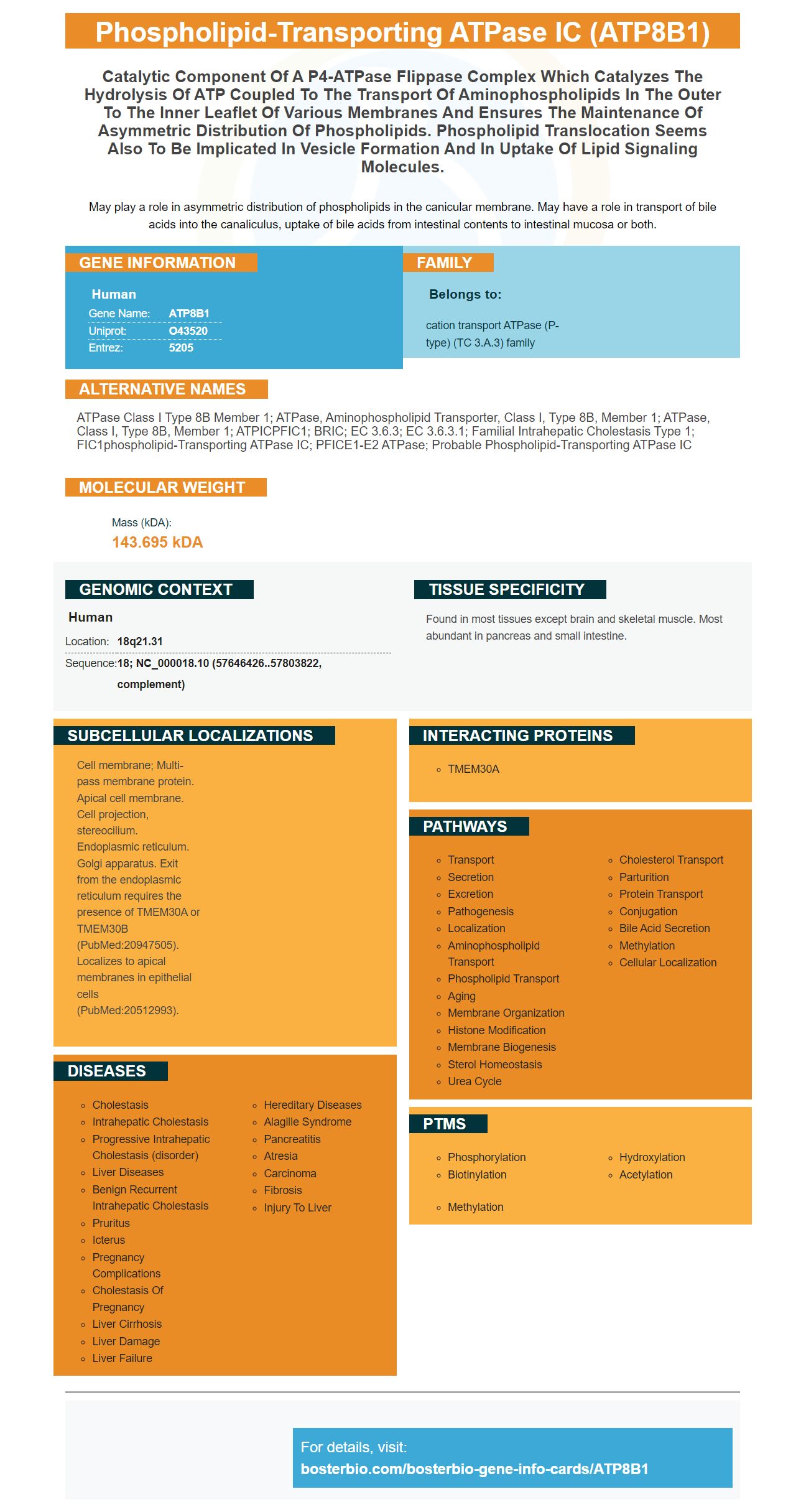
Facts about Phospholipid-transporting ATPase IC.
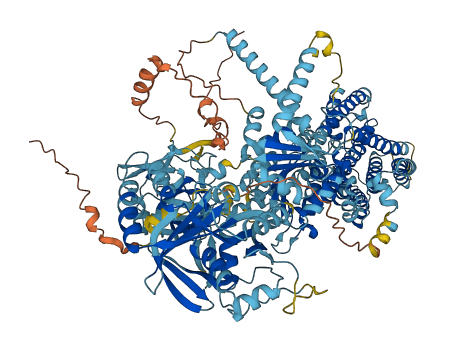
May play a role in asymmetric distribution of phospholipids in the canicular membrane. May have a role in transport of bile acids into the canaliculus, uptake of bile acids from intestinal contents to intestinal mucosa or both.
| Human | |
|---|---|
| Gene Name: | ATP8B1 |
| Uniprot: | O43520 |
| Entrez: | 5205 |

| Belongs to: |
|---|
| cation transport ATPase (P-type) (TC 3.A.3) family |

ATPase class I type 8B member 1; ATPase, aminophospholipid transporter, class I, type 8B, member 1; ATPase, class I, type 8B, member 1; ATPICPFIC1; BRIC; EC 3.6.3; EC 3.6.3.1; Familial intrahepatic cholestasis type 1; FIC1phospholipid-transporting ATPase IC; PFICE1-E2 ATPase; probable phospholipid-transporting ATPase IC
Mass (kDA):
143.695 kDA

| Human | |
|---|---|
| Location: | 18q21.31 |
| Sequence: | 18; NC_000018.10 (57646426..57803822, complement) |
Found in most tissues except brain and skeletal muscle. Most abundant in pancreas and small intestine.
Cell membrane; Multi-pass membrane protein. Apical cell membrane. Cell projection, stereocilium. Endoplasmic reticulum. Golgi apparatus. Exit from the endoplasmic reticulum requires the presence of TMEM30A or TMEM30B (PubMed:20947505). Localizes to apical membranes in epithelial cells (PubMed:20512993).




PMID: 9500542 by Bull L.N., et al. A gene encoding a P-type ATPase mutated in two forms of hereditary cholestasis.
PMID: 9548971 by Halleck M.S., et al. Multiple members of a third subfamily of P-type ATPases identified by genomic sequences and ESTs.