This website uses cookies to ensure you get the best experience on our website.


- Table of Contents
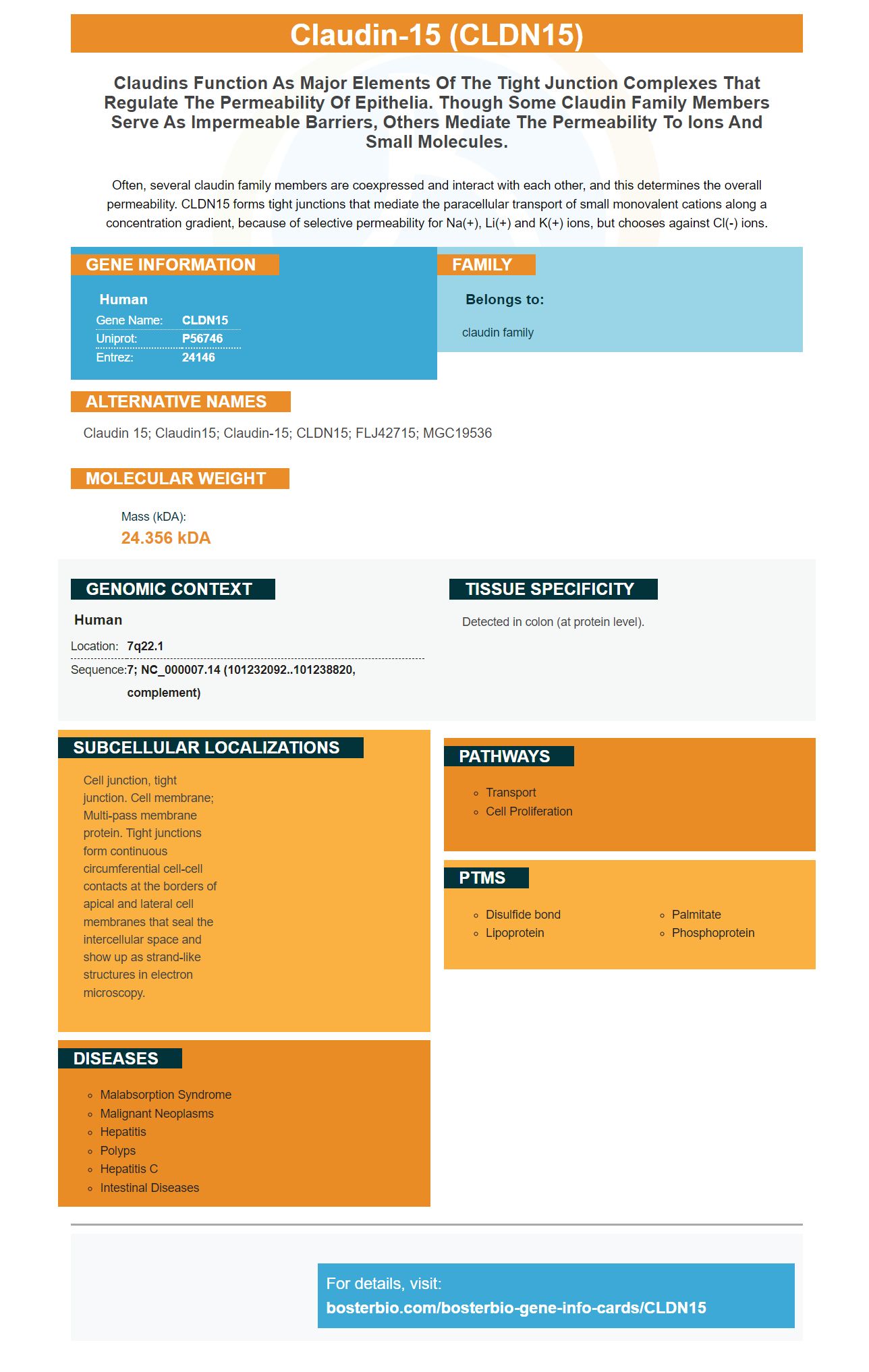
Facts about Claudin-15.
Often, several claudin family members are coexpressed and interact with each other, and this determines the overall permeability. CLDN15 forms tight junctions that mediate the paracellular transport of small monovalent cations along a concentration gradient, because of selective permeability for Na(+), Li(+) and K(+) ions, but chooses against Cl(-) ions.
| Human | |
|---|---|
| Gene Name: | CLDN15 |
| Uniprot: | P56746 |
| Entrez: | 24146 |
| Belongs to: |
|---|
| claudin family |

claudin 15; Claudin15; Claudin-15; CLDN15; FLJ42715; MGC19536
Mass (kDA):
24.356 kDA
| Human | |
|---|---|
| Location: | 7q22.1 |
| Sequence: | 7; NC_000007.14 (101232092..101238820, complement) |
Detected in colon (at protein level).
Cell junction, tight junction. Cell membrane; Multi-pass membrane protein. Tight junctions form continuous circumferential cell-cell contacts at the borders of apical and lateral cell membranes that seal the intercellular space and show up as strand-like structures in electron microscopy.

PMID: 12055082 by Colegio O.R., et al. Claudins create charge-selective channels in the paracellular pathway between epithelial cells.
PMID: 13129853 by Van Itallie C.M., et al. Reversal of charge selectivity in cation or anion-selective epithelial lines by expression of different claudins.