This website uses cookies to ensure you get the best experience on our website.


- Table of Contents
Designing an IHC experiment for DOCK3? The guide has the expected staining pattern, antigen retrieval and fixation, antibodies backed by real IHC images, the tissue controls to run alongside, and protocols taken from published papers.
Open the DOCK3 IHC Guide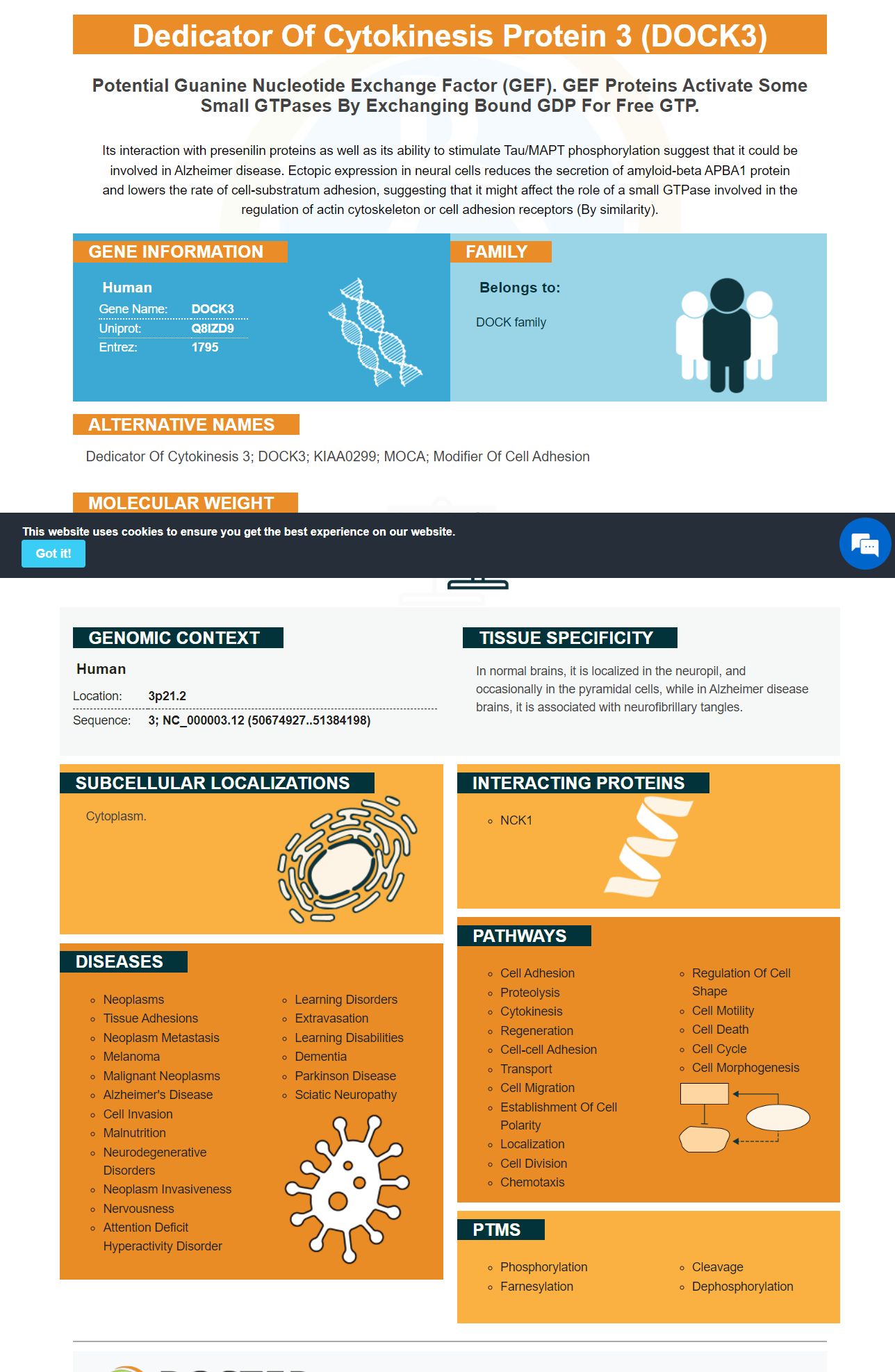
Facts about Dedicator of cytokinesis protein 3.
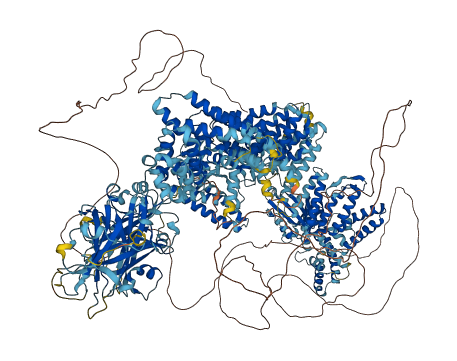
Its interaction with presenilin proteins as well as its ability to stimulate Tau/MAPT phosphorylation suggest that it could be involved in Alzheimer disease. Ectopic expression in neural cells reduces the secretion of amyloid-beta APBA1 protein and lowers the rate of cell-substratum adhesion, suggesting that it might affect the role of a small GTPase involved in the regulation of actin cytoskeleton or cell adhesion receptors (By similarity).
| Human | |
|---|---|
| Gene Name: | DOCK3 |
| Uniprot: | Q8IZD9 |
| Entrez: | 1795 |

| Belongs to: |
|---|
| DOCK family |

dedicator of cytokinesis 3; DOCK3; KIAA0299; MOCA; modifier of cell adhesion
Mass (kDA):
233.103 kDA

| Human | |
|---|---|
| Location: | 3p21.2 |
| Sequence: | 3; NC_000003.12 (50674927..51384198) |
In normal brains, it is localized in the neuropil, and occasionally in the pyramidal cells, while in Alzheimer disease brains, it is associated with neurofibrillary tangles.
Cytoplasm.


PMID: 10854253 by Kashiwa A., et al. Isolation and characterization of novel presenilin binding protein.
PMID: 14569117 by De Silva M.G., et al. Disruption of a novel member of a sodium/hydrogen exchanger family and DOCK3 is associated with an attention deficit hyperactivity disorder-like phenotype.