This website uses cookies to ensure you get the best experience on our website.


- Table of Contents
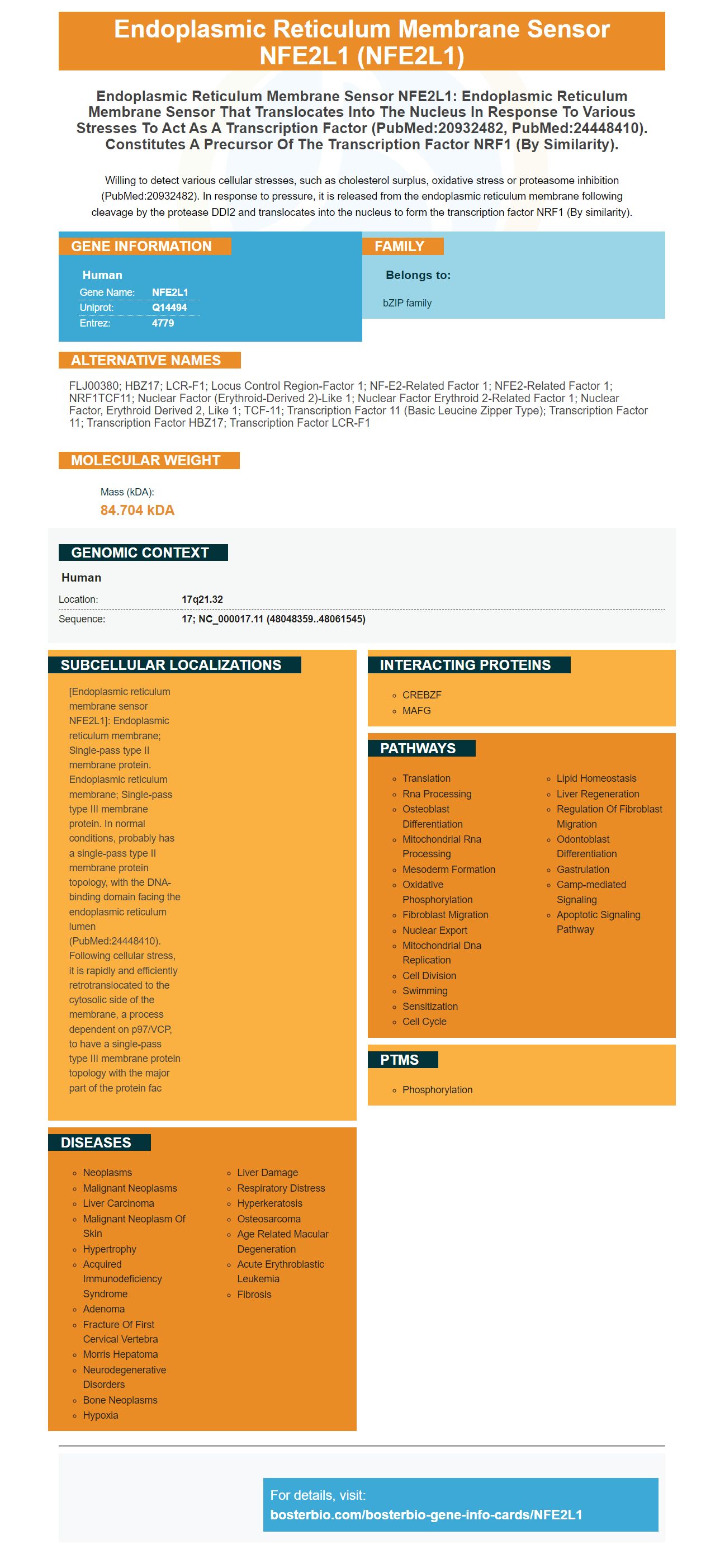
Facts about Endoplasmic reticulum membrane sensor NFE2L1.
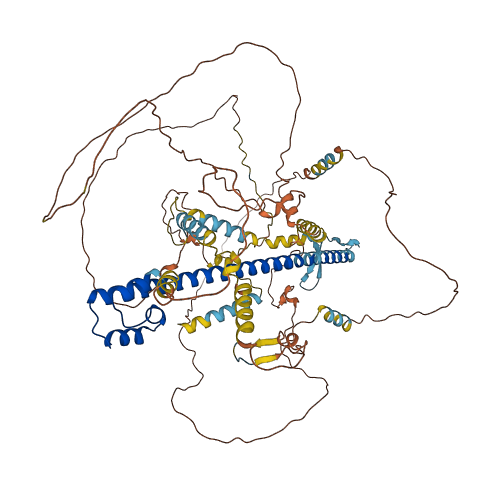
Willing to detect various cellular stresses, such as cholesterol surplus, oxidative stress or proteasome inhibition (PubMed:20932482). In response to pressure, it is released from the endoplasmic reticulum membrane following cleavage by the protease DDI2 and translocates into the nucleus to form the transcription factor NRF1 (By similarity).
| Human | |
|---|---|
| Gene Name: | NFE2L1 |
| Uniprot: | Q14494 |
| Entrez: | 4779 |
| Belongs to: |
|---|
| bZIP family |

FLJ00380; HBZ17; LCR-F1; Locus control region-factor 1; NF-E2-related factor 1; NFE2-related factor 1; NRF1TCF11; nuclear factor (erythroid-derived 2)-like 1; nuclear factor erythroid 2-related factor 1; Nuclear factor, erythroid derived 2, like 1; TCF-11; transcription factor 11 (basic leucine zipper type); Transcription factor 11; Transcription factor HBZ17; Transcription factor LCR-F1
Mass (kDA):
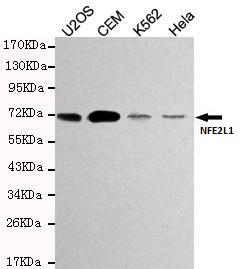
84.704 kDA

| Human | |
|---|---|
| Location: | 17q21.32 |
| Sequence: | 17; NC_000017.11 (48048359..48061545) |
[Endoplasmic reticulum membrane sensor NFE2L1]: Endoplasmic reticulum membrane; Single-pass type II membrane protein. Endoplasmic reticulum membrane; Single-pass type III membrane protein. In normal conditions, probably has a single-pass type II membrane protein topology, with the DNA-binding domain facing the endoplasmic reticulum lumen (PubMed:24448410). Following cellular stress, it is rapidly and efficiently retrotranslocated to the cytosolic side of the membrane, a process dependent on p97/VCP, to have a single-pass type III membrane protein topology with the major part of the protein fac




PMID: 8248256 by Chan J.Y., et al. Cloning of Nrf1, an NF-E2-related transcription factor, by genetic selection in yeast.
PMID: 8001966 by Luna L., et al. Molecular cloning of a putative novel human bZIP transcription factor on chromosome 17q22.