This website uses cookies to ensure you get the best experience on our website.


- Table of Contents
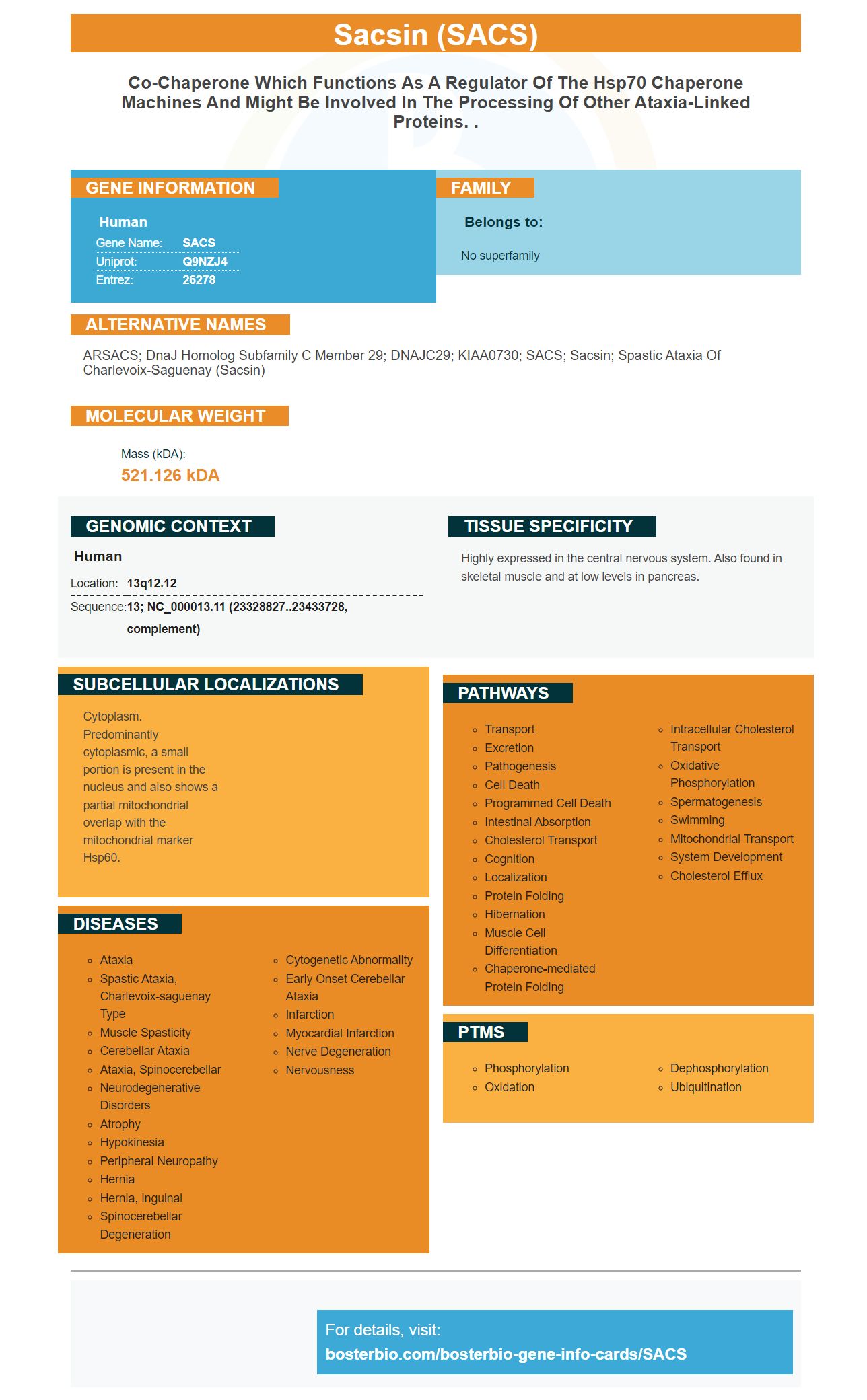
Facts about Sacsin.
| Human | |
|---|---|
| Gene Name: | SACS |
| Uniprot: | Q9NZJ4 |
| Entrez: | 26278 |
| Belongs to: |
|---|
| No superfamily |

ARSACS; dnaJ homolog subfamily C member 29; DNAJC29; KIAA0730; SACS; Sacsin; spastic ataxia of Charlevoix-Saguenay (sacsin)
Mass (kDA):
521.126 kDA

| Human | |
|---|---|
| Location: | 13q12.12 |
| Sequence: | 13; NC_000013.11 (23328827..23433728, complement) |
Highly expressed in the central nervous system. Also found in skeletal muscle and at low levels in pancreas.
Cytoplasm. Predominantly cytoplasmic, a small portion is present in the nucleus and also shows a partial mitochondrial overlap with the mitochondrial marker Hsp60.

PMID: 10655055 by Engert J.C., et al. ARSACS, a spastic ataxia common in northeastern Quebec, is caused by mutations in a new gene encoding an 11.5-kb ORF.
PMID: 19208651 by Parfitt D.A., et al. The ataxia protein sacsin is a functional co-chaperone that protects against polyglutamine-expanded ataxin-1.