This website uses cookies to ensure you get the best experience on our website.


- Table of Contents
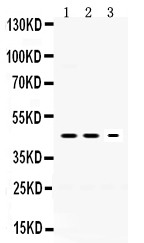
Designing a Western blot for Neuroserpin? The guide has the expected band size, antibodies backed by real blot images, the controls to run alongside, and protocols taken from published papers.
Open the SERPINI1 Western Blot Guide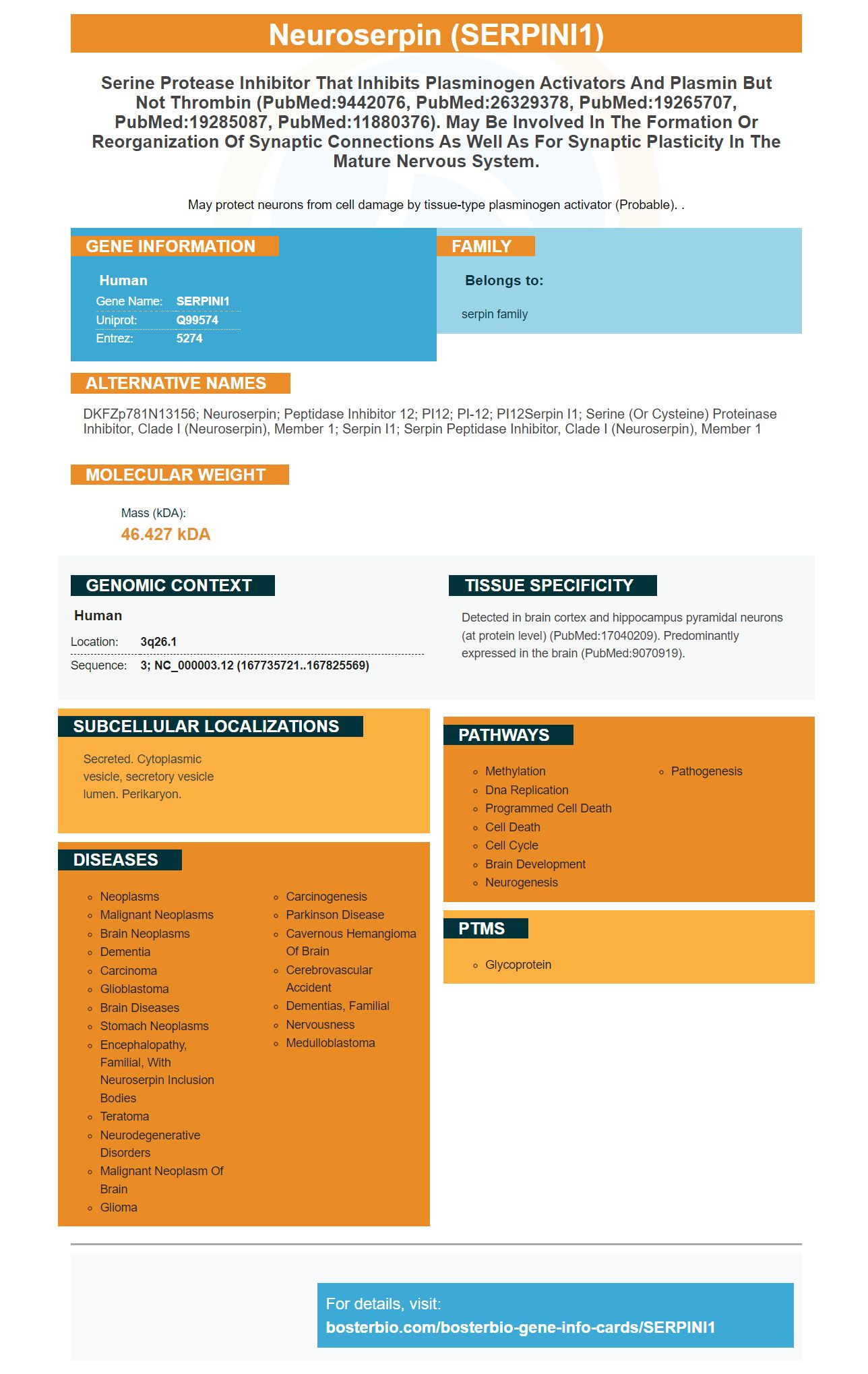
Facts about Neuroserpin.
May protect neurons from cell damage by tissue-type plasminogen activator (Probable). .
| Human | |
|---|---|
| Gene Name: | SERPINI1 |
| Uniprot: | Q99574 |
| Entrez: | 5274 |
| Belongs to: |
|---|
| serpin family |

DKFZp781N13156; Neuroserpin; Peptidase inhibitor 12; PI12; PI-12; PI12Serpin I1; serine (or cysteine) proteinase inhibitor, clade I (neuroserpin), member 1; Serpin I1; serpin peptidase inhibitor, clade I (neuroserpin), member 1
Mass (kDA):
46.427 kDA

| Human | |
|---|---|
| Location: | 3q26.1 |
| Sequence: | 3; NC_000003.12 (167735721..167825569) |
Detected in brain cortex and hippocampus pyramidal neurons (at protein level) (PubMed:17040209). Predominantly expressed in the brain (PubMed:9070919).
Secreted. Cytoplasmic vesicle, secretory vesicle lumen. Perikaryon.



PMID: 9070919 by Schrimpf S.P., et al. Human neuroserpin (PI12): cDNA cloning and chromosomal localization to 3q26.
PMID: 9442076 by Osterwalder T., et al. The axonally secreted serine proteinase inhibitor, neuroserpin, inhibits plasminogen activators and plasmin but not thrombin.