Customer Testimonials

Peer Reviews from Real Labs

Browse peer-submitted results linked to specific products—ratings, images, and practical notes included. Contribute your own result to strengthen the evidence base and claim rewards after verification.

Video Interviews

See real workflows and decision points—what researchers tried, what worked, and why. Share your story in a short interview and claim rewards!

Get Interview Rewards

Filter by category, reactivity, and host to find the most relevant peer results.

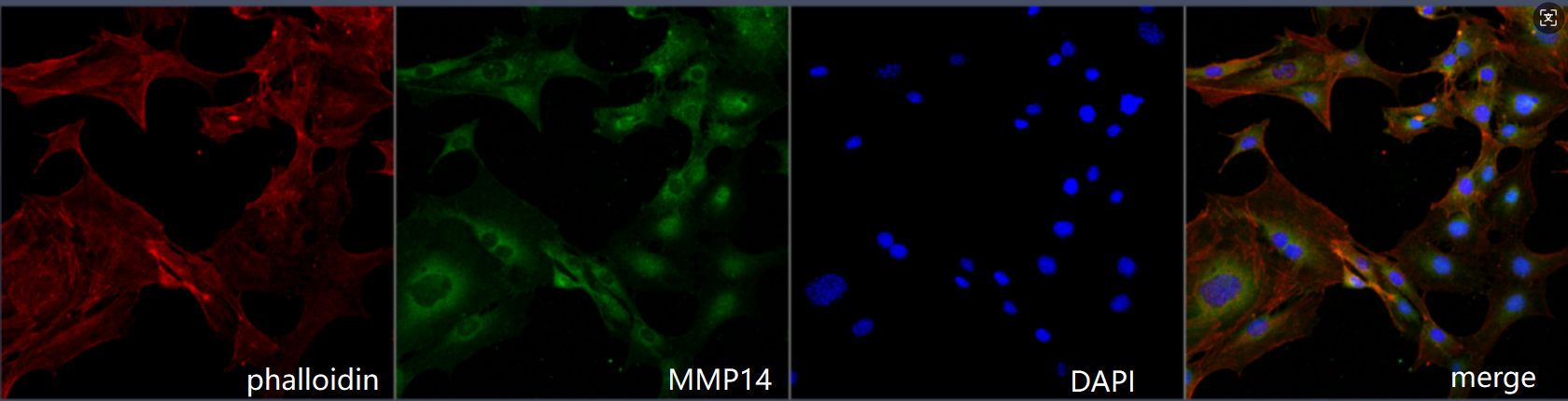
Highly prone to positive signals, with precise expression localization

Excellent, submitted by on
SKU M00656
Application Immunofluorenscence
Sample Mouse MC-8 cells
Sample Processing Description 4% paraformaldehyde for 15 minutes
Primary Antibody Anti-MMP14/Mt1 Mmp Rabbit Monoclonal Antibody
Primary Incubation 1:200, overnight at 4 ℃
Blocking Agent Goat serum
Secondary Antibody DyLight 488-conjugated Goat Anti-Rabbit IgG.
Secondary Incubation Incubate at room temperature for 1 hour
Detection Laser confocal microscopy
Results Summary I will purchase Boster products again and recommend them to my classmates and colleagues.

The antibody is highly efficient and specific, showing a clear target band with no non-specific bands.

Excellent, submitted by on
SKU M30929
Application Western Blot
Sample HEK293T
Primary Incubation 1:1000, overnight at 4 ℃
Blocking Agent 5% non-fat milk
Secondary Antibody Anti-Rabbit IgG Secondary Antibody, HRP-conjugated
Secondary Incubation Incubate at room temperature for 1 hour
Detection Signal was developed using ECL substrate on a Azure Biosystems c600.
Results Summary I will definitely purchase BosterBio products again and recommend them to my classmates and colleagues.

Thank you for all the work on this project

Excellent, submitted by on
SKU DZ01481
Application Immunofluorescence
Sample wildtype and KO mutant zebrafish retina
Primary Incubation 1:200
Blocking Agent 10% normal goat serum and 2% bovine serum albumin in PBS
Secondary Antibody Alexa Fluor 568 goat anti-rabbit was used in blocking solution.

The antibody performs efficiently and specifically, with very few nonspecific bands.

Excellent, submitted by on
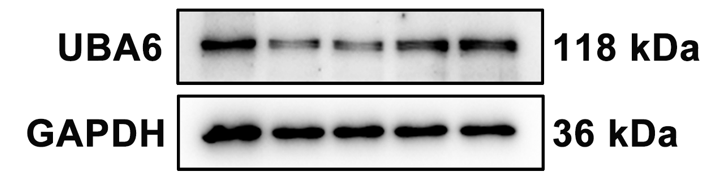
WB result image
SKU A03213-2
Application Western Blot
Sample MCF-7 cell
Sample Processing Description Cells were directly lysed in NP-40 buffer, mixed with loading buffer at the appropriate ratio, and denatured by heating at 98 °C. Then, 20 µL of protein sample was loaded per lane onto SDS-PAGE.
Primary Antibody UBA6 Antibody
Primary Incubation 1:1000, overnight at 4 °C
Blocking Agent 5% Non-fat milk
Secondary Antibody HRP-conjugated Goat Anti-Rabbit IgG
Secondary Incubation Incubate at room temperature for 1 hour
Detection Signal was developed using ECL substrate on a Tanon system.
Results Summary The antibody performs efficiently and specifically, with very few nonspecific bands.

This antibody shows excellent consistency and reproducibility across batches, ensuring reliable and stable experimental results. Its performance remains consistent across different experiments, providing strong technical support for our research.

Excellent, submitted by on
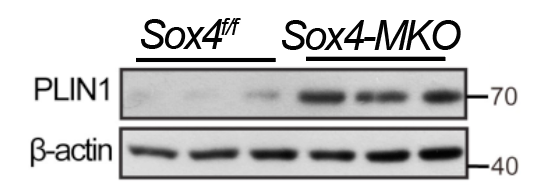
SKU M03918
Application Western Blot
Sample Mouse brown adipose tissue
Sample Processing Description Tissue and cell proteins were extracted using RIPA buffer. After BCA quantification, 5× loading buffer was added, and the samples were boiled for 5 minutes for denaturation.
Primary Incubation The membrane was incubated with the PLIN1 primary antibodies (1:1000) overnight at 4 °C.
Secondary Antibody Goat Anti-Rabbit IgG Antibody (1:5000)
Secondary Incubation Incubate at room temperature for 1 hour
Other Reagents used Non-fat milk
Detection Signal was developed using ECL substrate
Results Summary This antibody shows excellent consistency and reproducibility across batches, ensuring reliable and stable experimental results. Its performance remains consistent across different experiments, providing strong technical support for our research.

The antibody is highly efficient and specific, showing a clear target band with no nonspecific bands.

Excellent, submitted by on
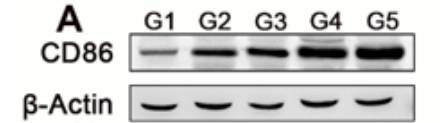
SKU M00220-1
Application Western Blot
Sample Mouse lung cancer tissue
Sample Processing Description Tissue samples were directly lysed in RIPA buffer, mixed with loading buffer at the appropriate ratio, and denatured by heating at 98 °C. Load 20 µL of protein sample per lane onto SDS-PAGE.
Primary Incubation The membrane was incubated with the CD86 primary antibodies (1:2000) overnight at 4 °C.
Secondary Antibody HRP-conjugated Goat Anti-Rabbit IgG Secondary Antibody
Secondary Incubation Incubate at room temperature for 1 hour
Other Reagents used 5% non-fat milk
Detection Signal was developed using ECL substrate on an Tanon system.
Results Summary The antibody is highly efficient and specific, showing a clear target band with no nonspecific bands. I will definitely continue using BosterBio products and will recommend them to my classmates and colleagues.

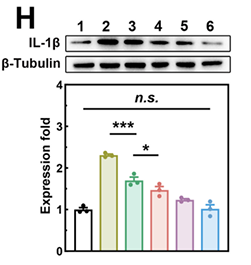
IL-6 and IL-1β levels in the pancreas are key for assessing the anti-inflammatory effect of this nanomedicine. Antibodies from two previous suppliers showed poor specificity, while BosterBio antibodies proved highly specific, potent, and cost-effective.

Excellent, submitted by on
SKU M00101-1
Application Western Blot
Sample Mouse pancreatic acinar cells
Sample Processing Description After centrifugation, collect the supernatant. Take a small portion for protein quantification using the BCA assay. Mix the remaining protein solution with an equal volume of loading buffer and denature in a 100°C water bath for 5 mins.
Primary Incubation The membrane was incubated with the IL-6 and IL-1β primary antibodies (1:1000) overnight at 4 °C.
Secondary Antibody HRP-conjugated Goat Anti-Rabbit IgG Secondary Antibody
Secondary Incubation Incubate at room temperature for 1 hour
Other Reagents used Protein-Free Blocking Buffer
Detection Signal was developed using ECL substrate on a ChemiDoc MP system.
Results Summary IL-6 and IL-1β levels in the pancreas are key for assessing the anti-inflammatory effect of this nanomedicine. Antibodies from two previous suppliers showed poor specificity, while BosterBio antibodies proved highly specific, potent, and cost-effective. In our subsequent experiments, our group continued to use BosterBio products, which proved to be highly reliable and provided solid support for the publication of several articles.

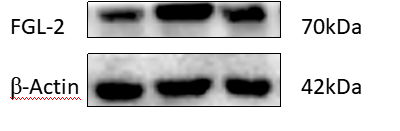
Works very well in Western blot for rat enteric glial cells and mouse FGL-2 protein, with only slight nonspecific bands.

Excellent, submitted by on
SKU A06303-3
Application Western Blot
Sample rat enteric glial cells and mouse tissue
Sample Processing Description Samples (5 µL per lane) were run on 10% resolving and stacking gels at 80 V for 20 min, then 150 V for 70 min, and transferred at 400 mA for 100 min.
Primary Incubation The membrane was incubated with the FGL-2 primary antibody (1:1000) overnight at 4 °C.
Secondary Antibody HRP-conjugated Goat Anti-Rabbit IgG Secondary Antibody
Secondary Incubation Incubate at room temperature for 2 hour
Other Reagents used 5% non-fat milk
Detection Signal was developed using ECL substrate on an ImageQuant LAS4000mini system.
Results Summary Works very well in Western blot for rat enteric glial cells and mouse FGL-2 protein, with only slight nonspecific bands.

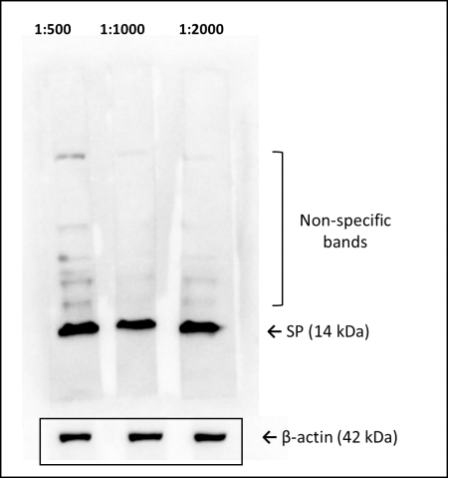
The SP antibody demonstrated strong performance across all tested dilutions, producing clear and specific signal detection.

Excellent, submitted by on
SKU DZ41720
Application Western Blot
Sample HEK293T whole cell lysates
Sample Processing Description HEK293T cells were transfected with a plasmid expressing SP only (and not Env or Rem) and lysed using RIPA buffer. A total of 80 µg of protein was resolved on a 4–12% gradient SDS-PAGE gel and transferred to a membrane. The membrane was blocked for 1 hour at room temperature with 5% non-fat milk in PBS-Tween (PBS-T). After washing three times with 1× PBS-T (10 minutes each), the membrane was incubated overnight at 4 °C with varying dilutions ofthe SP antibody prepared in 2% non-fat milk (1:500; 1:1000; 1:2000). Following three additional washes with PBS-T (10 minutes each), the membrane was incubated with anti-rabbit secondary antibody, washed again three times, and developed using ECL Plus.
Primary Incubation The membrane was incubated with the SP primary antibody (1:500; 1:1000; 1:2000) overnight at 4 °C.
Secondary Antibody Anti-rabbit-HRP-conjugated secondary antibody
Secondary Incubation Dilution: 1:25,000 in PBS-T/2% milk
Other Reagents used 1× RIPA lysis buffer
1× PBS-T washing buffer (T = 1% Tween 20)
Non-fat milk (for blocking and antibody dilution)
Anti-rabbit HRP-conjugated secondary antibody
Detection Signal was developed using ECL Plus chemiluminescent substrate
Results Summary The SP antibody demonstrated strong performance across all tested dilutions, producing clear and specific signal detection. Dilutions of 1:1000 and 1:2000 yielded the most optimal results, showing minimal background compared to 1:500, which highlights the antibody’s high specificity and sensitivity at these concentrations. To ensure equal protein loading across lanes, the membrane was also probed with a β-actin antibody, confirming equal sample loading and validating the observed signal intensity for SP. Overall, these results demonstrate that the SP antibody is reliable for detecting SP in RIPA-lysed HEK293T samples.

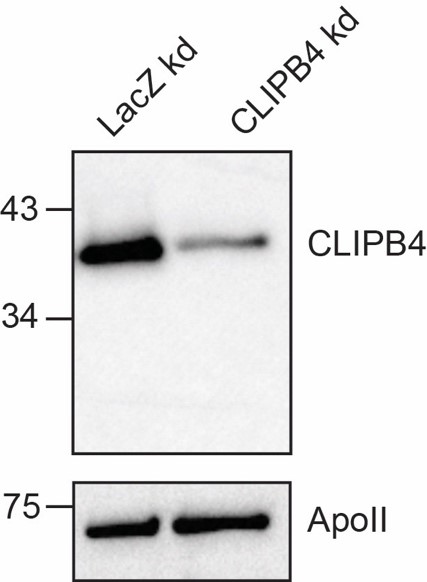
The CLIPB4 antibody was efficiently used to detect CLIPB4 protein secreted in the mosquito hemolymph. The protein migrates at ~40 kDa in SDS-PAGE.

Excellent, submitted by on
CLIPB4 antibody Western blot result
SKU DZ33989-1
Application Western Blot
Sample β-galactosidase gene knockdown mosquito hemolymph, CLIPB4 knockdown mosquito hemolymph
Primary Incubation Overnight at 4°C
Secondary Incubation For 1 hour at room temperature
Secondary Antibody Dilution 1:3000
Detection Clarity Max Western ECL substrate
Results Summary Image showing the specificity of CLIPB4 antibody. Lane 1 includes hemolymph extracted from mosquitoes silenced for the bacterial β-galactosidase gene. Lane 2 contains hemolymph extracted from mosquitoes silenced for the CLIPB4 gene.