This website uses cookies to ensure you get the best experience on our website.


- Table of Contents
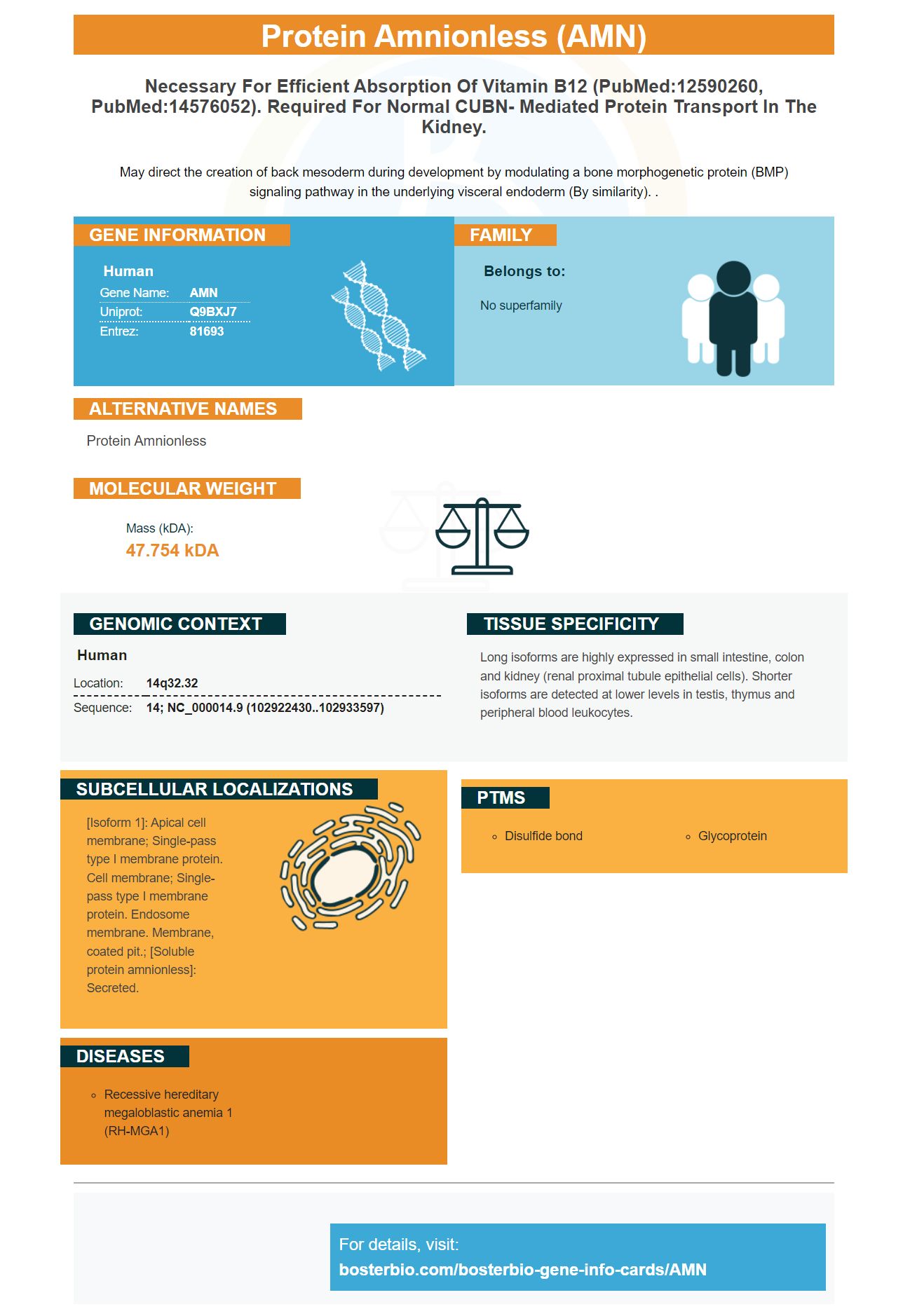

Facts about Protein amnionless.
May direct the creation of back mesoderm during development by modulating a bone morphogenetic protein (BMP) signaling pathway in the underlying visceral endoderm (By similarity). .
| Human | |
|---|---|
| Gene Name: | AMN |
| Uniprot: | Q9BXJ7 |
| Entrez: | 81693 |
| Belongs to: |
|---|
| No superfamily |

Protein amnionless
Mass (kDA):
47.754 kDA

| Human | |
|---|---|
| Location: | 14q32.32 |
| Sequence: | 14; NC_000014.9 (102922430..102933597) |
Long isoforms are highly expressed in small intestine, colon and kidney (renal proximal tubule epithelial cells). Shorter isoforms are detected at lower levels in testis, thymus and peripheral blood leukocytes.
[Isoform 1]: Apical cell membrane; Single-pass type I membrane protein. Cell membrane; Single-pass type I membrane protein. Endosome membrane. Membrane, coated pit.; [Soluble protein amnionless]: Secreted.



PMID: 11279523 by Kalantry S., et al. The amnionless gene, essential for mouse gastrulation, encodes a visceral-endoderm-specific protein with an extracellular cysteine-rich domain.
PMID: 12590260 by Tanner S.M., et al. Amnionless, essential for mouse gastrulation, is mutated in recessive hereditary megaloblastic anemia.
*More publications can be found for each product on its corresponding product page