This website uses cookies to ensure you get the best experience on our website.


- Table of Contents
Designing a Western blot for BRD4? The guide has the expected band size, antibodies backed by real blot images, the controls to run alongside, and protocols taken from published papers.
Open the BRD4 Western Blot Guide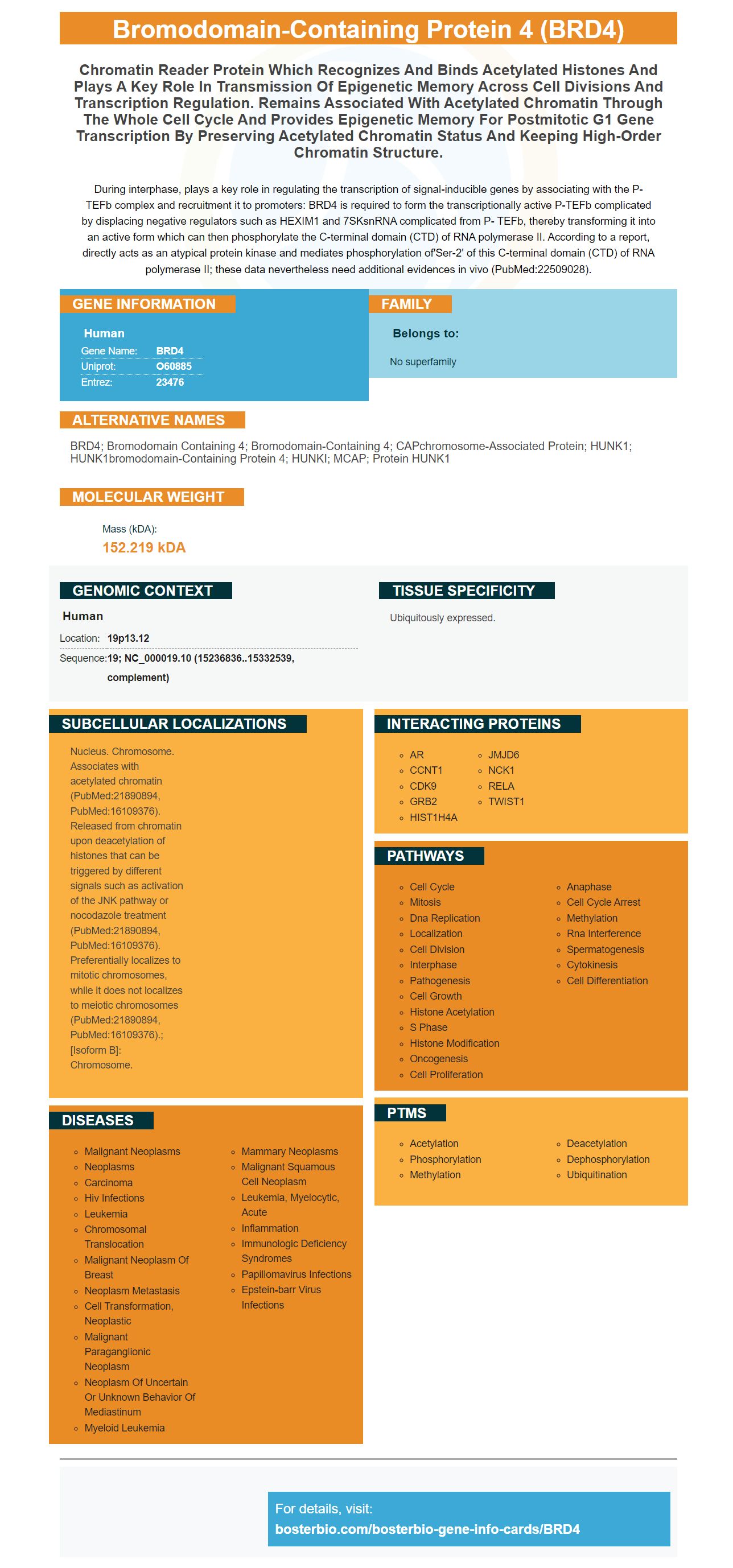
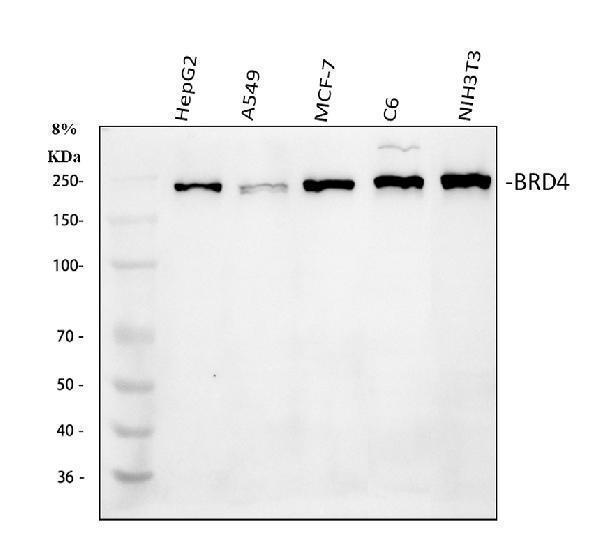
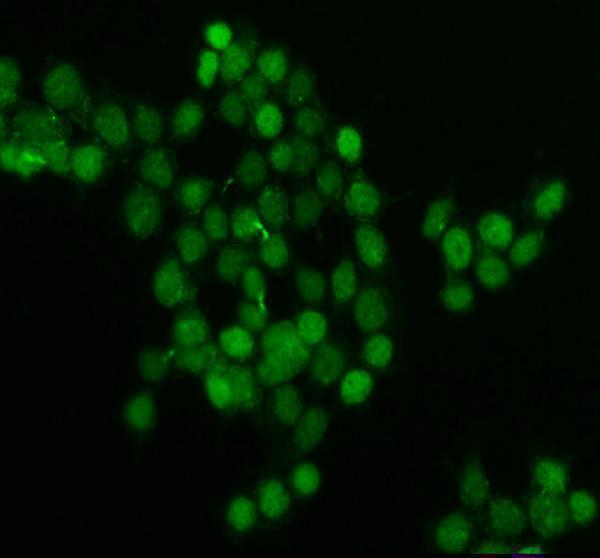
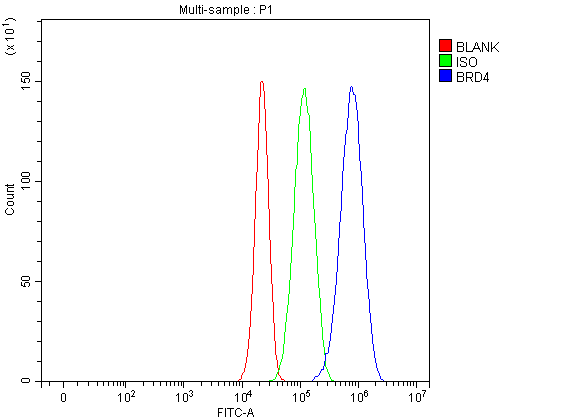
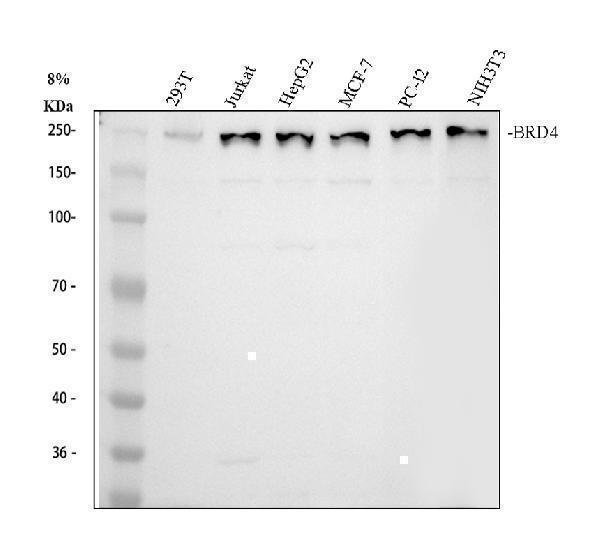
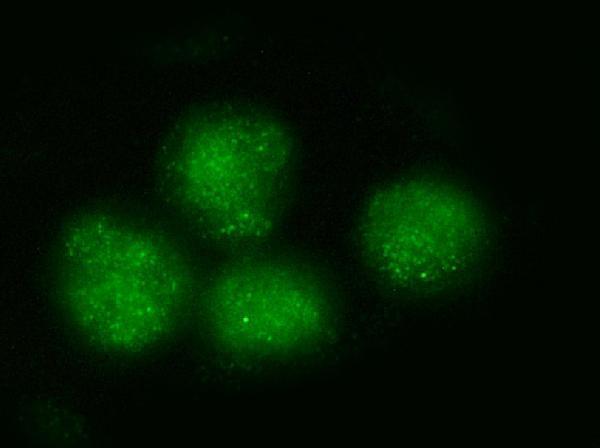
Facts about Bromodomain-containing protein 4.
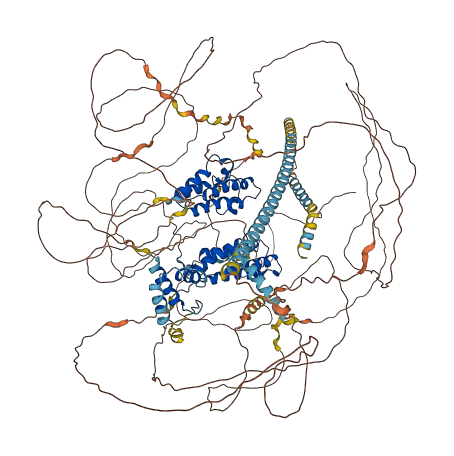
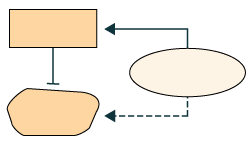
During interphase, plays a key role in regulating the transcription of signal-inducible genes by associating with the P- TEFb complex and recruitment it to promoters: BRD4 is required to form the transcriptionally active P-TEFb complicated by displacing negative regulators such as HEXIM1 and 7SKsnRNA complicated from P- TEFb, thereby transforming it into an active form which can then phosphorylate the C-terminal domain (CTD) of RNA polymerase II. According to a report, directly acts as an atypical protein kinase and mediates phosphorylation of'Ser-2' of this C-terminal domain (CTD) of RNA polymerase II; these data nevertheless need additional evidences in vivo (PubMed:22509028).
| Human | |
|---|---|
| Gene Name: | BRD4 |
| Uniprot: | O60885 |
| Entrez: | 23476 |
| Belongs to: |
|---|
| No superfamily |

BRD4; bromodomain containing 4; bromodomain-containing 4; CAPchromosome-associated protein; HUNK1; HUNK1bromodomain-containing protein 4; HUNKI; MCAP; Protein HUNK1
Mass (kDA):
152.219 kDA

| Human | |
|---|---|
| Location: | 19p13.12 |
| Sequence: | 19; NC_000019.10 (15236836..15332539, complement) |
Ubiquitously expressed.
Nucleus. Chromosome. Associates with acetylated chromatin (PubMed:21890894, PubMed:16109376). Released from chromatin upon deacetylation of histones that can be triggered by different signals such as activation of the JNK pathway or nocodazole treatment (PubMed:21890894, PubMed:16109376). Preferentially localizes to mitotic chromosomes, while it does not localizes to meiotic chromosomes (PubMed:21890894, PubMed:16109376).; [Isoform B]: Chromosome.




PMID: 11733348 by French C.A., et al. BRD4 bromodomain gene rearrangement in aggressive carcinoma with translocation t(15;19).
PMID: 12543779 by French C.A., et al. BRD4-NUT fusion oncogene: a novel mechanism in aggressive carcinoma.