This website uses cookies to ensure you get the best experience on our website.


- Table of Contents
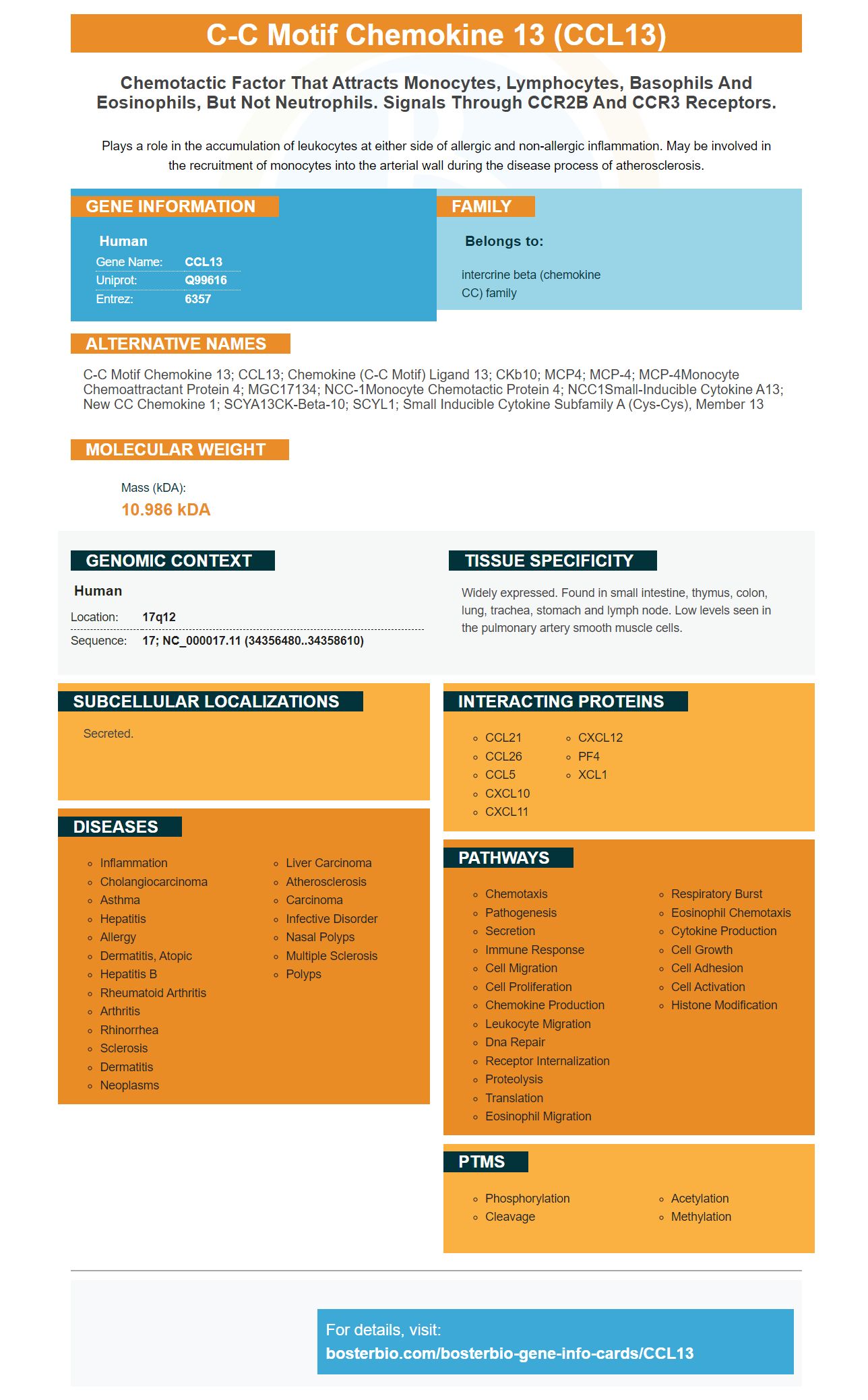

Facts about C-C motif chemokine 13.
Plays a role in the accumulation of leukocytes at either side of allergic and non-allergic inflammation. May be involved in the recruitment of monocytes into the arterial wall during the disease process of atherosclerosis.
| Human | |
|---|---|
| Gene Name: | CCL13 |
| Uniprot: | Q99616 |
| Entrez: | 6357 |
| Belongs to: |
|---|
| intercrine beta (chemokine CC) family |

C-C motif chemokine 13; CCL13; chemokine (C-C motif) ligand 13; CKb10; MCP4; MCP-4; MCP-4Monocyte chemoattractant protein 4; MGC17134; NCC-1Monocyte chemotactic protein 4; NCC1Small-inducible cytokine A13; new CC chemokine 1; SCYA13CK-beta-10; SCYL1; small inducible cytokine subfamily A (Cys-Cys), member 13
Mass (kDA):
10.986 kDA

| Human | |
|---|---|
| Location: | 17q12 |
| Sequence: | 17; NC_000017.11 (34356480..34358610) |
Widely expressed. Found in small intestine, thymus, colon, lung, trachea, stomach and lymph node. Low levels seen in the pulmonary artery smooth muscle cells.
Secreted.




PMID: 8955214 by Garcia-Zepeda E.A., et al. Human monocyte chemoattractant protein (MCP)-4 is a novel CC chemokine with activities on monocytes, eosinophils, and basophils induced in allergic and nonallergic inflammation that signals through the CC chemokine receptors (CCR)-2 and -3.
PMID: 8642349 by Uguccioni M., et al. Monocyte chemotactic protein 4 (MCP-4), a novel structural and functional analogue of MCP-3 and eotaxin.