This website uses cookies to ensure you get the best experience on our website.


- Table of Contents
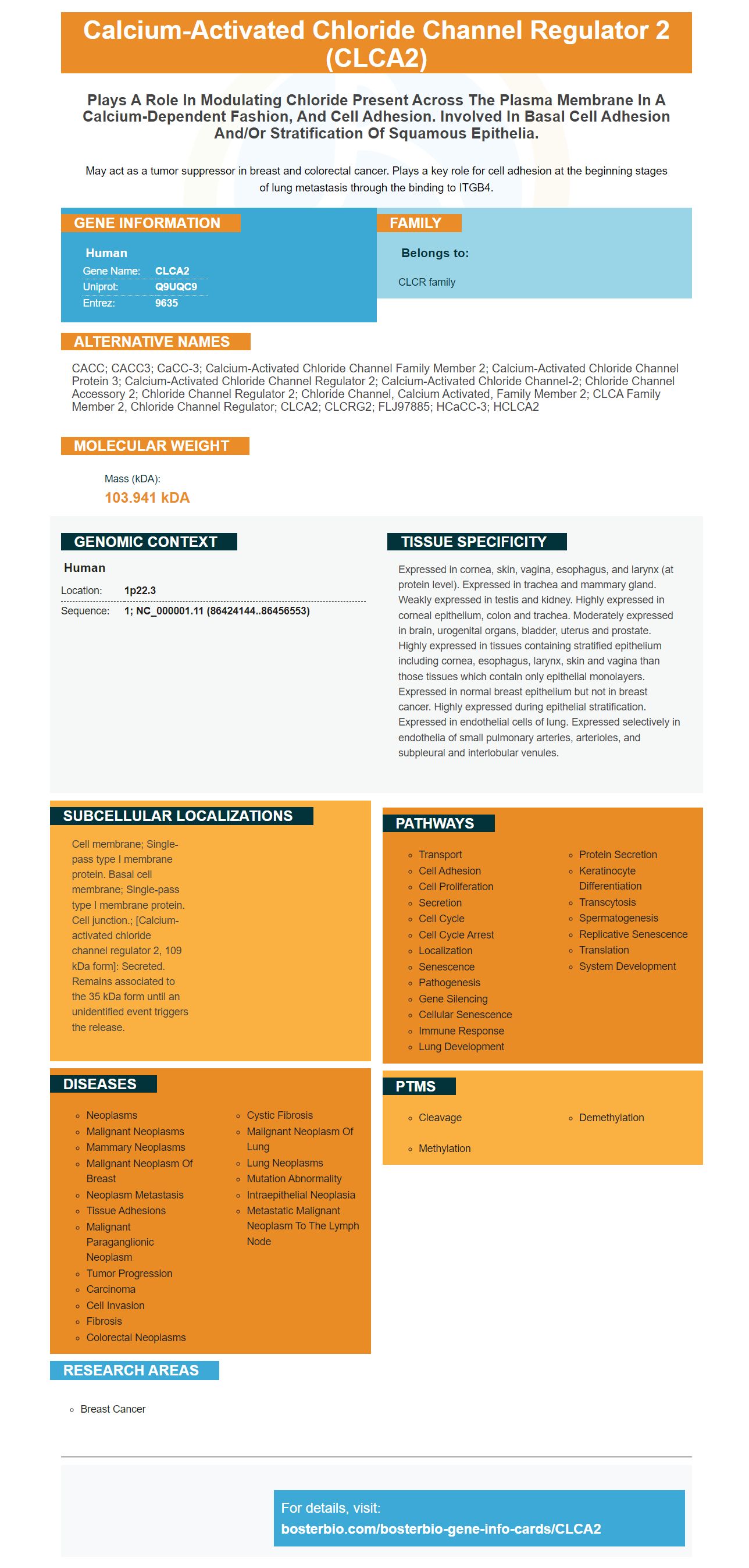
Facts about Calcium-activated chloride channel regulator 2.
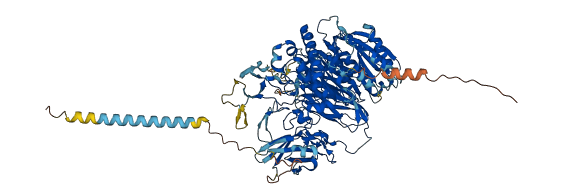
May act as a tumor suppressor in breast and colorectal cancer. Plays a key role for cell adhesion at the beginning stages of lung metastasis through the binding to ITGB4.
| Human | |
|---|---|
| Gene Name: | CLCA2 |
| Uniprot: | Q9UQC9 |
| Entrez: | 9635 |
| Belongs to: |
|---|
| CLCR family |

CACC; CACC3; CaCC-3; Calcium-activated chloride channel family member 2; Calcium-activated chloride channel protein 3; calcium-activated chloride channel regulator 2; calcium-activated chloride channel-2; chloride channel accessory 2; chloride channel regulator 2; chloride channel, calcium activated, family member 2; CLCA family member 2, chloride channel regulator; CLCA2; CLCRG2; FLJ97885; hCaCC-3; hCLCA2
Mass (kDA):
103.941 kDA

| Human | |
|---|---|
| Location: | 1p22.3 |
| Sequence: | 1; NC_000001.11 (86424144..86456553) |
Expressed in cornea, skin, vagina, esophagus, and larynx (at protein level). Expressed in trachea and mammary gland. Weakly expressed in testis and kidney. Highly expressed in corneal epithelium, colon and trachea. Moderately expressed in brain, urogenital organs, bladder, uterus and prostate. Highly expressed in tissues containing stratified epithelium including cornea, esophagus, larynx, skin and vagina than those tissues which contain only epithelial monolayers. Expressed in normal breast epithelium but not in breast cancer. Highly expressed during epithelial stratification. Expressed in endothelial cells of lung. Expressed selectively in endothelia of small pulmonary arteries, arterioles, and subpleural and interlobular venules.
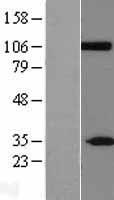
Cell membrane; Single-pass type I membrane protein. Basal cell membrane; Single-pass type I membrane protein. Cell junction.; [Calcium-activated chloride channel regulator 2, 109 kDa form]: Secreted. Remains associated to the 35 kDa form until an unidentified event triggers the release.




PMID: 10362588 by Gruber A.D., et al. Molecular cloning and transmembrane structure of hCLCA2 from human lung, trachea, and mammary gland.
PMID: 10437792 by Agnel M., et al. Identification of three novel members of the calcium-dependent chloride channel (CaCC) family predominantly expressed in the digestive tract and trachea.