This website uses cookies to ensure you get the best experience on our website.


- Table of Contents
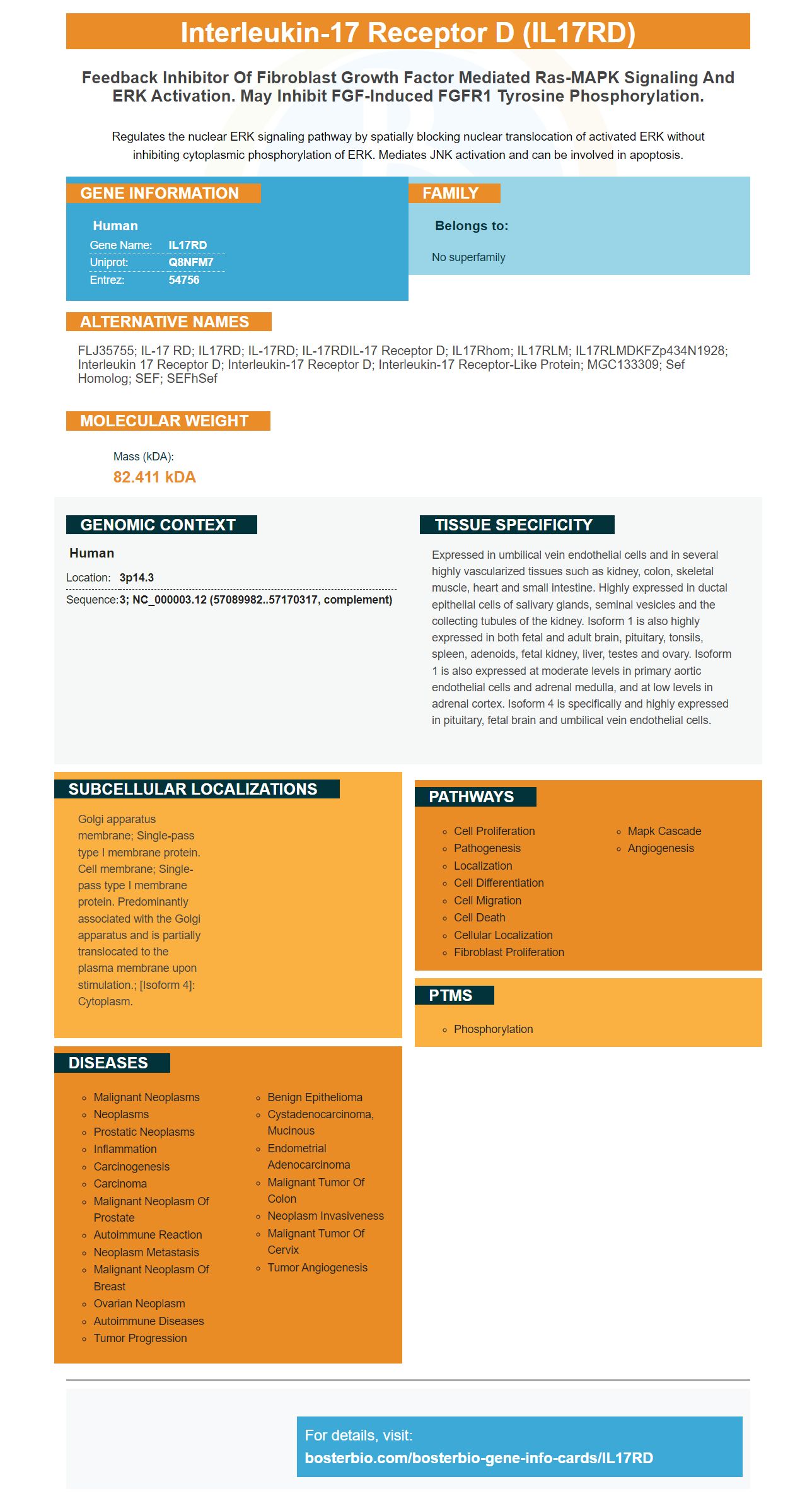


Facts about Interleukin-17 receptor D.
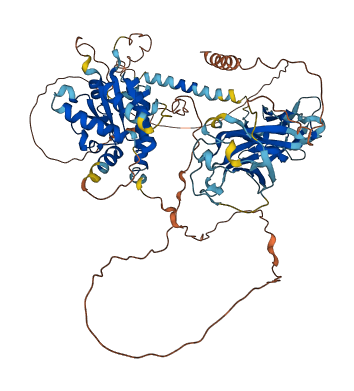
Regulates the nuclear ERK signaling pathway by spatially blocking nuclear translocation of activated ERK without inhibiting cytoplasmic phosphorylation of ERK. Mediates JNK activation and can be involved in apoptosis.
| Human | |
|---|---|
| Gene Name: | IL17RD |
| Uniprot: | Q8NFM7 |
| Entrez: | 54756 |
| Belongs to: |
|---|
| No superfamily |

FLJ35755; IL-17 RD; IL17RD; IL-17RD; IL-17RDIL-17 receptor D; IL17Rhom; IL17RLM; IL17RLMDKFZp434N1928; interleukin 17 receptor D; interleukin-17 receptor D; Interleukin-17 receptor-like protein; MGC133309; Sef homolog; SEF; SEFhSef
Mass (kDA):
82.411 kDA

| Human | |
|---|---|
| Location: | 3p14.3 |
| Sequence: | 3; NC_000003.12 (57089982..57170317, complement) |
Expressed in umbilical vein endothelial cells and in several highly vascularized tissues such as kidney, colon, skeletal muscle, heart and small intestine. Highly expressed in ductal epithelial cells of salivary glands, seminal vesicles and the collecting tubules of the kidney. Isoform 1 is also highly expressed in both fetal and adult brain, pituitary, tonsils, spleen, adenoids, fetal kidney, liver, testes and ovary. Isoform 1 is also expressed at moderate levels in primary aortic endothelial cells and adrenal medulla, and at low levels in adrenal cortex. Isoform 4 is specifically and highly expressed in pituitary, fetal brain and umbilical vein endothelial cells.
Golgi apparatus membrane; Single-pass type I membrane protein. Cell membrane; Single-pass type I membrane protein. Predominantly associated with the Golgi apparatus and is partially translocated to the plasma membrane upon stimulation.; [Isoform 4]: Cytoplasm.


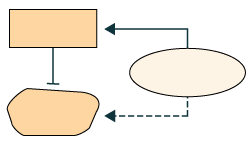

PMID: 12958313 by Xiong S.Q., et al. hSef inhibits PC-12 cell differentiation by interfering with Ras- mitogen-activated protein kinase MAPK signaling.
PMID: 14742870 by Preger E., et al. Alternative splicing generates an isoform of the human Sef gene with altered subcellular localization and specificity.