This website uses cookies to ensure you get the best experience on our website.


- Table of Contents
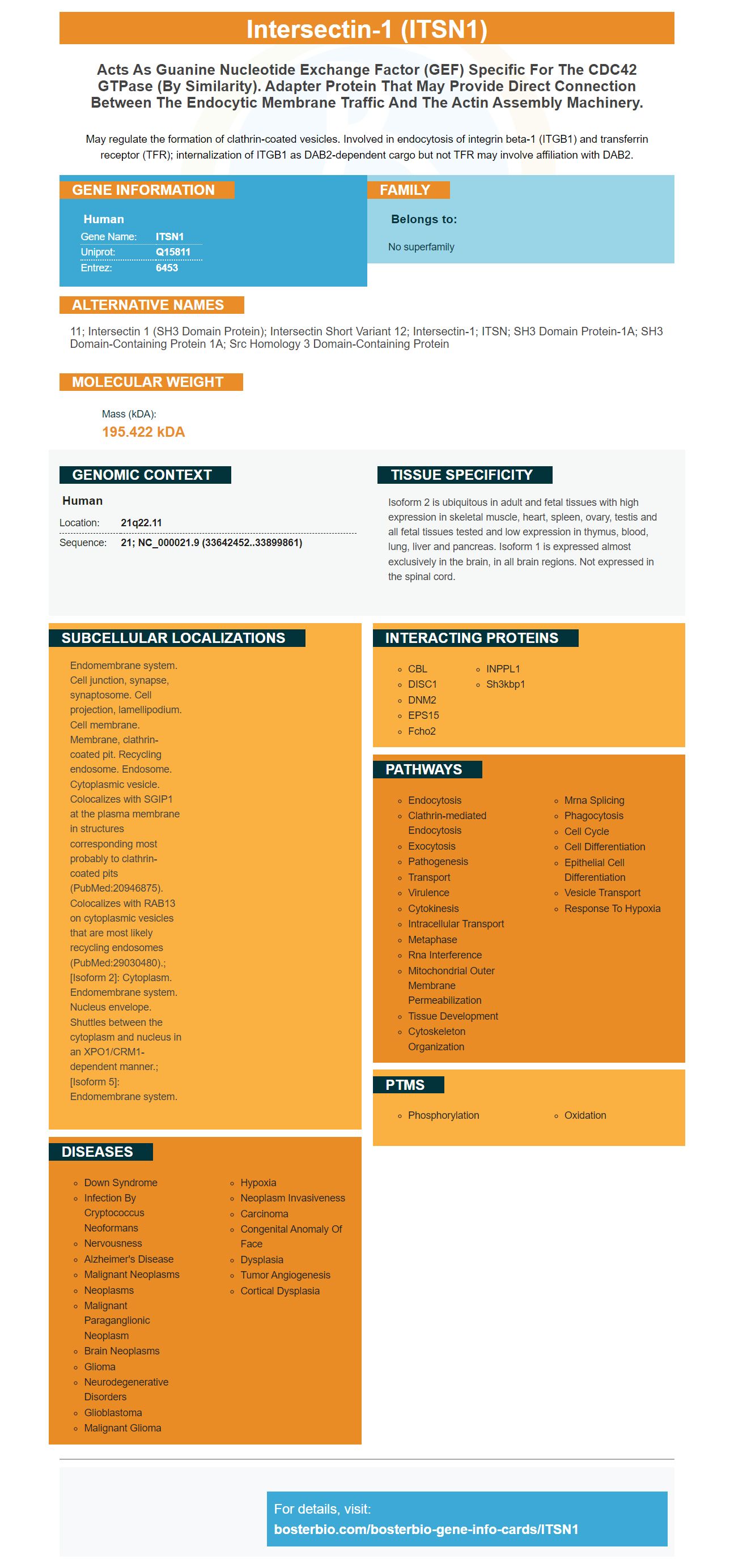
Facts about Intersectin-1.
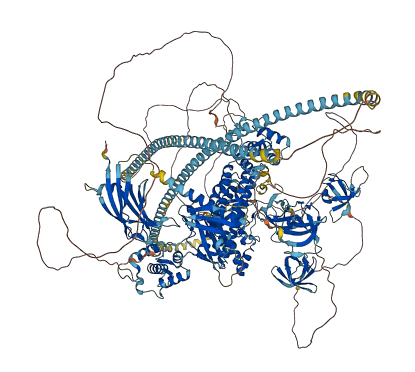
May regulate the formation of clathrin-coated vesicles. Involved in endocytosis of integrin beta-1 (ITGB1) and transferrin receptor (TFR); internalization of ITGB1 as DAB2-dependent cargo but not TFR may involve affiliation with DAB2.
| Human | |
|---|---|
| Gene Name: | ITSN1 |
| Uniprot: | Q15811 |
| Entrez: | 6453 |
| Belongs to: |
|---|
| No superfamily |

11; intersectin 1 (SH3 domain protein); intersectin short variant 12; intersectin-1; ITSN; SH3 domain protein-1A; SH3 domain-containing protein 1A; Src homology 3 domain-containing protein
Mass (kDA):
195.422 kDA

| Human | |
|---|---|
| Location: | 21q22.11 |
| Sequence: | 21; NC_000021.9 (33642452..33899861) |
Isoform 2 is ubiquitous in adult and fetal tissues with high expression in skeletal muscle, heart, spleen, ovary, testis and all fetal tissues tested and low expression in thymus, blood, lung, liver and pancreas. Isoform 1 is expressed almost exclusively in the brain, in all brain regions. Not expressed in the spinal cord.
Endomembrane system. Cell junction, synapse, synaptosome. Cell projection, lamellipodium. Cell membrane. Membrane, clathrin-coated pit. Recycling endosome. Endosome. Cytoplasmic vesicle. Colocalizes with SGIP1 at the plasma membrane in structures corresponding most probably to clathrin-coated pits (PubMed:20946875). Colocalizes with RAB13 on cytoplasmic vesicles that are most likely recycling endosomes (PubMed:29030480).; [Isoform 2]: Cytoplasm. Endomembrane system. Nucleus envelope. Shuttles between the cytoplasm and nucleus in an XPO1/CRM1-dependent manner.; [Isoform 5]: Endomembrane system.



PMID: 9799604 by Guipponi M., et al. Two isoforms of a human intersectin (ITSN) protein are produced by brain-specific alternative splicing in a stop codon.
PMID: 10482960 by Pucharcos C., et al. Alu-splice cloning of human intersectin (ITSN), a putative multivalent binding protein expressed in proliferating and differentiating neurons and overexpressed in Down syndrome.