This website uses cookies to ensure you get the best experience on our website.


- Table of Contents
Source-linked RAMP1 Western blot protocol options, expected-band and isoform facts, troubleshooting for weak or shifted signal, and recommended anti-RAMP1 WB antibodies. Everything you need to plan the experiment before you commit precious samples.

Expected bands, source-linked protocol options, controls and antibodies — the at-a-glance facts below, then the full design guide.
| Expected band | ~17 kDa | |
| Gel | 15% (standard starting point) | |
| Negative control | Suggested KO / knockdown lysate |
| PTM | Cleaved | |
| Caveat | — | |
| Gene-set association | MSigDB C7 membership | |
| Isoform | 1 isoform(s) |
The A04978 protocol combines labelled catalog values with standard starting conditions. Published comparisons retain their own sample, reagent and detection scope.
| Sample / lysate | Hela, NIH-3T3, H9C2 (catalog A04978) |
| Gel % | 15% (standard starting point) |
| Load | 20–30 µg total protein per lane; optimize for abundance (standard starting point) |
| Transfer | Short semi-dry transfer; verify retention (standard starting point) |
| Membrane | 0.2 µm PVDF (standard starting point) |
| Blocking | 5% milk or 5% BSA in TBST (standard starting point) |
| Primary antibody | A04978; use the WB datasheet starting dilution (standard starting point) |
| Primary incubation | Overnight at 4 °C (standard starting point) |
| Secondary antibody | Species-matched HRP conjugate at validated dilution (standard starting point) |
| Secondary incubation | 1 h at room temperature (standard starting point) |
| Wash | 3 × 5 min in TBST (standard starting point) |
| Detection | ECL; bracket exposures to avoid saturation (standard starting point) |
UniProt predicts a 17 kDa RAMP1 precursor; signal-peptide cleavage could lower its size, but no empirical migration is supplied.
| Band near 17 kDa | consistent with the predicted full-length RAMP1 precursor; confirm its identity |
| Band below 17 kDa | could reflect removal of the 1–26 signal peptide; identity remains unverified |
| Two nearby bands around 17 kDa | could represent precursor and signal-cleaved RAMP1 if both forms are present |
| Little or no band in a soluble lysate fraction | consistent with RAMP1 localization at the cell membrane |
| UniProt predicted mass | places the full-length precursor near 17 kDa |
| Full-length 148-residue precursor | includes the signal peptide in the predicted mass |
| Signal peptide at residues 1–26 | provides a segment that can be removed during maturation |
| Signal-peptide cleavage | could yield a smaller mature band; its migration is not supplied |
| Situation | Likely cause | Next action |
|---|---|---|
| No band in lysate | membrane-associated RAMP1 may be poorly recovered | check membrane extraction and a membrane-enriched fraction |
| Band higher than expected | the supplied features do not establish a higher-mass form | check antibody specificity with a RAMP1-deficient control |
| Band lower than expected | signal-peptide removal could reduce size | compare with a RAMP1-deficient control before assigning the band |
| Multiple bands | precursor and mature forms are possible, but distinct bands are unproven | compare bands with a RAMP1-deficient control |
| Weak or no signal | incomplete recovery of membrane-localized RAMP1 | verify extraction and loading with a membrane protein control |
Comprehensive Human Protein Atlas IHC scoring per tissue. Rows are taken directly from the HPA tissue chart — click any row's HPA link to view the source.
| Tissue | Cell type | Level | Evidence | Source |
|---|---|---|---|---|
| No high/medium HPA tissues identified in the supplied evidence. | ||||
| Tissue | Cell type | Level | Evidence | Source |
|---|---|---|---|---|
| No lower-expression tissue rows available in the supplied evidence. | ||||
Deeper troubleshooting and optimisation questions for RAMP1, answered from its protein features.
Catalog antibodies with Western blot application and product-specific WB images. Evaluate suitability with the reported sample, controls and experimental conditions.
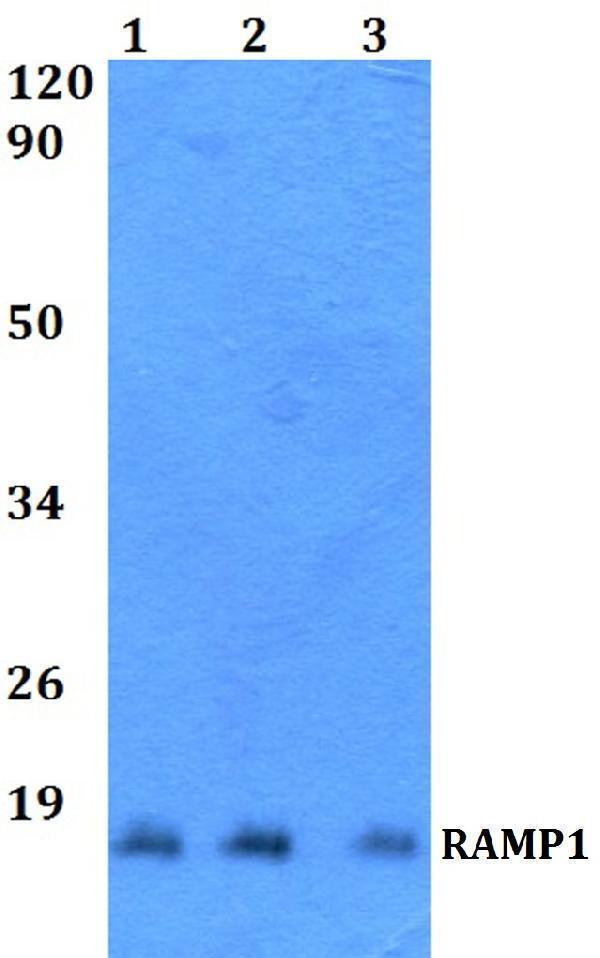
A04978 is an anti-RAMP1 antibody listed for Human, Mouse, and Rat. Its WB image shows HeLa, NIH-3T3, and H9C2 whole-cell lysates at 1:500 dilution. The supplied evidence does not establish performance beyond those tested samples and conditions.
Which to pick: A04978 is the only listed option and has a WB image. Use the reported lysates and 1:500 dilution as a starting point for planning your RAMP1 blot.