This website uses cookies to ensure you get the best experience on our website.


- Table of Contents
Designing an IHC experiment for Cohesin subunit SA-2? The guide has the expected staining pattern, antigen retrieval and fixation, antibodies backed by real IHC images, the tissue controls to run alongside, and protocols taken from published papers.
Open the STAG2 IHC Guide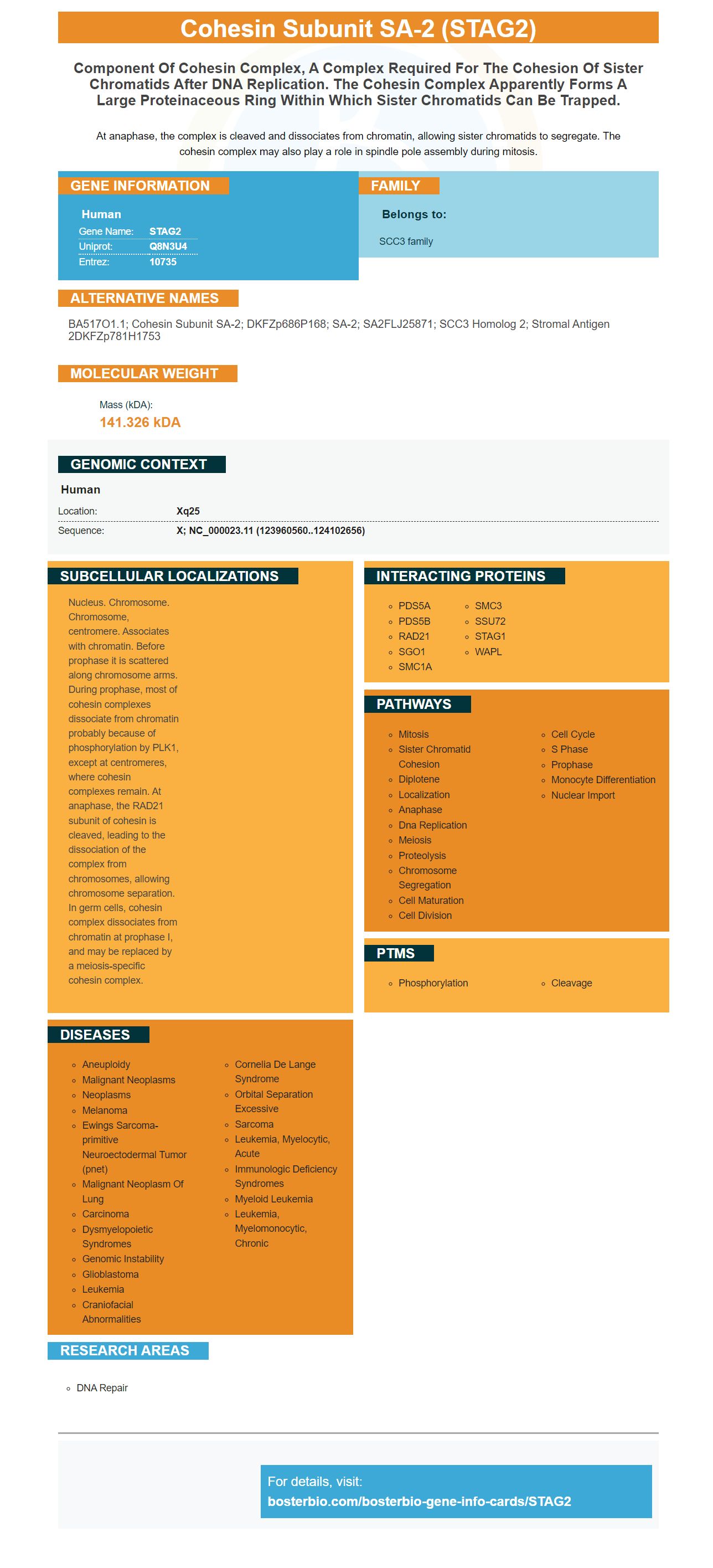
Facts about Cohesin subunit SA-2.
At anaphase, the complex is cleaved and dissociates from chromatin, allowing sister chromatids to segregate. The cohesin complex may also play a role in spindle pole assembly during mitosis.
| Human | |
|---|---|
| Gene Name: | STAG2 |
| Uniprot: | Q8N3U4 |
| Entrez: | 10735 |
| Belongs to: |
|---|
| SCC3 family |

bA517O1.1; cohesin subunit SA-2; DKFZp686P168; SA-2; SA2FLJ25871; SCC3 homolog 2; stromal antigen 2DKFZp781H1753
Mass (kDA):
141.326 kDA
| Human | |
|---|---|
| Location: | Xq25 |
| Sequence: | X; NC_000023.11 (123960560..124102656) |
Nucleus. Chromosome. Chromosome, centromere. Associates with chromatin. Before prophase it is scattered along chromosome arms. During prophase, most of cohesin complexes dissociate from chromatin probably because of phosphorylation by PLK1, except at centromeres, where cohesin complexes remain. At anaphase, the RAD21 subunit of cohesin is cleaved, leading to the dissociation of the complex from chromosomes, allowing chromosome separation. In germ cells, cohesin complex dissociates from chromatin at prophase I, and may be replaced by a meiosis-specific cohesin complex.


PMID: 9305759 by Carramolino L., et al. SA-1, a nuclear protein encoded by one member of a novel gene family: molecular cloning and detection in hemopoietic organs.
PMID: 11076961 by Sumara I., et al. Characterization of vertebrate cohesin complexes and their regulation in prophase.


