ZNF23 / Zinc finger protein 23 · Western blot design guide

Design a Western Blot for ZNF23

Source-linked ZNF23 Western blot protocol options, expected-band and isoform facts, troubleshooting for weak or shifted signal, and recommended anti-ZNF23 WB antibodies. Everything you need to plan the experiment before you commit precious samples.

Evidence assembled October 2026 · For research use; verify linked source records and product datasheet before use
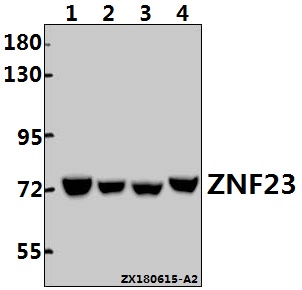
Western blot protocol sheet for ZNF23: expected band ~73.1 kDa, hero antibody A13364-1, catalog values and labelled standard workflow; separate PMC comparisons on the guide
Printable ZNF23 Western blot protocol sheet — expected band ~73.1 kDa, antibody A13364-1, controls and PMC citations. Open the full ZNF23 WB guide →

ZNF23 Western Blot Experimental Design Guide

Expected bands, source-linked protocol options, controls and antibodies — the at-a-glance facts below, then the full design guide.

Must know before running
Expected band ~73.1 kDa
Gel 12–15% (standard starting point)
Negative control ⓘ Suggested KO / knockdown lysate
Important caveats
Reasons your observed band may differ from the expected size.
PTM Ubl conjugation
Caveat Modification-state controls
Gene-set association MSigDB C7 membership
Isoform 2 isoform(s)
Section 1

Source-Linked ZNF23 Western Blot Protocol Options

The A13364-1 protocol combines labelled catalog values with standard starting conditions. Published comparisons retain their own sample, reagent and detection scope.

Recommended Western blot protocol parameters
Sample / lysateA2780 (40ug), The Testis of Mouse(40ug), Hela (40ug), The Testis of Rat(40ug) (catalog A13364-1)
Gel %12–15% (standard starting point)
Load20–30 µg total protein per lane; optimize for abundance (standard starting point)
TransferStandard semi-dry transfer; verify efficiency (standard starting point)
Membrane0.45 µm PVDF (standard starting point)
Blocking5% milk or 5% BSA in TBST (standard starting point)
Primary antibodyA13364-1; use the WB datasheet starting dilution (standard starting point)
Primary incubationOvernight at 4 °C (standard starting point)
Secondary antibodySpecies-matched HRP conjugate at validated dilution (standard starting point)
Secondary incubation1 h at room temperature (standard starting point)
Wash3 × 5 min in TBST (standard starting point)
DetectionECL; bracket exposures to avoid saturation (standard starting point)
Section 2

What Is the Expected ZNF23 Western Blot Band Size?

ZNF23 is predicted at 73.1 kDa; two isoforms could affect migration, but no empirical band size or distinct isoform pattern is established.

What am I looking at on my blot?
Single band near 73.1 kDaConsistent with the predicted ZNF23 mass; confirm band identity with controls
Two bands at different positionsCould reflect isoforms 1 and 2; their migration has not been established
Only one detectable bandDoes not rule out either annotated isoform
Band away from 73.1 kDaCould reflect an isoform, but its identity requires validation
💡Expected ZNF23 appearanceUniProt predicts ZNF23 at 73.1 kDa, but no empirical band size or isoform migration is supplied; validate any candidate band with appropriate identity controls.
How each factor affects band size
UniProt predicted massPlaces the reference band near 73.1 kDa
Isoform 1Its individual apparent size is not supplied
Isoform 2Its individual apparent size is not supplied
Alternative splicingMay change band position, but distinct migration is not established
Why is my band missing or off?
SituationLikely causeNext action
No band in lysateNuclear ZNF23 may be poorly recoveredCheck extraction and compare a nuclear-enriched sample
Band higher than expectedBand identity or isoform migration is uncertainCheck antibody specificity with ZNF23 depletion
Band lower than expectedAn isoform or unrelated band is possibleTest whether the band decreases after ZNF23 depletion
Multiple bandsTwo isoforms are annotated, but their migration is unknownCompare bands after ZNF23 depletion
Weak or no signalNuclear target recovery or abundance may be lowVerify nuclear extraction and sample loading

Sample controls for ZNF23 Western blot

🧪For positive controls for ZNF23 in Western blot, you can use no HPA-supported tissue or cell line from the supplied evidence.
Positive control: No high/medium HPA tissue identified
Negative control: Suggested KO / knockdown lysate
Loading controls: Run GAPDH, β-actin, and a total-protein stain such as Ponceau alongside the samples.
⚠️Feasibility: HPA expression data are absent, so tissue controls require experimental validation.

HPA tissue expression evidence for ZNF23

Comprehensive Human Protein Atlas IHC scoring per tissue. Rows are taken directly from the HPA tissue chart — click any row's HPA link to view the source.

Higher expression tissues · candidate positive controls from IHC

TissueCell typeLevelEvidenceSource
No high/medium HPA tissues identified in the supplied evidence.

Lower expression tissues · IHC evidence, not confirmed WB-negative controls

TissueCell typeLevelEvidenceSource
No lower-expression tissue rows available in the supplied evidence.
Section 3

Advanced ZNF23 Western Blot Tips

Deeper troubleshooting and optimisation questions for ZNF23, answered from its protein features.

How should ZNF23 band migration be interpreted?
Band shift · Use the separately labelled calculated mass and catalog-observed evidence above. A sequence annotation does not establish an observed migration shift. Verify target identity with orthogonal controls.
How might ZNF23 isoforms appear on a Western blot?
Isoforms · UniProt lists two isoforms. Isoform 2 lacks canonical residues 1–58, so it may migrate below isoform 1. The features do not establish whether the two bands can be resolved or detected by a particular antibody.

Choose an epitope outside canonical residues 1–58, which are missing from isoform 2. An antibody targeting that segment would not be expected to detect isoform 2. These coordinates use the supplied UniProt canonical sequence.
Do annotated modifications prove a band shift?
PTM · The linked UniProt record describes protein features. A modification annotation alone does not demonstrate a visible shift; retain any condition or experimental qualifier attached to it.
Does this guide establish induction of ZNF23?
Induction · No general induction response is established by this guide. A pathway or gene-set association is not evidence of induction in a particular specimen. Verify the relevant treatment and control in a target-specific experiment.
How should transfer be checked for ZNF23?
Transfer · Standard workflow guidance: verify transfer efficiency for the intended target size before interpreting a weak signal. Use total-protein assessment and optimize transfer for the membrane, gel and apparatus; the labelled catalog values take precedence.
How should blocking be optimized?
Blocking · Standard workflow guidance: follow the A13364-1 datasheet where specified. Otherwise compare 5% milk or 5% BSA in TBST; for a phospho-specific assay start with BSA. Optimize background and specific signal with matched controls.
How should ZNF23 bands be quantified across samples?
Quantitation · Define whether the measurement covers isoform 1, isoform 2, or both. Isoform 2 lacks canonical residues 1–58, so an antibody against that region cannot measure both isoforms. Compare the same assigned band or set of bands across samples.
Why might a ZNF23 band differ from 73.1 kDa?
Interpretation · 73.1 kDa is the predicted mass for the 643-residue canonical protein. The supplied features do not establish an apparent Western-blot mass or demonstrate a band shift. Check whether the band could represent isoform 2, which lacks residues 1–58.

UniProt lists Ubl conjugation and isopeptide bond keywords, but supplies no modified-residue coordinates. These annotations alone do not establish a visible shift or explain a higher band. Treat such a band as unassigned without further evidence.

ZNF23 is annotated as nuclear. Include a nuclear fraction when evaluating detection, and account for the fraction used when comparing band intensity across samples.

First consider the two annotated isoforms and whether the antibody recognizes residues 1–58. The Ubl conjugation keyword permits a modification hypothesis but does not identify a modified site or establish a shifted band. No empirical apparent band is supplied for comparison.
Boster reagents

ZNF23 Western Blot Antibodies

Catalog antibodies with Western blot application and product-specific WB images. Evaluate suitability with the reported sample, controls and experimental conditions.

Real WB data Western blot (WB) analysis of ZNF23 (Q185) pAb at 1:500 dilution Lane1:A2780 whole cell lysate(40ug) Lane2:The Testis tissue lysate of Mouse(40ug) Lane3:Hela whole cell lysate(40ug) Lane4:The Testis tissue lysate of Rat(40ug)
Anti-ZNF23 (Q185) Antibody
Cat # A13364-1

The catalog reports A13364-1, an anti-ZNF23 antibody with stated human, mouse, and rat reactivity. Its WB image shows A2780 and HeLa whole-cell lysates and mouse and rat testis lysates, each at 40 µg, using a 1:500 antibody dilution. These are tested examples.

Which to pick: A13364-1 is the only listed ZNF23 antibody and has a WB image. Choose it when its stated reactivity and the shown lysate contexts fit your experiment; the image does not establish performance in every sample type.

Source: BosterBio ZNF23 gene-info card — filtered to Western-blot-capable antibodies; each card shows that product's actual WB validation figure.