


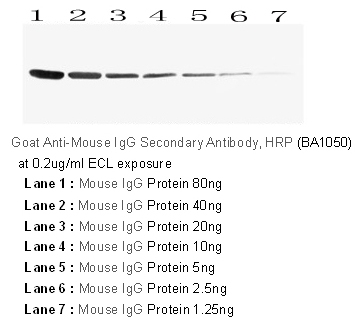
Click image to see more details
Product Info Summary
| SKU: | BA1050 |
|---|---|
| Size: | 0.5ml |
| Reactive Species: | Mouse |
| Host: | Goat |
| Application: | ELISA, WB |
Customers Who Bought This Also Bought


Product info
Product Overview
| Product Name | HRP Conjugated AffiniPure Goat Anti-Mouse IgG (H+L) |
|---|---|
| Synonyms | HRP-conjugated goat anti-mouse IgG |
| Description | HRP Conjugated Goat Anti-mouse IgG (H+L) (gamma-chain specific) secondary antibody This HRP conjugated antibody is specific for mouse IgG and shows no cross-reactivity with human/bovine/rabbit IgG. |
| Reagent Type | Secondary antibody, reporter enzyme labeled |
| Label | HRP (Horseradish Peroxidase) |
| Host | Goat |
| Target Species | Mouse |
| Antibody Class | IgG |
| Clonality | Polyclonal |
| Immunogen | Mouse IgG (whole molecular) |
| Preparation | Affinity purified from rabbit antiserum |
| Specificyity | This HRP conjugated antibody is specific for mouse IgG and shows no cross-reactivity with human/bovine/rabbit IgG. |
| Form Supplied | Concentrated, Liquid |
| Formulation | 0.5 mg of HRP conjugated specific antibody
0.01 M PBS (pH7.4) 50% glycerol |
| Pack Size | 0.5 ml |
| Concentration | 1mg/ml |
| Application | ELISA*, WB* *Our Boster Guarantee covers the use of this product in the above marked tested applications. |
| Storage | At -20˚C for one year from date of receipt. Avoid repeated freezing and thawing. |
| Shipping | Ships in room temperature. Can also ship with gel ice or dry ice but not necessary. |
| Precautions | FOR RESEARCH USE ONLY. NOT FOR DIAGNOSTIC OR CLINICAL USE |
Assay Information
| Sample Type | SDS-PAGE separated-, membrane-immobilized-, mouse primary-antibody-probed proteins from cell/tissue lysates |
|---|---|
| Assay Type | Immunoassay |
| Assay Purpose | Protein detection/quantification |
| Technique | Immunodetection of target antibody with HRP reporter enzyme |
| Equipment Needed | WB/ELISA instrumentation; X-ray film cassette or a charge-coupled device (CCD) imager; Spectrophotometer |
| Compatibility with Reagents | Incompatible with sodium azide and metals incompatible with high phosphate concentrations |
Main Advantages
| Specificity | High signal-to-noise ratio |
|---|---|
| Sensitive | Detects low-abundant targets due to an optimal number of HRP molecules per antibody |
| High Signal Amplification | Multiple secondary antibodies can bind to a single primary antibody;Secondary antibodies Fc regions provide further binding locations for biotin, or enable the use of ABC and SABC |
| Fast | Generates strong signals in a relatively short time span |
| Quantifieable | Allows quantification of detected signal |
| Easy to Use | Supplied in a workable liquid format |
| Flexible | HRP: compatible with chromogenic, fluorogenic and chemiluminescent substrates; |
| Convenient | HRP’s small size: no interference with the primary/secondary antibody interaction; no steric hindrance to antibody/antigen complexes |
Background
Most commonly, secondary antibodies are generated by immunizing the host animal with a pooled population of immunoglobulins from the target species. The host antiserum is then purified through immunoaffinity chromatography to remove all host serum proteins, except the specific antibody of interest. Purified secondary antibodies are further solid phase adsorbed with other species serum proteins to minimize cross-reactivity in tissue or cell preparations, and are then modified with antibody fragmentation, label conjugation, etc., to generate highly specific reagents. Secondary antibodies can be conjugated to a large number of labels, including enzymes, biotin, and fluorescent dyes/proteins. Here, the antibody provides the specificity to locate the protein of interest, and the label generates a detectable signal. The label of choice depends upon the experimental application.
Horseradish peroxidase (HRP) is extensively used for labeling secondary antibodies in ELISA, western blot, dot blot and immunohistochemistry. The HRP enzyme is made visible using a substrate that, when oxidized by HRP in the presence of hydrogen peroxide as an oxidizing agent, yields a characteristic change that is detectable by specific detection methods. The substrates commonly used with HRP fall into different categories including chromogenic, fluorogenic, and chemiluminescent substrates depending on whether they produce a colored, fluorimetric or luminescent derivative respectively. The intensity of the signal is proportional to peroxidase activity and is a measure of the number of enzyme molecules reacting, hence of the amount of recognized primary antibodies, and thus of the amount of target antigen.
Product Images
Assay Dilutions Recommendation
The recommendations below provide a starting point for assay optimization. Actual working concentration varies and should be decided by the user.
Western Blotting: 0.1-0.2μg/ml (ECLdetection)
Western Blotting: 0.7-3.3μg/ml (DAB detection)
ELISA: 0.05-0.5μg/ml (TMB detection)
Validation Images & Assay Conditions
Click image to see more details
Specific Publications For BA1050
Loading publications
Customer Reviews
Have you used HRP Conjugated AffiniPure Goat Anti-Mouse IgG (H+L)?
Submit a review and receive an Amazon gift card.
- $30 for a review with an image
0 Reviews For HRP Conjugated AffiniPure Goat Anti-Mouse IgG (H+L)
Customer Q&As
Have a question?
Find answers in Q&As, reviews.
Can't find your answer?
Submit your question
1 Customer Q&As for HRP Conjugated AffiniPure Goat Anti-Mouse IgG (H+L)
Question
Is this product suitable for IHC? Keyword: application, Immunohistochemistry
Verified Customer
Verified customer
Asked: 2014-12-26
Answer
Please beware that this product is not suitable for IHC. Small package of secondaries (0.5 ml) can do 15-75 slides and 1ml can do 30-150 slides. The difference is in the way customer uses the reagent.
Boster Scientific Support
Answered: 2014-12-26

