


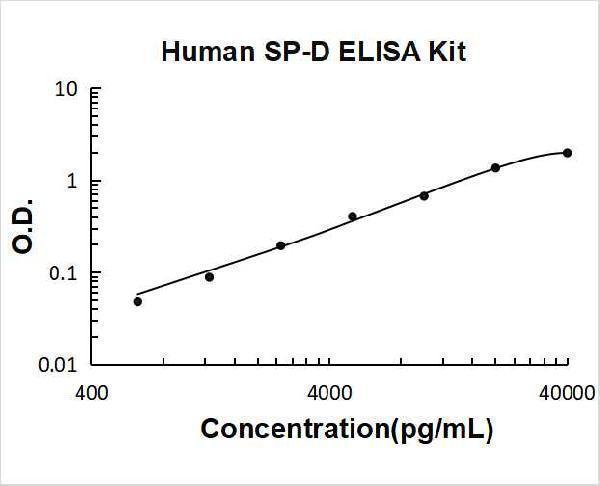
Click image to see more details
Product Info Summary
| SKU: | EK1171 |
|---|---|
| Size: | 96 wells/kit, with removable strips. |
| Reactive Species: | Human |
| Application: | ELISA |
| Sample Types: | cell culture supernatants, cell lysates, serum and plasma (heparin, EDTA). |
Product info
Product Name
Human SP-D / Surfactant protein D ELISA Kit PicoKine®
SKU/Catalog Number
EK1171
Size
96 wells/kit, with removable strips.
*Question: How many samples can I assay/run in this kit?
Description
SFTPD (surfactant protein D; SP-D) is a collectin that contributes to pulmonary innate defense by binding microbial ligands (e.g., LPS) and can engage pattern-recognition receptor modules (e.g., reported interactions with TLR complexes in curated pathway resources). SP-D is also widely studied as a circulating biomarker of alveolar-capillary barrier injury in acute/chronic lung disease contexts (clinical interpretation depends on cohort and assay). Assay context: quantitative human SFTPD ELISA for cell culture supernatants, cell lysates, serum, and plasma (heparin/EDTA); sensitivity 20 pg/mL; can be interpreted alongside anti-inflammatory cytokines such as IL-10 when profiling inflammation–resolution balance (putative co-panel).
Storage & Handling
Store at 4°C for 6 months, at -20°C for 12 months. Avoid multiple freeze-thaw cycles (Ships with gel ice, can store for up to 3 days in room temperature. Freeze upon receiving.)
Cite This Product
Human SP-D / Surfactant protein D ELISA Kit PicoKine® (Boster Biological Technology, Pleasanton CA, USA, Catalog # EK1171)
Clonality of Antibodies
See Datasheet for details
Standard Protein
Expression system for standard: NS0; Immunogen sequence: A21-F375
Sensitivity
<20 pg/ml
Assay Range
625 pg/ml - 40,000 pg/ml
Standard Dilution Instructions
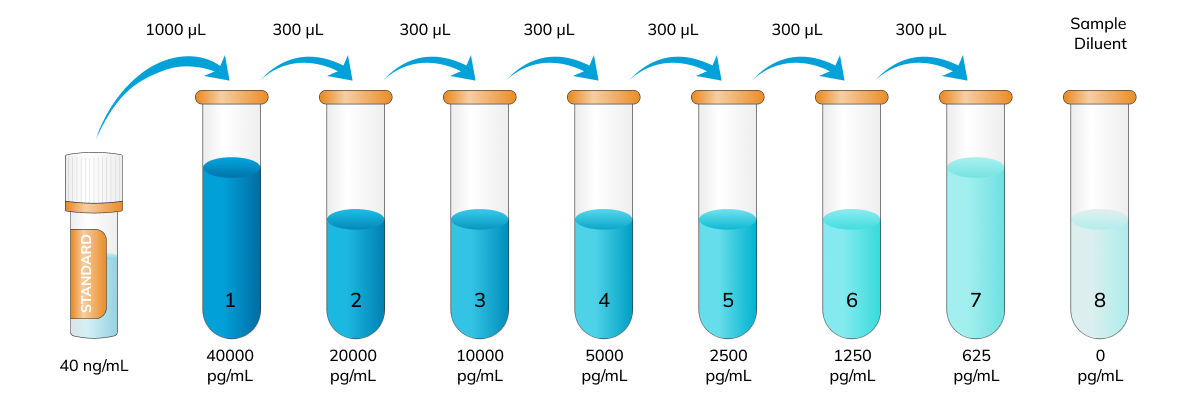
See datasheet of EK1171 for more details
Cross-reactivity
There is no detectable cross-reactivity with other relevant proteins.
Reactive Species
EK1171 is reactive to SFTPD in Human samples
Validated Sample Types
cell culture supernatants, cell lysates, serum and plasma (heparin, EDTA).
Application Guarantee
EK1171 is guaranteed for ELISA in Human by Boster Guarantee
See how Boster Bio validate our ELISA kits: ELISA Validation Information
Background of SFTPD
Surfactant, pulmonary-associated protein D, also known as SFTPD or SP-D, is a protein which in humans is encoded by the SFTPD gene. By fluorescence in situ hybridization, the SP-D gene was localized in 10q22.2-q23.1. On the basis of homology with other collectins, potential functions for SP-D include roles in innate immunity and surfactant metabolism, SP-D is produced in the bronchiolar and terminal epithelium of human fetal lung from about 21 weeks of gestation. What’s more, SP-A and SP-D act as dual-function surveillance molecules that reverse orientation and function and become initiators of host-defense reactions.
Kit Components
| Catalog Number | Description | Quantity |
|---|---|---|
| EK1171-CAP | Anti-Human SFTPD Pre-coated 96-well strip microplate | 1 |
| EK1171-ST | Human SFTPD Standard | 2 vials, 40 ng/tube |
| EK1171-DA | Human SFTPD Biotinylated antibody (100x) | 100ul |
| AR1103 | Avidin-Biotin-Peroxidase Complex (100x) | 100ul |
| AR1106-1 | Sample Diluent | 30ml |
| AR1106-2 | Antibody Diluent | 12ml |
| AR1106-3 | Avidin-Biotin-Peroxidase Diluent | 12ml |
| AR1104 | Color Developing Reagent (TMB) | 10ml |
| AR1105 | Stop Solution | 10ml |
| AR1106-5 | Wash Buffer (25x) | 20ml |
| PLA-SEA | Adhesive plate sealers | 4 |
*The kit components are not available for individual purchase.
Materials Required But Not Included In Kit
- Microplate Reader capable of reading absorbance at 450nm.
- Incubator.
- Automated plate washer (optional).
- Pipettes and pipette tips capable of precisely dispensing 0.5 µl through 1 ml volumes of aqueous solutions.
- Multichannel pipettes are recommended for large amount of samples.
- Deionized or distilled water.
- 500ml graduated cylinders.
- Test tubes for dilution.
Data Examples, Quality Control Data & Sample Dilution
Validation Standard Curve O.D. At 450nm
| Concentration (ng/ml) | 0 | 0.625 | 1.25 | 2.5 | 5 | 10 | 20 | 40 |
| O.D. | 0.09 | 0.138 | 0.179 | 0.286 | 0.497 | 0.766 | 1.456 | 2.084 |
Data Example Images
Click image to see more details
Human SP-D PicoKine ELISA Kit standard curve
Recommended Sample Dilution Ratios
According to our internal validation assays using this ELISA kit, to detect SFTPD,
| Application | Dilution | Species |
|---|---|---|
| Dilution ratio of 1:1 | concentration in serum and plasma is around 2.6 ng/ml. |
Some articles we found to cite concentrations of SFTPD in samples: 25488319 (Pubmed IDs).
Intra Assay Consistency & Inter Assay Consistency
We measured random samples of Human SP-D / Surfactant protein D ELISA Kit PicoKine® within the same batch/lot to ensure the consistency of the kits' performances. ELISA intra assay consistency is measured using wells from the same plate/assay kit. ELISA inter assay consistency is measured using wells from different plates from the same batch production/lot.
| Intra-Assay Precision | Inter-Assay Precision | |||||
|---|---|---|---|---|---|---|
| Sample | 1 | 2 | 3 | 1 | 2 | 3 |
| n | 16 | 16 | 16 | 24 | 24 | 24 |
| Mean (pg/ml) | 1547 | 3580 | 25269 | 1591 | 3588 | 23717 |
| Standard deviation | 92.82 | 221.96 | 1693.02 | 111.37 | 279.86 | 1683.9 |
| CV (%) | 6% | 6.2% | 6.7% | 7% | 7.8% | 7.1% |
Specific Publications For Human SP-D / Surfactant protein D ELISA Kit PicoKine® (EK1171)
Loading publications
Recommended Resources
Here are featured tools and databases that you might find useful.
- Boster's Pathways Library
- Protein Databases
- Bioscience Research Protocol Resources
- Data Processing & Analysis Software
- Photo Editing Software
- Scientific Literature Resources
- Research Paper Management Tools
- Molecular Biology Software
- Primer Design Tools
- Bioinformatics Tools
- Phylogenetic Tree Analysis
Customer Reviews
0 Reviews For Human SP-D / Surfactant protein D ELISA Kit PicoKine®
Customer Q&As
Have a question?
Find answers in Q&As, reviews.
Can't find your answer?
Submit your question
10 Customer Q&As for Human SP-D / Surfactant protein D ELISA Kit PicoKine®
Question
What is the assay range of EK1171?
Verified customer
Asked: 2021-02-05
Answer
The assay range of the Human SP-D / Surfactant Protein D ELISA Kit PicoKine™ (EK1171) is 0.625ng/ml-40ng/ml.
Boster Scientific Support
Answered: 2021-02-07
Question
What is the concentration range of SP-D in serum samples of EK1171?
Verified customer
Asked: 2021-02-05
Answer
The concentration range of SP-D in serum samples of the Human SP-D / Surfactant Protein D ELISA Kit PicoKine™ (EK1171) is 0.8-20ng/ml.
Boster Scientific Support
Answered: 2021-02-07
Question
Q: what is the protocol regarding preparation of cell lysates prepared for use in Picokine® ELISA kits?
T. Mitchell
Verified customer
Asked: 2020-03-04
Answer
A: in those Picokine® ELISAs where cell or tissue lysate is a validated sample type, sample preparation instructions for lysate can be found in the product insert. Components in lysate and lysis buffer may affect immunoreactivity, so if lysate is not a validated sample type, care must be taken in sample preparation and validation.
Boster Scientific Support
Answered: 2020-03-04
Question
Q: is there any online tool I can use to streamline the data analysis for my ELISA results?
C. Martinez
Verified customer
Asked: 2020-02-16
Answer
A: We have a web based ELISA curve fitting (4pl) and data analysis tool. Please give it a try: bosterbio.com/biology-research-tools/elisa-data-analysis-online. You can also consult our article on ELISA data analysis: bosterbio.com/elisa-data-analysis-instructions
Boster Scientific Support
Answered: 2020-02-16
Question
What is the immunized animal and purification way of the antibody in EK1171?
Verified customer
Asked: 2019-10-02
Answer
The capture antibody of the Human SP-D / Surfactant Protein D ELISA Kit PicoKine® (EK1171) is polyclonal antibody from goat, the detection antibody is polyclonal antibody from goat. The purification method of the antibody used is affinity purified.
Boster Scientific Support
Answered: 2019-10-08
Question
Q: Can SP-D ELISA Kits be used with tissue homogenates (or other non-validated sample types)?
Verified Customer
Verified customer
Asked: 2019-04-19
Answer
A: Unfortunately, Boster Bio has not routinely validated tissue homogenates as a sample type for ELISA kits. This does not mean that ELISA kits are not suitable for other sample types than we have tested: it means further investigation is a must. One will need to perform a spike and recovery study to determine if an unvalidated sample type will work with a particular kit. To perform a spike and recovery experiment, one should divide a sample into two aliquots. In one of the aliquots, the user should spike in a known amount of the kit standard. a dilution series is performed comparing the spiked versus the unspiked sample. Generally, samples with expected recovery and linearity between 80-120% are considered acceptable. This method can be used to validate any sample type that has not been assessd by Boster Bio. for a more detailed spike and recovery protocol, please contact technical support.
Note: acceptable ranges should be determined individually by each laboratory. Additionally, technical support can help determine if a buffer component is not compatible with a given ELISA kit. please see the Citations tab on the product webpage for peer-reviewed papers utilizing a wide range of sample types. We also have an innovator's reward program where if the user validates our ELISA kits in applications or samples previously not validated by Boster Bio or other users, and share such information with us by submit a review, we will reward the user's efforts with a free antibody or ELISA kit from our catalog. Biocompare.com will also give $20 Amazon giftcard as an additional reward, if the review is submitted there as well.
Boster Scientific Support
Answered: 2019-04-19
Question
Q: Are Boster Bio recombinant proteins and antibodies sterile?
R. Hall
Verified customer
Asked: 2018-08-21
Answer
A: although the vials are bottled using aseptic techniques, heat-treated vials, and sterile stock solutions, they are not considered or guaranteed to be sterile. If sterile material is required for an experiment, the material can be filtered through a 0.2 micron filter designed for use with biological fluids.
Boster Scientific Support
Answered: 2018-08-21
Question
Q: how do I analyze ELISA data? I measured SP-D level in cell lysates.
C. Bhatt
Verified customer
Asked: 2018-04-03
Answer
A: please read this article on ELISA data analysis. bosterbio.com/elisa-data-analysis-instructions. Boster also provides a free tool that you can use to analyze ELISA data. bosterbio.com/biology-research-tools/elisa-data-analysis-online
Boster Scientific Support
Answered: 2018-04-03
Question
Q: if the enzyme conjugated SP-D antibodies are mixed with the substrate, will that change the substrate into the enzymatic reaction product? Or the enzyme function is only activated when the antibody is attached with the SP-D antigen?
Verified Customer
Verified customer
Asked: 2018-03-27
Answer
A: The enzyme is always active. Avoid contaminating the substrate with enzyme prior to the incubation otherwise it compromises the assay with false positive signal.
Boster Scientific Support
Answered: 2018-03-27
Question
Q: how to thaw whole blood sample for SP-D ELISA after freezing?
Verified Customer
Verified customer
Asked: 2016-06-13
Answer
A: do not freeze and thaw whole blood. erythrocytes are fragile and, if frozen and thawed, will undergo hemolysis rendering the samples useless. To keep your blood samples to test SP-D for a later time, you should let the blood clot in glass tubes and collect the serum to freeze for later use.
Boster Scientific Support
Answered: 2016-06-13

