This website uses cookies to ensure you get the best experience on our website.


- Table of Contents
Learn how to choose the right fluorochrome conjugates for multicolor flow cytometry to improve signal clarity and reduce spectral overlap. Discover proven strategies for pairing FACS fluorophores, designing balanced multi-color panels, and achieving accurate, reproducible results.
In multicolor flow cytometry, fluorescent conjugates enable the simultaneous detection of multiple antigens within a single sample. Each fluorochrome emits light at a distinct wavelength, and when selected and paired appropriately, they allow complex biological data to be captured with clarity and precision. Successful panel design involves assigning fluorochromes to antibodies based on antigen expression levels, instrument configuration, and experimental objectives. Careful planning helps minimize spectral overlap, reduce background noise, and avoid compensation errors, ensuring reliable gating and accurate detection of both high- and low-abundance targets.
Designing an effective multicolor flow cytometry panel requires balancing signal strength, minimizing spectral overlap, and implementing proper controls to ensure accurate, reproducible data.
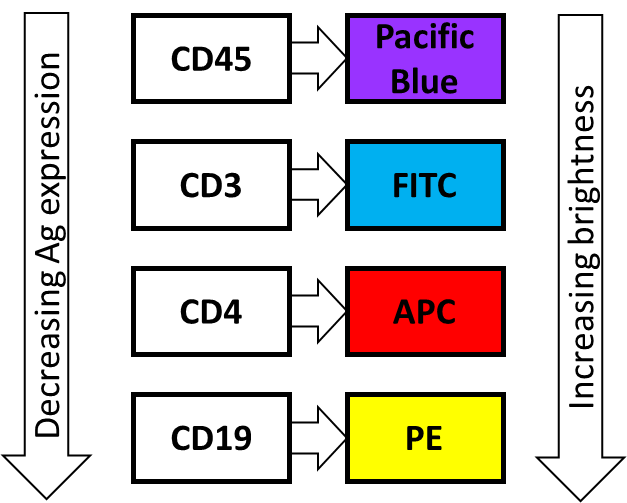
A well-designed panel balances brightness, spectral compatibility, and laser excitation efficiency. Below is an illustrative example applying the flow cytometry principles above:
| Laser | Fluorochrome | Antigen Target Type | Notes |
|---|---|---|---|
| Blue(488nm) | FITC | High-expression antigen | Dimmer fluorochrome for strong signal antigens |
| Blue(488nm) | PE | Low-expression antigen | Bright fluorochrome for weak signal detection |
| Red(633nm) | APC | Medium-expression antigen | Minimal spillover from blue lasers |
| Violet(405nm) | BV421 | Low-expression antigen | High brightness, minimal overlap |
Keywords: FACS fluorophores, fluorochrome conjugates, multi color panel, flow validated antibody panel, excitation emission, FACS dyes
Click for more optimization tips
Protocols, optimization tips, troubleshooting guides, and more for flow cytometry.
Technical Resources
Download troubleshooting handbooks for IHC, Western blot and ELISA for FREE.
Troubleshooting GuidesGet some of the best Bosterbio's flow cytometry optimization tips. This guide includes protocols, optimization tips, troubleshooting tips, and more on flow cytometry.
See MoreBoster Bio is an antibody company and supplier. Read more about our troubleshooting tips for flow cytometry (FACS) experiments. Learn tips on how to resolve issues such as high background, and weak or no signal
See MoreFlow cytometry is a popular cell biology technique that utilizes laser-based technology to count, sort, and profile cells in a heterogeneous fluid mixture. FACS is an abbreviation for fluorescence-activated cell sorting, which is a flow cytometry technique that further adds a degree of functionality.
See MoreAntibody titration is recommended to determine the correct concentration of an antibody for the optimum signal. Test different dilutions of the antibody to zero in on the lowest concentration that gives the strongest signal in positive control and th...
See MoreThe principle behind Immunohistochemistry (IHC) entails detection of antigen or happens in cells of a tissue section by exploiting the principle of antibodies binding specifically to antigens in biological tissues. Learn more about this in this guide.
See MoreThe choice of which detection system to use is influenced by the equipment available and the needs of the specific application being considered. Use this guide to help decide whether to use enzyme-linked secondary antibodies, or fluorescently labelled secondary antibodies as your detection system.
See MoreThis guide provides a thorough list of Immunohistochemistry troubleshooting tips, including weak staining, high background, nonspecific staining among others. Learn how to take control of your IHC process.
See MoreUse this guide to help decide whether to use enzyme-linked secondary antibodies, or fluorescently labelled secondary antibodies as your detection system. ELISA Blocking Buffer Optimization There are a variety of blocking buffers, not one of which is ...
See More