This website uses cookies to ensure you get the best experience on our website.


- Table of Contents
The following guide serves as a checklist for the possible causes and solutions with respect to some of the most commonly encountered problems from molecular biology experimental techniques. We at Boster Bio are committed to helping our customers get better results. While the troubleshooting guide below covers a multitude of problems encountered while performing in the lab, we do not expect it to be the exclusive solution to any problems during your specific experiment. We hope that you will find the information beneficial to you and useful as a reference guide in troubleshooting any problems you may encounter. If you ever need more assistance with your experiments, please contact the Boster Support Team by email at support@bosterbio.com.
| Symptom | Most likely causes | Fastest fixes to try first |
|---|---|---|
| No band (endpoint PCR) | Wrong annealing temp, low template, degraded template, primer issues, missing reagent | Run a temperature gradient, increase template slightly, make fresh primer working stocks, confirm thermocycler settings, remake master mix |
| Very weak band | Too few cycles, low template, suboptimal Mg²⁺/enzyme, inhibitors | Add 5–10 cycles, do a 1:5–1:10 template dilution series, switch polymerase, cleanup or dilute template |
| Multiple bands | Low specificity, annealing temp too low, primer design issue | Increase annealing temp, reduce primer concentration, reduce cycles, redesign primers if repeats/self-complementarity exist |
| Smear | Too many cycles, too much template, degraded template, nonspecific priming | Reduce cycles, reduce template input, increase annealing temp, improve template quality |
| Primer-dimer (small band near bottom) | Primers self-anneal, primer concentration too high, annealing temp too low | Increase annealing temp, lower primer concentration, redesign primers, use hot-start polymerase |
| Amplification in NTC | Contamination, carryover amplicons, contaminated reagents | Replace buffer/polymerase/water, set up in clean area, use sterile filter tips, consider UNG/dUTP workflow if available |
| High variability between replicates (qPCR) | Pipetting error, inconsistent standards, bubbles/poor sealing | Calibrate pipettes, prepare fresh dilutions, spin down plate/tubes, check sealing and loading technique |
| Erratic qPCR curves | Optics not calibrated, bubbles, wrong baseline/threshold, poor ROX setup | Calibrate optics, spin down, repeat with ROX normalization dye (if required by instrument), check analysis settings |
| Ct shifts later than expected | Inhibitors, low template, RNA/cDNA issues | Run dilution series to check inhibition, improve extraction cleanup, increase cDNA input, verify RNA integrity and reverse transcription conditions |
| Melt curve shows multiple peaks (SYBR) | Non-specific products, primer-dimers | Increase annealing temp, adjust primer concentration, add a short hot-start step, confirm with gel, redesign primers if needed |
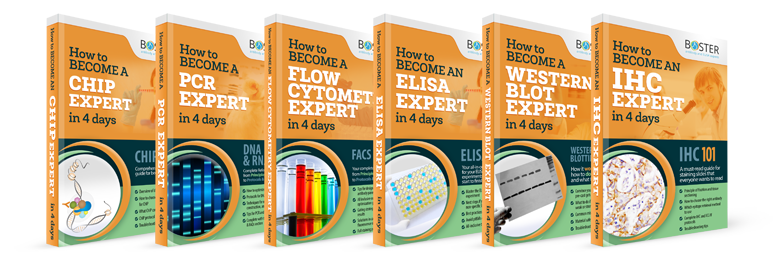
Download troubleshooting handbooks for IHC, Western blot, and ELISA for FREE.
Troubleshooting GuidesExtraction quality directly affects downstream PCR performance. Low yield or contamination can reduce amplification efficiency or introduce inhibitors.
| Problem | Possible Solutions |
|---|---|
| Low yields | Increase sample volume |
| Increase lysis time or add enzymatic lysis step | |
| Increase lysis time in 10 min | |
| Make sure that vortex and resuspension steps allow a good homogenization | |
| Suspend DNA or RNA in less volume | |
| Salt contamination | Repeat extraction protocol from precipitation process |
| Protein contamination | Increase lysis time or add enzymatic lysis step |
Boster has a convenient Miniprep Kit For Plasmid DNA Extraction And Purification.
Most amplification problems fall into a few categories: thermal settings, primer issues, template concentration/quality, contamination, or over-cycling.
| Problem | Possible Solutions |
|---|---|
| No amplification | Perform a temperature gradient PCR |
| Make new primer work solution | |
| Increase template concentration | |
| Decrease Tm temperature | |
| Increase cDNA concentration | |
| Check DNA template quality in Nanodrop | |
| Verify time and temperature settings | |
| Use new template | |
| Non-specific amplification | Increase Tm temperature |
| Avoid self-complementary sequences within primers | |
| Avoid stretches of 4 or more of the same nucleotide or dinucleotide repeats | |
| Lower primer concentration | |
| Follow general rules of primer design | |
| Decrease the number of cycles | |
| Amplification in negative control | Use new reagents, namely buffer and polymerase |
| “Homemade” polymerases usually contain genetic contaminants. Try a commercial polymerase instead. | |
| Make sure to use sterile tips | |
| Low yields of PCR product | Increase number of cycles by 10 |
| High quantification in standards | Use new diluted standards |
| Check pipettes calibration | |
| High variability in replicates | Verify pipettes calibration |
| Use fresh diluted standards | |
| Erratic curves | Calibrate optics of the system |
| Repeat with rox-normalisation dye | |
| Bands and smear are very intense | Reduce the number of cycles |
| Incorrect product size | Look for additional primer complementary sequences in the template |
| Increase Tm temperature | |
| Make new primer work solutions |
Possible solutions
Possible solutions
Possible solutions
Possible solutions
Boster has convenient PCR Master Mixes. Save your time and reduce contamination with our pre-mixed formulations!
Learn stepwise PCR protocols from reagent preparation to data analysis. Check out their differences to learn how they compare and their advantages and disadvantage.
See MoreThis guide will teach you everything you need to become a PCR expert, including a critical review of PCR and molecular biology principles, protocols, all-in-one FAQs, and more. Optimized Protocols Need protocols for DNA and RNA extraction and purific...
See MoreThe DNA strand used to produce the complementary strand is referred to as the template strand, which is used to synthesize complementary strands of each parental strand. These molecules are responsible for giving information to cells of each organism...
See MorePCR sample preparation is very crucial for reliable results. It includes accurate extraction and purification of DNA or RNA to the library preparation and screening.
See Moreprotocol and troubleshooting chromatin immunoprecipitation chip troubleshooting guide ChIP Troubleshooting Guide|Chromatin Immunoprecipitation Troubleshooting
See MoreThese molecular biology techniques have various broad and useful applications in our scientific community, so understanding the fundamental principles will be useful in your journey. Manipulation and investigation of genetic material is done through ...
See MoreThis guide provides a thorough list of Immunohistochemistry troubleshooting tips, including weak staining, high background, nonspecific staining among others. Learn how to take control of your IHC process.
See MoreBoster Bio is an antibody company and supplier. Read more about our troubleshooting tips for flow cytometry (FACS) experiments. Learn tips on how to resolve issues such as high background, and weak or no signal
See More