Customer Testimonials

Peer Reviews from Real Labs

Browse peer-submitted results linked to specific products—ratings, images, and practical notes included. Contribute your own result to strengthen the evidence base and claim rewards after verification.

Video Interviews

See real workflows and decision points—what researchers tried, what worked, and why. Share your story in a short interview and claim rewards!

Get Interview Rewards

Filter by category, reactivity, and host to find the most relevant peer results.

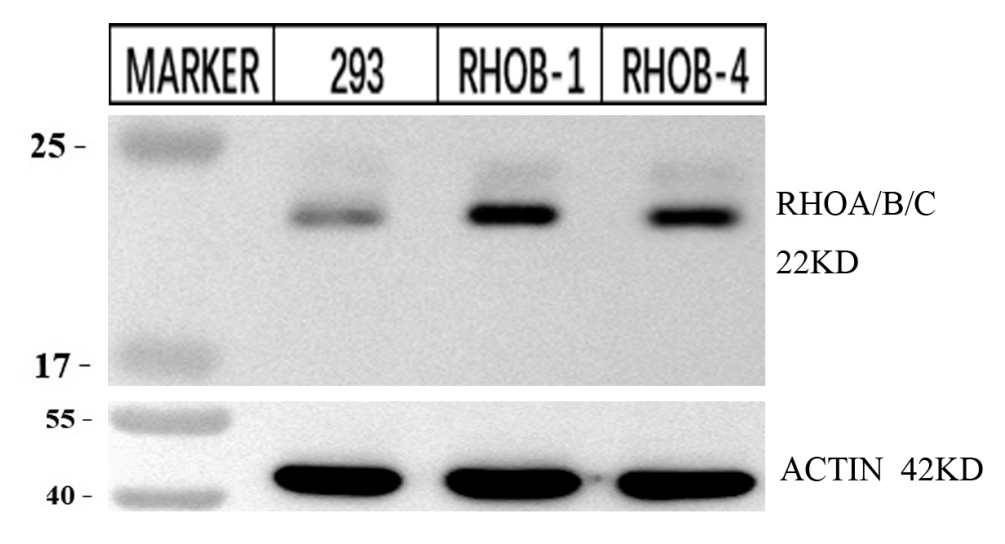
The target band of this antibody is clear and at the correct position, with minimal nonspecific bands, and the results are good.

Excellent, submitted by on
SKU M00207-1
Application Western Blot
Sample huaman 293 cells
Sample Processing Description RHOB detection was performed using total protein extracted from normal 293 cells and 293 cells with RHOB overexpression.
Other Reagents RIPA lysis buffer, Protease inhibitor, Electrophoresis buffer, Transfer buffer, Blocking buffer
Primary Antibody ATF4 Rabbit Monoclonal Antibody
Primary Incubation 1:2500, overnight at 4 ℃
Secondary Antibody HRP Goat Anti-Rabbit IgG
Secondary Incubation 1:10000, 1 hour in room temperature
Detection Substrate: ECL, Imaging system:ChemiDoc MP
Results Summary We generated a stable RHOB overexpression cell line using 293 cells. The results show that the RHOB expression level in the transfected samples is significantly higher than in the normal 293 cells, indicating successful transfection.

The antibody shows a clear target band at the correct position and has strong affinity for phosphorylated IRE1 protein from pig.

Excellent, submitted by on
SKU M00371
Application Western Blot
Sample Porcine intestinal tissue
Sample Processing Description Intestinal tissues from different segments of pigs infected with swine fever.
Other Reagents RIPA lysis buffer, Protease inhibitor, Electrophoresis buffer, Transfer buffer, Blocking buffer
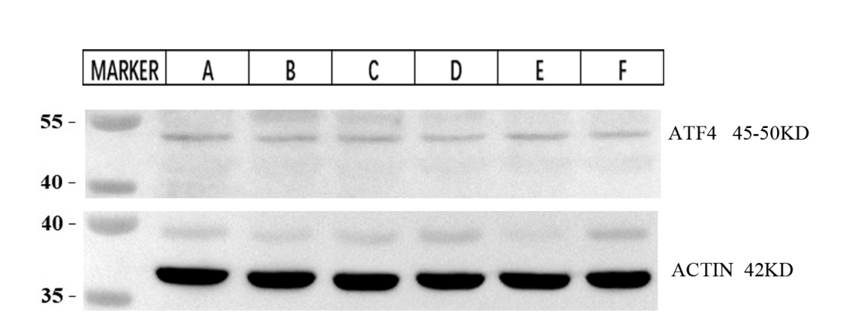
Primary Antibody ATF4 Rabbit Monoclonal Antibody
Primary Incubation 1:2000, overnight at 4 ℃
Secondary Antibody HRP Goat Anti-Rabbit IgG
Secondary Incubation 1:10000, 1 hour in room temperature
Detection Substrate: ECL, Imaging system:ChemiDoc MP
Results Summary ATF4 is a key regulator of the integrated stress response. When cells encounter conditions such as oxidative stress or endoplasmic reticulum stress, the expression of ATF4 is rapidly induced and upregulated. The aim of this experiment is to determine the expression levels of ATF4 protein in different intestinal segments infected with classical swine fever.

The antibody shows a clear target band at the correct molecular weight and exhibits strong affinity for phosphorylated EIF2A protein in pig samples.

Excellent, submitted by on
SKU P04387
Application Western Blot
Sample Porcine intestinal tissue
Sample Processing Description Intestinal tissues from different segments of pigs infected with swine fever.
Other Reagents RIPA lysis buffer, Protease inhibitor, Electrophoresis buffer, Transfer buffer, Blocking buffer
Primary Antibody Anti-Phospho-EIF2S1 (S51) Rabbit Monoclonal Antibody
Primary Incubation 1:2000, overnight at 4 ℃
Secondary Antibody HRP Goat Anti-Rabbit IgG
Secondary Incubation 1:10000, 1 hour in room temperature
Detection Substrate: ECL, Imaging system:ChemiDoc MP
Results Summary Phosphorylation of eIF2α is one of the most important switches controlling intracellular protein synthesis. When cells encounter conditions such as oxidative stress or endoplasmic reticulum stress, phosphorylated eIF2α rapidly suppresses the majority of protein synthesis to help the cell cope with the crisis. The purpose of this experiment is to determine the expression levels of phosphorylated EIF2A protein in different intestinal segments infected with classical swine fever virus.

The target band of this antibody is clear and at the correct position, and it shows strong affinity for porcine GRP78 protein.

Excellent, submitted by on
SKU PA1815
Application Western Blot
Sample Porcine intestinal tissue
Sample Processing Description Intestinal tissues from different segments of pigs infected with swine fever.
Other Reagents RIPA lysis buffer, Protease inhibitor, Electrophoresis buffer, Transfer buffer, Blocking buffer
Primary Antibody Anti-GRP78 BiP/HSPA5 Antibody Picoband®
Primary Incubation 1:2000, overnight at 4 ℃
Secondary Antibody HRP Goat Anti-Rabbit IgG
Secondary Incubation 1:10000, 1 hour in room temperature
Detection Substrate: ECL, Imaging system:ChemiDoc MP
Results Summary When cells experience stress such as hypoxia, nutrient deprivation, or calcium imbalance, large amounts of unfolded proteins accumulate in the endoplasmic reticulum. GRP78 senses this stress and undergoes dissociation upon upregulation, activating a series of signaling pathways to reduce new protein synthesis and increase the production of molecular chaperones (including GRP78 itself) to relieve the stress. The aim of the experiment is to determine the expression levels of GRP78 in different intestinal segments of pigs infected with swine fever.

The antibody shows a clear target band, correct positioning, minimal background, and overall good results.

Excellent, submitted by on
SKU PB9253
Application Western Blot
Sample mouse 4T1 cells
Sample Processing Description normal 4T1 cells, LPS-stimulated 4T1 cells, cells treated with low, medium, or high doses of the drug, and cells treated with a positive control drug.
Other Reagents RIPA lysis buffer, Protease inhibitor, Electrophoresis buffer, Transfer buffer, Blocking buffer
Primary Antibody HIF-1-alpha/HIF1A Antibody Picoband®
Primary Incubation 1:2500, overnight at 4 ℃
Secondary Antibody HRP Goat Anti-Rabbit IgG
Secondary Incubation 1:10000, 1 hour in room temperature
Detection Substrate: ECL, Imaging system:ChemiDoc MP
Results Summary With equal loading amounts, the HIF1A protein levels showed clear differences among the groups: the blank group had the lowest level, the model group the highest, and in the drug-treated groups, the levels decreased sequentially from low, medium, to high dose. The positive control group was comparable to the high-dose group.

The antibody shows a clear target band, correct localization, minimal background, and overall good results.

Excellent, submitted by on
SKU P00003
Application Western Blot
Sample mouse 4T1 cells
Sample Processing Description normal 4T1 cells, LPS-stimulated 4T1 cells, cells treated with low, medium, or high doses of the drug, and cells treated with a positive control drug.
Other Reagents RIPA lysis buffer, Protease inhibitor, Electrophoresis buffer, Transfer buffer, Blocking buffer
Primary Antibody Anti-Phospho-mTOR (S2448) Rabbit Monoclonal Antibody
Primary Incubation 1:2500, overnight at 4 ℃
Secondary Antibody HRP Goat Anti-Rabbit IgG
Secondary Incubation 1:10000, 1 hour in room temperature
Detection Substrate: ECL, Imaging system:ChemiDoc MP
Results Summary With equal loading amounts, total MTOR protein levels were similar across all groups. However, phosphorylated MTOR levels showed significant changes: the blank group was the lowest, the model group the highest, and in the drug-treated groups, phosphorylation decreased sequentially from low, medium, to high dose. The positive control group was comparable to the high-dose group.

The antibody shows a clear target, correct localization, minimal background, and overall good results.

Excellent, submitted by on
SKU P00024-4
Application Western Blot
Sample mouse 4T1 cells
Sample Processing Description normal 4T1 cells, LPS-stimulated 4T1 cells, cells treated with low, medium, or high doses of the drug, and cells treated with a positive control drug.
Other Reagents RIPA lysis buffer, Protease inhibitor, Electrophoresis buffer, Transfer buffer, Blocking buffer
Primary Antibody Anti-AKT1,2,3 Antibody Picoband®
Primary Incubation 1:10000, overnight at 4 ℃
Secondary Antibody HRP Goat Anti-Rabbit IgG
Secondary Incubation 1:10000, 1 hour in room temperature
Detection Substrate: ECL, Imaging system:ChemiDoc MP
Results Summary Under equal loading conditions, the total AKT protein levels were similar across all groups, while the amount of phosphorylated AKT1 showed significant changes. The blank group had the lowest level, the model group had the highest, and in the drug-treated groups, the levels decreased progressively from low to medium to high dose. The positive control drug group was close to the high-dose group.

The antibody shows a clear target, correct localization, minimal background, and overall good results.

Excellent, submitted by on
SKU M00003
Application Western Blot
Sample mouse 4T1 cells
Sample Processing Description normal 4T1 cells, LPS-stimulated 4T1 cells, cells treated with low, medium, or high doses of the drug, and cells treated with a positive control drug.
Other Reagents RIPA lysis buffer, Protease inhibitor, Electrophoresis buffer, Transfer buffer, Blocking buffer
Primary Antibody Anti-ATF4 Rabbit Monoclonal Antibody
Primary Incubation 1:10000, overnight at 4 ℃
Secondary Antibody HRP Goat Anti-Rabbit IgG
Secondary Incubation 1:10000, 1 hour in room temperature
Detection Substrate: ECL, Imaging system:ChemiDoc MP
Results Summary With equal loading amounts, the total MTOR protein levels were similar across all groups. However, the levels of phosphorylated MTOR showed significant changes: the blank group had the lowest, the model group the highest, and in the drug-treated groups, the phosphorylation levels decreased sequentially from low, medium, to high dose. The positive control group was comparable to the high-dose group.

Cell samples were lysed by sonication in RIPA buffer containing protease and phosphatase inhibitors, followed by centrifugation for 10 minutes. The supernatant was mixed with loading buffer at a 4:1 ratio and boiled for 10 minutes. Fifteen microliters of

Excellent, submitted by on
SKU M00003
Application Western Blot
Sample human OCI-LY1 cell
Sample Processing Description Cell samples were lysed by sonication in RIPA buffer containing protease and phosphatase inhibitors, followed by centrifugation for 10 minutes. The supernatant was mixed with loading buffer at a 4:1 ratio and boiled for 10 minutes. Fifteen microliters of each sample were loaded per well.
Other Reagents 5% Non-fat milk
Primary Antibody mTOR/Tor Rabbit Monoclonal Antibody
Primary Incubation 1:3000, overnight at 4 ℃
Secondary Antibody HRP-conjugated Anti-Rabbit IgG Secondary Antibody
Secondary Incubation 1 hour in room temperature
Detection Substrate: ECL reagent, Imaging system:ChemiDoc MP
Results Summary This antibody is highly specific and efficient, with a clean background and no nonspecific bands. The target band has sharp and well-defined edges.

The CD71 antibody was used to detect protein expression in mouse uterine tissue. The bands were clear with no nonspecific signals. After recovery and reuse, the antibody still performed well.

Excellent, submitted by on
SKU PB9233
Application Western Blot
Sample mouse uterine tissue
Sample Processing Description Mouse uterine tissues were minced and further disrupted by sonication, then lysed on ice for 1 hour using RIPA buffer. After centrifugation, the supernatant was collected and quantified using the BCA method. The appropriate amount of loading buffer was added, and the samples were boiled in a water bath to denature the proteins. Finally, 15 μL of each protein sample was loaded into each lane of the SDS-PAGE gel.
Other Reagents 5% Non-fat milk
Primary Antibody Transferrin Receptor/TFRC Antibody
Primary Incubation 1:1000, overnight at 4 ℃
Secondary Antibody HRP-conjugated Anti-Rabbit IgG Secondary Antibody
Secondary Incubation 1 hour in room temperature
Detection Substrate: ECL reagent, Imaging system:Tanon
Results Summary The CD71 antibody was used to detect protein expression in mouse uterine tissue. The bands were clear with no nonspecific signals, and after recovery and reuse, the antibody still showed good performance.