This website uses cookies to ensure you get the best experience on our website.


- Table of Contents
Designing an IHC experiment for Cryptochrome-1? The guide has the expected staining pattern, antigen retrieval and fixation, antibodies backed by real IHC images, the tissue controls to run alongside, and protocols taken from published papers.
Open the CRY1 IHC Guide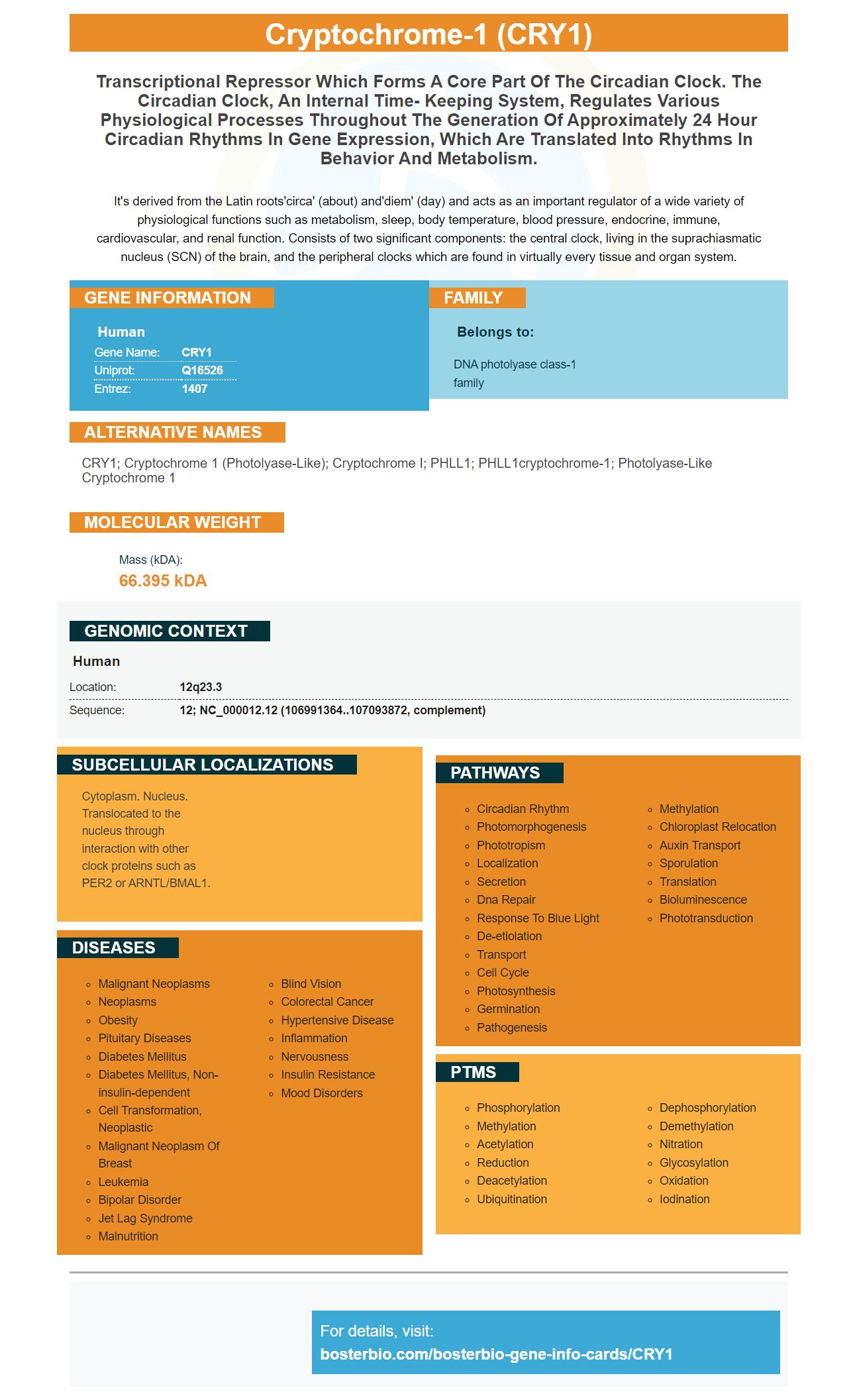
Facts about Cryptochrome-1.
It's derived from the Latin roots'circa' (about) and'diem' (day) and acts as an important regulator of a wide variety of physiological functions such as metabolism, sleep, body temperature, blood pressure, endocrine, immune, cardiovascular, and renal function. Consists of two significant components: the central clock, living in the suprachiasmatic nucleus (SCN) of the brain, and the peripheral clocks which are found in virtually every tissue and organ system.
| Human | |
|---|---|
| Gene Name: | CRY1 |
| Uniprot: | Q16526 |
| Entrez: | 1407 |

| Belongs to: |
|---|
| DNA photolyase class-1 family |

CRY1; cryptochrome 1 (photolyase-like); Cryptochrome I; PHLL1; PHLL1cryptochrome-1; photolyase-like cryptochrome 1
Mass (kDA):
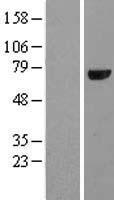
66.395 kDA

| Human | |
|---|---|
| Location: | 12q23.3 |
| Sequence: | 12; NC_000012.12 (106991364..107093872, complement) |
Cytoplasm. Nucleus. Translocated to the nucleus through interaction with other clock proteins such as PER2 or ARNTL/BMAL1.




PMID: 8909283 by Hsu D.S., et al. Putative human blue-light photoreceptors hCRY1 and hCRY2 are flavoproteins.
PMID: 8921389 by van der Spek P.J., et al. Cloning, tissue expression, and mapping of a human photolyase homolog with similarity to plant blue-light receptors.


