This website uses cookies to ensure you get the best experience on our website.


- Table of Contents
Designing a Western blot for PAK2? The guide has the expected band size, antibodies backed by real blot images, the controls to run alongside, and protocols taken from published papers.
Open the PAK2 Western Blot GuideDesigning an IHC experiment for PAK2? The guide has the expected staining pattern, antigen retrieval and fixation, antibodies backed by real IHC images, the tissue controls to run alongside, and protocols taken from published papers.
Open the PAK2 IHC Guide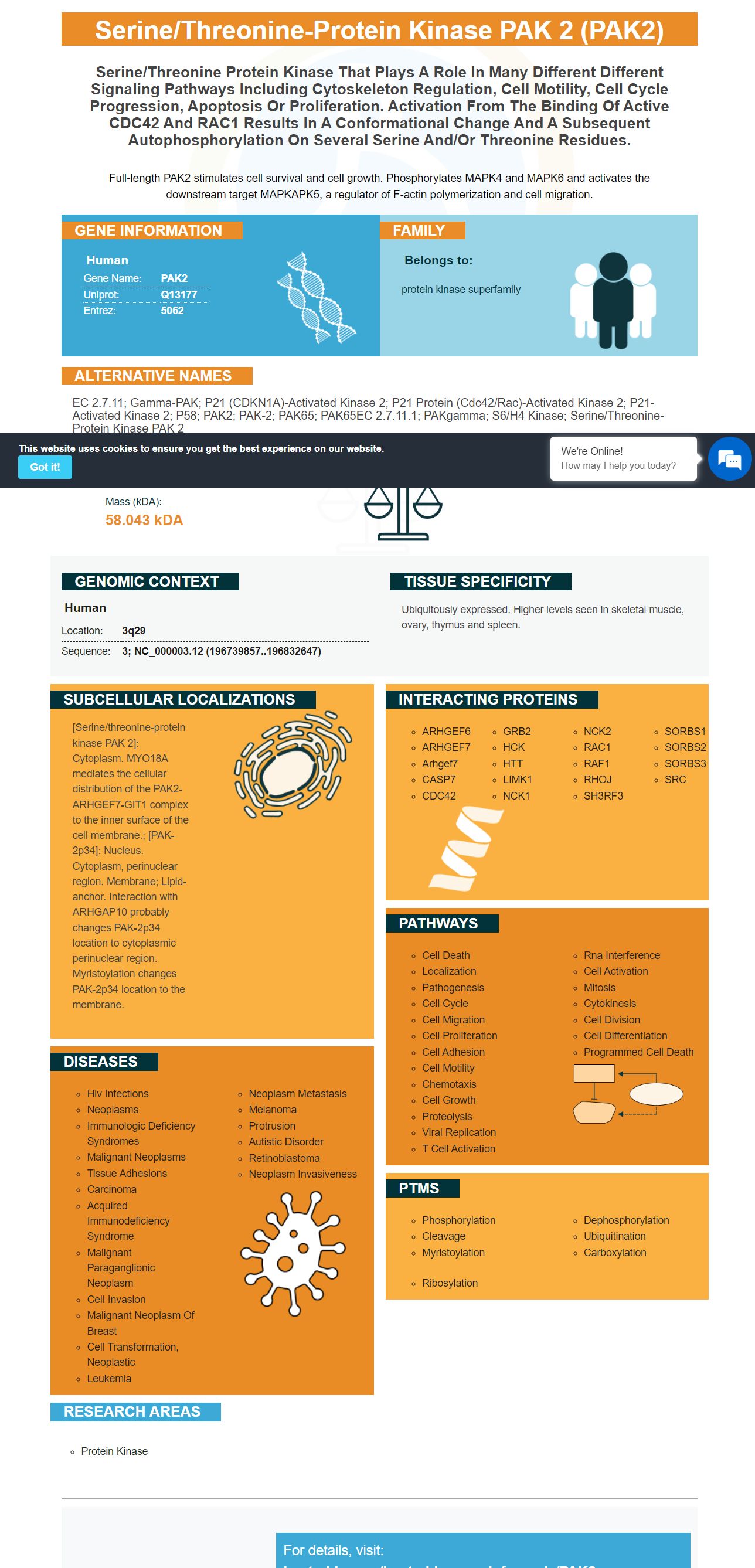



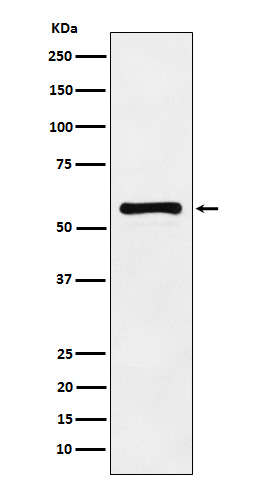
Facts about Serine/threonine-protein kinase PAK 2.
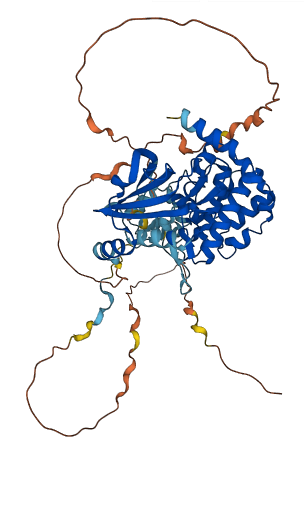
Full-length PAK2 stimulates cell survival and cell growth. Phosphorylates MAPK4 and MAPK6 and activates the downstream target MAPKAPK5, a regulator of F-actin polymerization and cell migration.
| Human | |
|---|---|
| Gene Name: | PAK2 |
| Uniprot: | Q13177 |
| Entrez: | 5062 |

| Belongs to: |
|---|
| protein kinase superfamily |

EC 2.7.11; gamma-PAK; p21 (CDKN1A)-activated kinase 2; p21 protein (Cdc42/Rac)-activated kinase 2; p21-activated kinase 2; p58; PAK2; PAK-2; PAK65; PAK65EC 2.7.11.1; PAKgamma; S6/H4 Kinase; serine/threonine-protein kinase PAK 2
Mass (kDA):
58.043 kDA

| Human | |
|---|---|
| Location: | 3q29 |
| Sequence: | 3; NC_000003.12 (196739857..196832647) |
Ubiquitously expressed. Higher levels seen in skeletal muscle, ovary, thymus and spleen.
[Serine/threonine-protein kinase PAK 2]: Cytoplasm. MYO18A mediates the cellular distribution of the PAK2-ARHGEF7-GIT1 complex to the inner surface of the cell membrane.; [PAK-2p34]: Nucleus. Cytoplasm, perinuclear region. Membrane; Lipid-anchor. Interaction with ARHGAP10 probably changes PAK-2p34 location to cytoplasmic perinuclear region. Myristoylation changes PAK-2p34 location to the membrane.






PMID: 7744004 by Martin G.A., et al. A novel serine kinase activated by rac1/CDC42Hs-dependent autophosphorylation is related to PAK65 and STE20.
PMID: 7673144 by Benner G.E., et al. Activation of an S6/H4 kinase (PAK 65) from human placenta by intramolecular and intermolecular autophosphorylation.