This website uses cookies to ensure you get the best experience on our website.


- Table of Contents
Designing an IHC experiment for Spatacsin? The guide has the expected staining pattern, antigen retrieval and fixation, antibodies backed by real IHC images, the tissue controls to run alongside, and protocols taken from published papers.
Open the SPG11 IHC Guide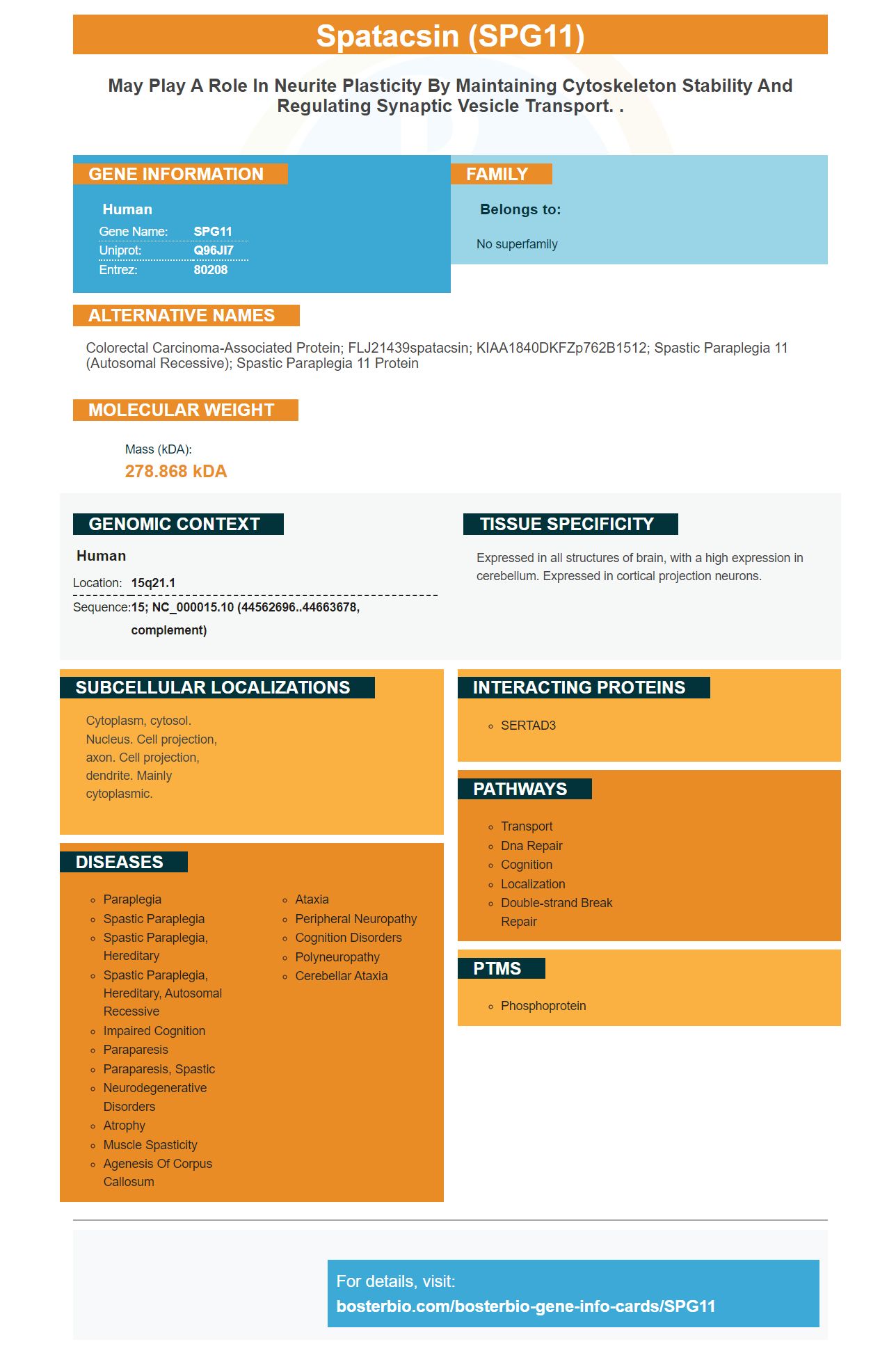
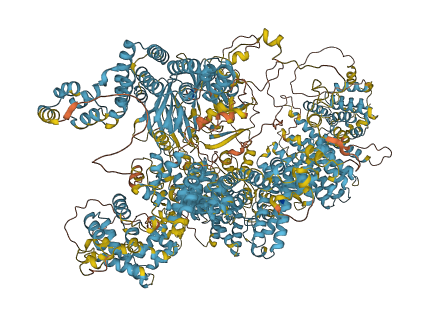
Facts about Spatacsin.
| Human | |
|---|---|
| Gene Name: | SPG11 |
| Uniprot: | Q96JI7 |
| Entrez: | 80208 |

| Belongs to: |
|---|
| No superfamily |

Colorectal carcinoma-associated protein; FLJ21439spatacsin; KIAA1840DKFZp762B1512; spastic paraplegia 11 (autosomal recessive); Spastic paraplegia 11 protein
Mass (kDA):
278.868 kDA

| Human | |
|---|---|
| Location: | 15q21.1 |
| Sequence: | 15; NC_000015.10 (44562696..44663678, complement) |
Expressed in all structures of brain, with a high expression in cerebellum. Expressed in cortical projection neurons.
Cytoplasm, cytosol. Nucleus. Cell projection, axon. Cell projection, dendrite. Mainly cytoplasmic.





PMID: 17322883 by Stevanin G., et al. Mutations in SPG11, encoding spatacsin, are a major cause of spastic paraplegia with thin corpus callosum.
PMID: 18079167 by Stevanin G., et al. Mutations in SPG11 are frequent in autosomal recessive spastic paraplegia with thin corpus callosum, cognitive decline and lower motor neuron degeneration.