This website uses cookies to ensure you get the best experience on our website.


- Table of Contents
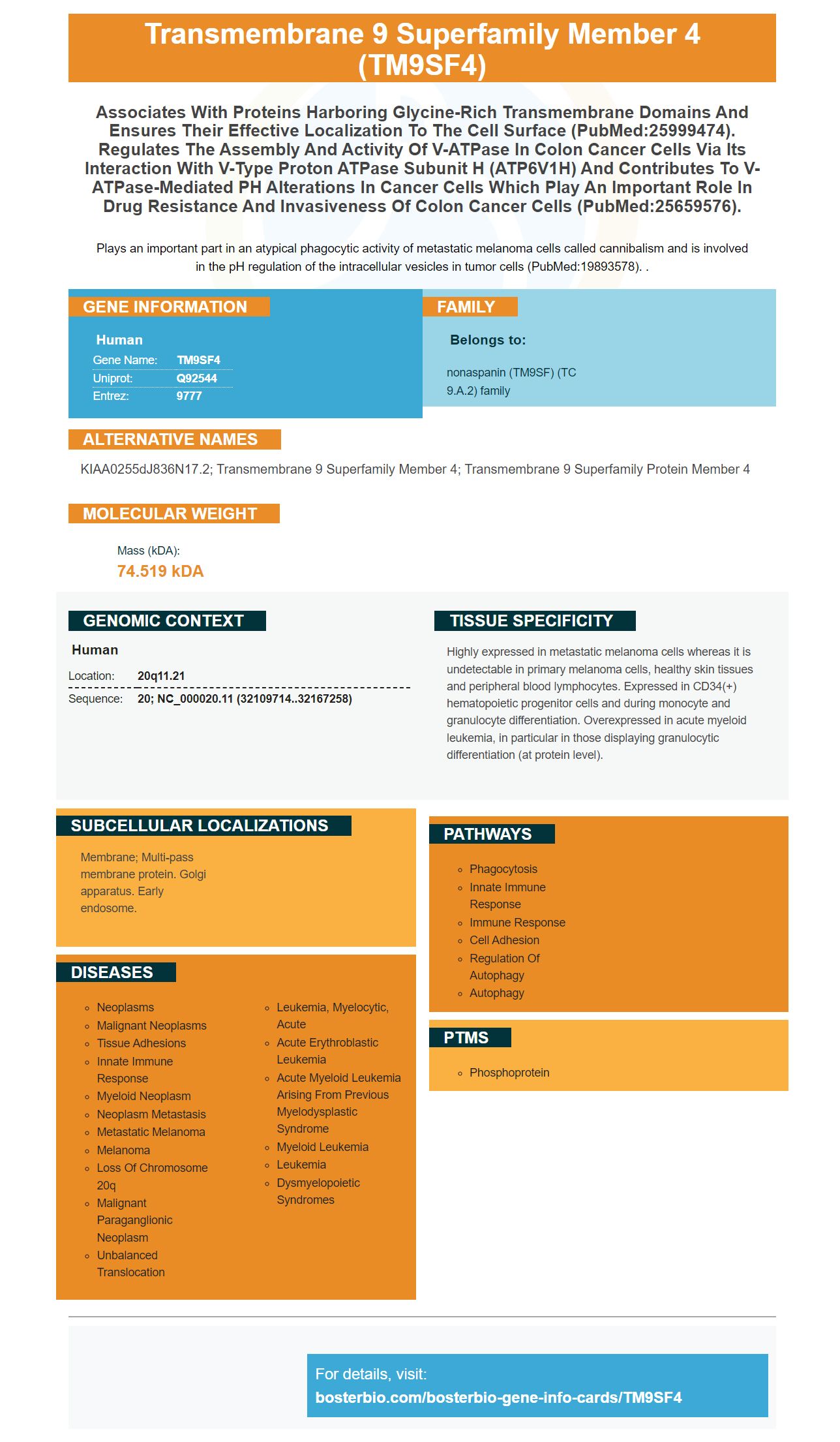
Facts about Transmembrane 9 superfamily member 4.
Plays an important part in an atypical phagocytic activity of metastatic melanoma cells called cannibalism and is involved in the pH regulation of the intracellular vesicles in tumor cells (PubMed:19893578). .
| Human | |
|---|---|
| Gene Name: | TM9SF4 |
| Uniprot: | Q92544 |
| Entrez: | 9777 |
| Belongs to: |
|---|
| nonaspanin (TM9SF) (TC 9.A.2) family |

KIAA0255dJ836N17.2; transmembrane 9 superfamily member 4; transmembrane 9 superfamily protein member 4
Mass (kDA):
74.519 kDA

| Human | |
|---|---|
| Location: | 20q11.21 |
| Sequence: | 20; NC_000020.11 (32109714..32167258) |
Highly expressed in metastatic melanoma cells whereas it is undetectable in primary melanoma cells, healthy skin tissues and peripheral blood lymphocytes. Expressed in CD34(+) hematopoietic progenitor cells and during monocyte and granulocyte differentiation. Overexpressed in acute myeloid leukemia, in particular in those displaying granulocytic differentiation (at protein level).
Membrane; Multi-pass membrane protein. Golgi apparatus. Early endosome.




PMID: 19893578 by Lozupone F., et al. The human homologue of Dictyostelium discoideum phg1A is expressed by human metastatic melanoma cells.
PMID: 25999474 by Perrin J., et al. TM9 family proteins control surface targeting of glycine-rich transmembrane domains.