CXCR4 · Western blot design guide

CXCR4 Western Blot Planning Guide

Plan a CXCR4 Western blot around the catalog-observed 39.7 kDa band, image-backed A00031 evidence, HPA controls, and verified protocol records.
Evidence assembled July 2026 · For research use; verify linked source records and product datasheet before use
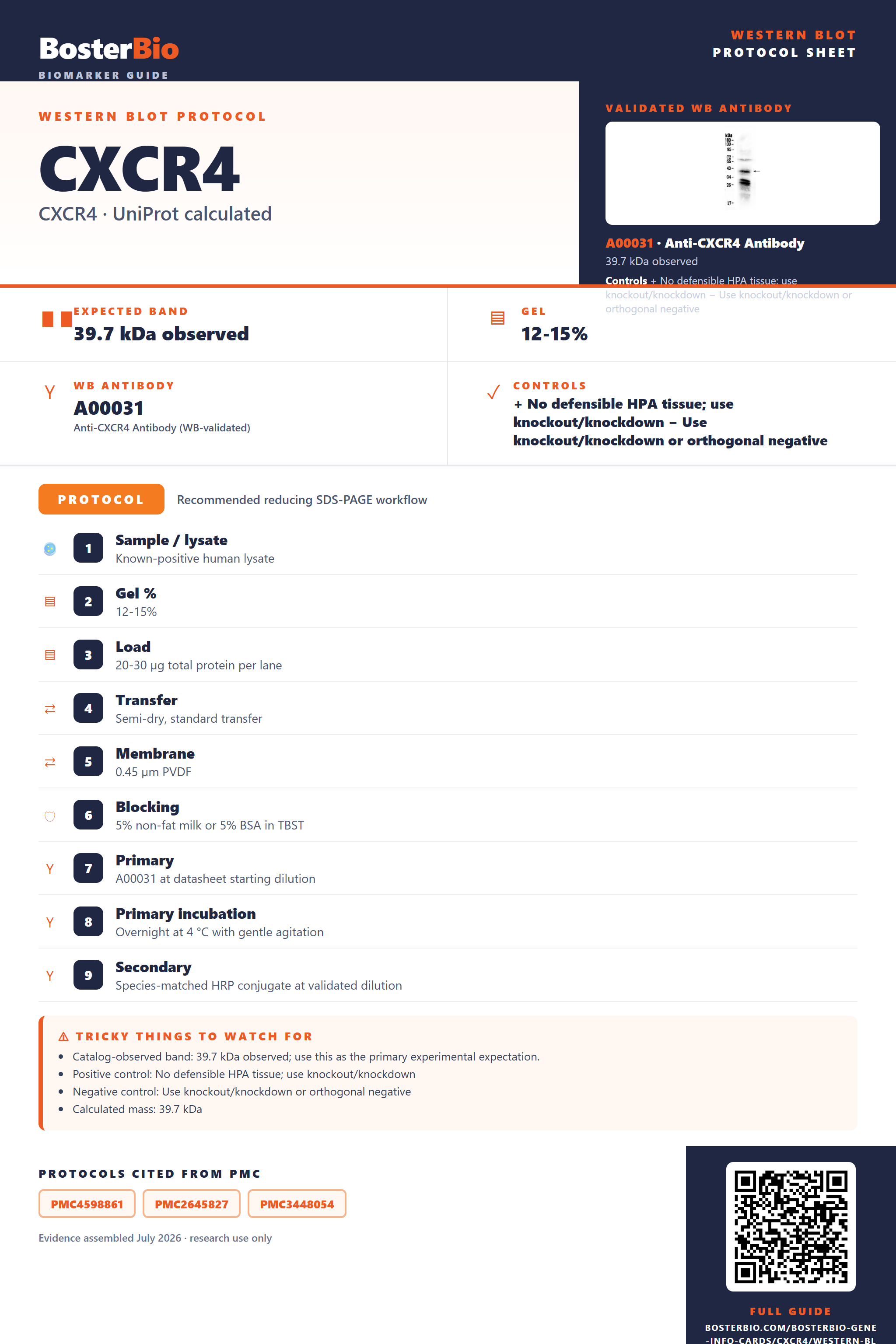
Western blot protocol sheet for CXCR4: expected band 39.7 kDa observed, antibody A00031, and PMC-cited SDS-PAGE protocol steps
CXCR4 Western blot protocol sheet — expected band 39.7 kDa observed, antibody A00031, controls and PMC citations. Open the full CXCR4 WB guide →

CXCR4 Western Blot Experimental Design Guide

Expected bands, validated protocols, controls and antibodies — the at-a-glance facts below, then the full design guide.

Must know before running
Expected band 39.7 kDa observed
Observed band 39.7 kDa observed
Gel 12-15%
Positive control ⓘ No defensible HPA tissue; use knockout/knockdown
Negative control ⓘ Use knockout/knockdown or orthogonal negative
Important caveats
Reasons your observed band may differ from the expected size.
ⓘ Calculated mass 39.7 kDa
ⓘ Localization Cell membrane / Cell junction
ⓘ Processing / PTM Record-dependent
ⓘ Reactivity Human / Mouse / Rat
Section 1

Real Curated CXCR4 Western Blot Protocols

Start with the molecular-weight rule, then compare verified publication-derived conditions.

Recommended Western blot protocol parameters
Sample / lysateKnown-positive human lysate
Gel %12-15%
Load20-30 µg total protein per lane
TransferSemi-dry, standard transfer
Membrane0.45 µm PVDF
Blocking5% non-fat milk or 5% BSA in TBST
PrimaryA00031 at datasheet starting dilution
Primary incubationOvernight at 4 °C with gentle agitation
SecondarySpecies-matched HRP conjugate at validated dilution
Wash3 × 5 min in TBST
DetectionChemiluminescent substrate
ExposureBracket exposures to avoid saturation
Section 2

What Is the Expected CXCR4 Western Blot Band Size?

Use the product-observed 39.7 kDa band as the primary planning value and retain the UniProt calculated mass as context.

What am I looking at on my blot?
39.7 kDaMatches the authoritative product WB observation.
39.7 kDa calculatedUse as UniProt context, not as a replacement observed band.
Unexpected additional signalDo not assign identity without orthogonal positive/negative controls.
💡Expected CXCR4 appearancePlan around 39.7 kDa and keep the calculated mass as supporting context.
How each factor affects band size
Catalog-observed band39.7 kDa; use this as the primary experimental expectation.
Calculated mass39.7 kDa from UniProt P61073; retain as context.
Gel selection12-15%; shared with the recommended protocol and poster.
Specificity checkCompare the lead HPA positive and negative controls with A00031.
Why is my band missing or off?
SituationLikely causeNext action
39.7 kDaMatches the authoritative product WB observation.Confirm with orthogonal controls and the linked product record.
Additional bandMay reflect processing, modification, or non-specific signal.Run a dilution series and compare positive/negative controls.
Weak signalTarget abundance or transfer may be limiting.Verify transfer, increase positive-control abundance, and bracket exposure.

Sample controls for CXCR4 Western blot

🧪No defensible HPA positive control was available; do not invent one.
HPA protein score determines control status; other expression data is supporting context only.

HPA tissue expression evidence for CXCR4

Comprehensive Human Protein Atlas IHC scoring per tissue. Rows are taken directly from the HPA tissue chart — click any row's HPA link to view the source.

Positive expression · recommended positive controls

TissueCell typeLevelEvidenceSource

Undetected expression · recommended negative controls

TissueCell typeLevelEvidenceSource
Section 3

Advanced CXCR4 Western Blot Tips

Deeper troubleshooting and optimisation questions for CXCR4, answered from its protein features.

Which band should guide the blot?
Use 39.7 kDa, the observation attached to the authoritative A00031 WB record.
How should calculated mass be interpreted?
Treat the UniProt calculated mass as context; it does not replace the catalog-observed 39.7 kDa expectation.
Which positive control should I start with?
No defensible positive tissue was supplied; do not invent one.
Which negative control is defensible?
Use a target knockdown/knockout control when no HPA Not detected tissue is available.
Which gel should I use?
Use 12-15% consistently across the quick facts, protocol table, and poster.
What transfer method to use for CXCR4 Western blot?
Use the transfer method in the recommended protocol and verify transfer before blocking.
How should A00031 be started?
Start at the linked datasheet condition and run a three-point primary-antibody dilution test.
Which publication-derived protocols can I compare?
No verified publication protocol was supplied; use only the deterministic recommended protocol.
Boster reagents

CXCR4 Western Blot Reagents

Human/Mouse/Rat-reactive CXCR4 Western blot reagents with authoritative product imagery.
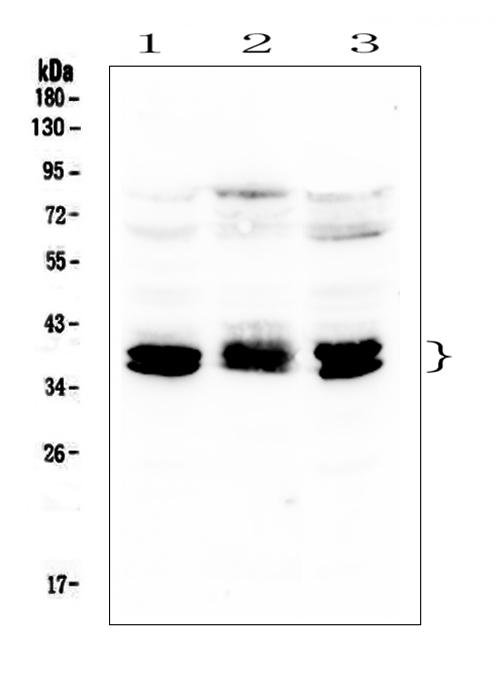
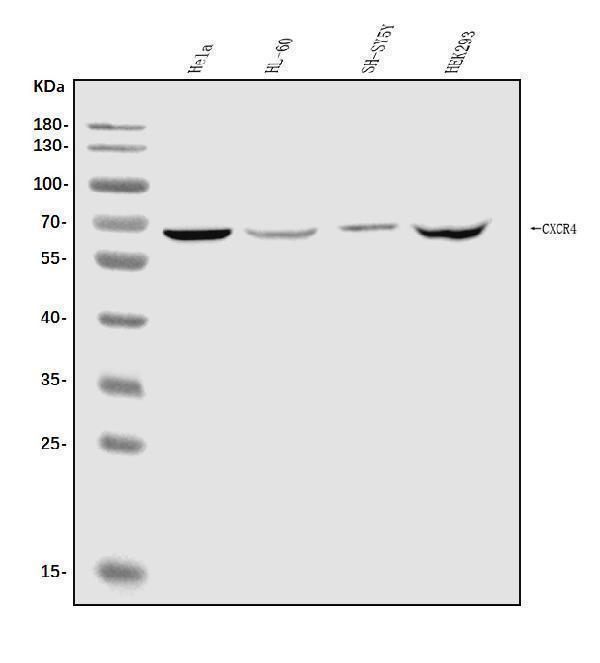
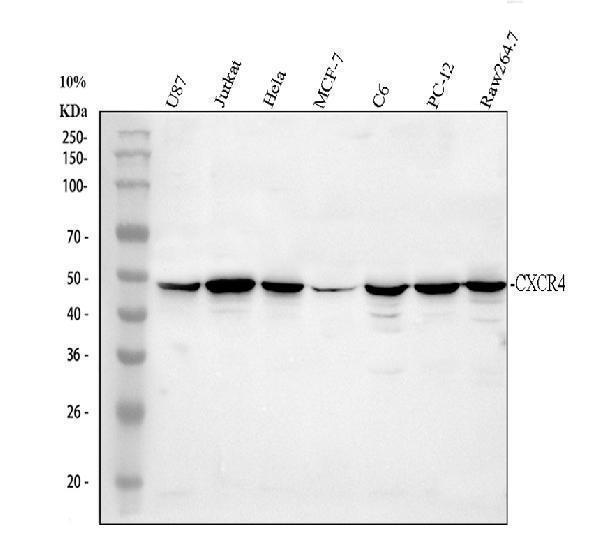
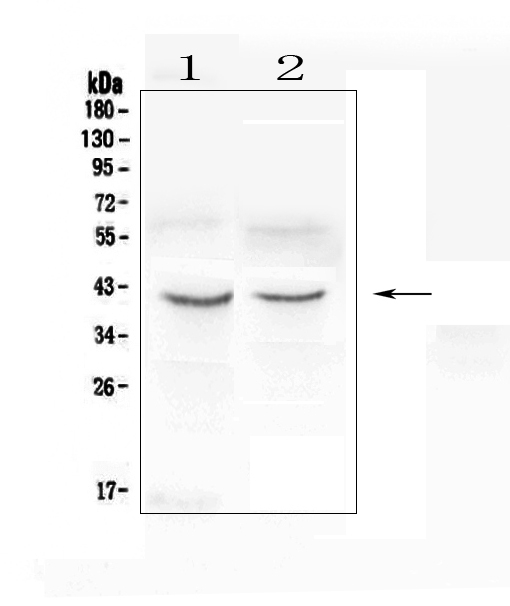
Real WB data Western blot validation image for CXCR4 using A00031; observed band 39.7 kDa
Anti-CXCR4 Antibody Picoband®
Cat # A00031
Real WB data Western blot validation image for CXCR4 using A00031-2; observed band 39.7 kDa
Anti-CXCR4 Antibody Picoband®
Cat # A00031-2
Real WB data Western blot validation image for CXCR4 using A00031-3; observed band 39.7 kDa
Anti-CXCR4 Antibody Picoband®
Cat # A00031-3
Real WB data Western blot validation image for CXCR4 using A00031-4; observed band 39.7 kDa
Anti-CXCR4 Antibody Picoband®
Cat # A00031-4
Real WB data Western blot validation image for CXCR4 using PA1237; observed band 39.7 kDa
Anti-CXCR4 Antibody Picoband®
Cat # PA1237
Real WB data Western blot validation image for CXCR4 using PA2081; observed band 39.7 kDa
Anti-CXCR4 Antibody Picoband®
Cat # PA2081

Only image-backed, WB-validated Human/Mouse/Rat recommendations from the prepared catalog evidence are shown.

Source: prepared picoband-wb product evidence; each card retains its own SKU, URL, observed band, and authoritative WB image.

References

  1. UniProt P61073
  2. A00031 product record
  3. PMC4598861 — EZH2-mediated loss of miR-622 determines CXCR4 activation in hepatocellular carcinoma (Nature communications, 2015)
  4. PMC2645827 — Deubiquitination of CXCR4 by USP14 is critical for both CXCL12-induced CXCR4 degradation and chemotaxis but not ERK ativation (The Journal of biological chemistry, 2009)
  5. PMC3448054 — Inhibition of stromal CXCR4 impairs development of lung metastases (Cancer immunology, immunotherapy : CII, 2012)