This website uses cookies to ensure you get the best experience on our website.


- Table of Contents
Designing a Western blot for Polyubiquitin-B? The guide has the expected band size, antibodies backed by real blot images, the controls to run alongside, and protocols taken from published papers.
Open the UBB Western Blot GuideDesigning an IHC experiment for Polyubiquitin-B? The guide has the expected staining pattern, antigen retrieval and fixation, antibodies backed by real IHC images, the tissue controls to run alongside, and protocols taken from published papers.
Open the UBB IHC Guide
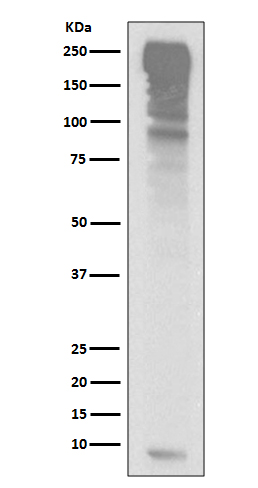


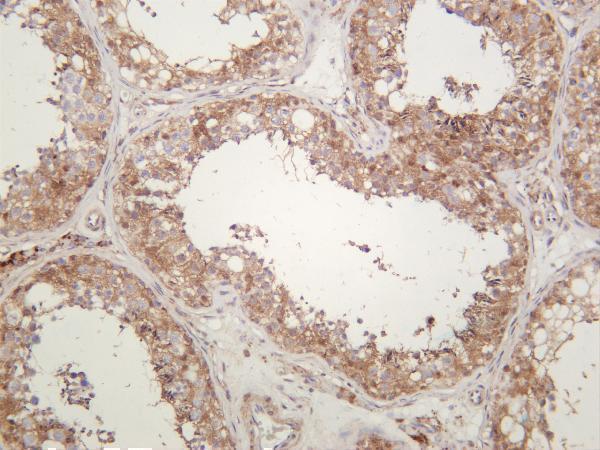
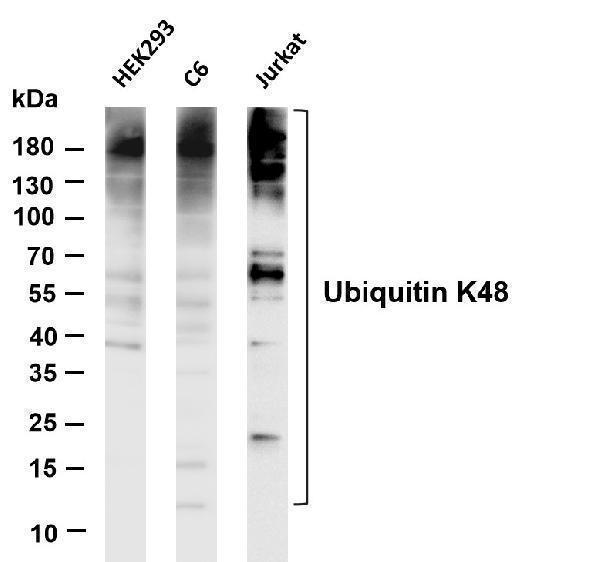
Facts about Polyubiquitin-B.
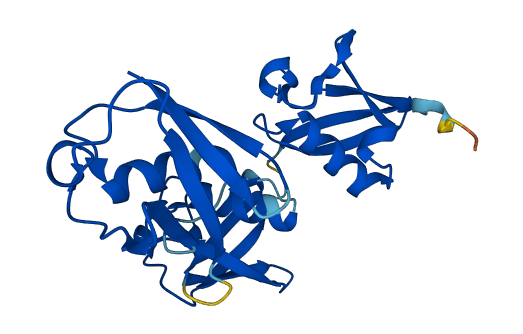
Polyubiquitin chains, when attached to a target protein, have different functions depending on the Lys residue of the ubiquitin that is linked: Lys-6-linked may be involved in DNA repair; Lys-11-linked is involved in ERAD (endoplasmic reticulum-associated degradation) and in cell-cycle regulation; Lys-29-linked is involved in lysosomal degradation; Lys-33-linked is involved in kinase modification; Lys-48-linked is involved in protein degradation via the proteasome; Lys-63-linked is involved in endocytosis, DNA-damage responses as well as in signaling processes leading to activation of the transcription factor NF-kappa-B. Linear polymer chains formed via attachment by the initiator Met lead to cell signaling.
| Human | |
|---|---|
| Gene Name: | UBB |
| Uniprot: | P0CG47 |
| Entrez: | 7314 |
| Belongs to: |
|---|
| ubiquitin family |

RPS27A; UBA52; UBB ubiquitin B; UBB; UBC; Ubiquitin
Mass (kDA):
25.762 kDA

| Human | |
|---|---|
| Location: | 17p11.2 |
| Sequence: | 17; NC_000017.11 (16380793..16382745) |
[Ubiquitin]: Cytoplasm. Nucleus.


PMID: 3029682 by Baker R.T., et al. The human ubiquitin gene family: structure of a gene and pseudogenes from the Ub B subfamily.
PMID: 14745543 by Tachikui H., et al. Lineage-specific homogenization of the polyubiquitin gene among human and great apes.
*More publications can be found for each product on its corresponding product page