

Click image to see more details
Product Info Summary
| SKU: | A02387 |
|---|---|
| Size: | 100ug |
| Reactive Species: | Human |
| Host: | Rabbit |
| Application: | ELISA, WB |
Customers Who Bought This Also Bought

Product info
Product Name
Anti-Fanconi anemia group C protein FANCC Antibody
SKU/Catalog Number
A02387
Size
100ug
Form
Liquid (sterile filtered)
Description
Boster Bio Anti-Fanconi anemia group C protein FANCC Antibody (Catalog # A02387). Tested in ELISA, WB applications. This antibody reacts with Human.
Storage & Handling
Store vial at -20°C prior to opening. Aliquot contents and freeze at -20°C or below for extended storage. Avoid cycles of freezing and thawing. Centrifuge product if not completely clear after standing at room temperature. This product is stable for several weeks at 4°C as an undiluted liquid. Dilute only prior to immediate use. Expiration date is one (1) year from date of opening. (Ship on dry ice.)
Cite This Product
Anti-Fanconi anemia group C protein FANCC Antibody (Boster Biological Technology, Pleasanton CA, USA, Catalog # A02387)
Host
Rabbit
Contents
0.02 M Potassium Phosphate, 0.15 M Sodium Chloride, pH 7.2, 0.01% (w/v) Sodium Azide
Clonality
Polyclonal
Isotype
IgG
Immunogen
This affinity purified antibody was prepared from whole rabbit serum produced by repeated immunizations with a synthetic peptide corresponding to an internal region near amino acids 80-115 of Human FANCC.
Cross-reactivity
No cross reactivity with other proteins.
Reactive Species
A02387 is reactive to FANCC in Human
Calculated molecular weight
63.4 kDa
Background of FANCC
FANCC (also called Protein FACC or Fanconi Anemia Group C protein) is involved in DNA repair, perhaps specifically with post-replication repair or a cell cycle checkpoint function. FANCC may also be implicated in interstrand DNA cross-link repair and in the maintenance of normal chromosome stability. FANCC belongs to the multi-subunit Fanconi Anemia (FA) complex composed of FANCA, FANCB, FANCC, FANCE, FANCF, FANCG, FANCL/PHF9 and FANCM. FANCC is mainly found within the nucleus although some protein is localized in the cytoplasm. This protein is ubiquitously expressed. Defects in FANCC are a cause of Fanconi anemia (FA). FA is a genetically heterogeneous, autosomal recessive disorder characterized by cytogenetic instability, hypersensitivity to DNA crosslinking agents, increased chromosomal breakage, and defective DNA repair. The members of the Fanconi anemia complementation group do not share sequence similarity; they are related by their assembly into a common nuclear protein complex. This gene encodes the protein for complementation group C.
Antibody Validation
Boster validates all antibodies on WB, IHC, ICC, Immunofluorescence, and ELISA with known positive control and negative samples to ensure specificity and high affinity, including thorough antibody incubations.
Application & Images
Applications
A02387 is guaranteed for ELISA, WB Boster Guarantee
Recommend Dilution
| Application | Dilution | Species |
|---|---|---|
| ELISA: 1:20 | 000 - 1:80 | 000 |
| WB: 1:1 | 000 - 1:3 | 000 |
Validation Images & Assay Conditions
Click image to see more details
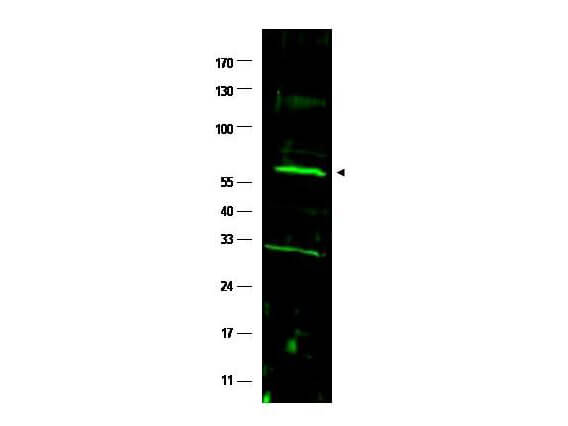
Western blot using Boster's affinity purified anti-FANCC antibody shows detection of a band at ~63 kDa (arrowhead) corresponding to FANCC present in a HeLa whole cell lysate . The identity of the lower molecular weight band is unknown. Approximately 35µg of lysate was separated by 4-20% Tris Glycine SDS-PAGE. After blocking, the membrane was probed overnight at 4°C with the primary antibody diluted to 1:1,500 in PBS supplemented with 1% normal goat serum and 0.1% BLOTTO . The membrane was washed and reacted with a 1:10,000 dilution of IRDye™800 conjugated Gt-a-Rabbit IgG [H&L] for 45 min at room temperature (800 nm channel, green). Molecular weight estimation was made by comparison to prestained MW markers (indicated at left). IRDye™800 fluorescence image was captured using the Odyssey® Infrared Imaging System developed by LI-COR. IRDye is a trademark of LI-COR, Inc. Other detection systems will yield similar results.
Specific Publications For Anti-Fanconi anemia group C protein FANCC Antibody (A02387)
Loading publications
Recommended Resources
Here are featured tools and databases that you might find useful.
- Boster's Pathways Library
- Protein Databases
- Bioscience Research Protocol Resources
- Data Processing & Analysis Software
- Photo Editing Software
- Scientific Literature Resources
- Research Paper Management Tools
- Molecular Biology Software
- Primer Design Tools
- Bioinformatics Tools
- Phylogenetic Tree Analysis
Customer Reviews
Have you used Anti-Fanconi anemia group C protein FANCC Antibody?
Share your experimental results or join a short interview to earn up to $1,000 in product credits or other rewards.
0 Reviews For Anti-Fanconi anemia group C protein FANCC Antibody
Customer Q&As
Have a question?
Find answers in Q&As, reviews.
Can't find your answer?
Submit your question
6 Customer Q&As for Anti-Fanconi anemia group C protein FANCC Antibody
Question
Thank you for helping with my inquiry over the phone. Here are the WB image, lot number and protocol we used for lung using anti-FANCC antibody A02387. Let me know if you need anything else.
Verified Customer
Verified customer
Asked: 2019-05-14
Answer
We appreciate the data. You have provided everything we needed. Our lab team are working to resolve your inquiry as quickly as possible, and we appreciate your patience and understanding! Please let me know if there is anything you need in the meantime.
Boster Scientific Support
Answered: 2019-05-14
Question
I was wanting to use your anti-FANCC antibody for WB for human lung on frozen tissues, but I want to know if it has been validated for this particular application. Has this antibody been validated and is this antibody a good choice for human lung identification?
Verified Customer
Verified customer
Asked: 2018-10-22
Answer
As indicated on the product datasheet, A02387 anti-FANCC antibody has been validated for WB on human tissues. We have an innovator award program that if you test this antibody and show it works in human lung in IHC-frozen, you can get your next antibody for free.
Boster Scientific Support
Answered: 2018-10-22
Question
Would anti-FANCC antibody A02387 work for WB with lung?
E. Williams
Verified customer
Asked: 2018-01-04
Answer
According to the expression profile of lung, FANCC is highly expressed in lung. So, it is likely that anti-FANCC antibody A02387 will work for WB with lung.
Boster Scientific Support
Answered: 2018-01-04
Question
Does A02387 anti-FANCC antibody work on parafin embedded sections? If so, which fixation method do you recommend we use (PFA, paraformaldehyde, other)?
Verified Customer
Verified customer
Asked: 2017-08-28
Answer
As indicated on the product datasheet, A02387 anti-FANCC antibody as been validated on WB. It is best to use PFA for fixation because it has better tissue penetration ability. PFA needs to be prepared fresh before use. Long term stored PFA turns into formalin, as the PFA molecules congregate and become formalin.
Boster Scientific Support
Answered: 2017-08-28
Question
I see that the anti-FANCC antibody A02387 works with WB, what is the protocol used to produce the result images on the product page?
S. Thomas
Verified customer
Asked: 2016-09-16
Answer
You can find protocols for WB on the "support/technical resources" section of our navigation menu. If you have any further questions, please send an email to support@bosterbio.com
Boster Scientific Support
Answered: 2016-09-16
Question
We are currently using anti-FANCC antibody A02387 for human tissue, and we are well pleased with the WB results. The species of reactivity given in the datasheet says human. Is it likely that the antibody can work on pig tissues as well?
H. Krishna
Verified customer
Asked: 2015-06-05
Answer
The anti-FANCC antibody (A02387) has not been tested for cross reactivity specifically with pig tissues, though there is a good chance of cross reactivity. We have an innovator award program that if you test this antibody and show it works in pig you can get your next antibody for free. Please contact me if I can help you with anything.
Boster Scientific Support
Answered: 2015-06-05

