

Click image to see more details
Product Info Summary
| SKU: | A01634-2 |
|---|---|
| Size: | 100 μl/vial |
| Reactive Species: | Human, Mouse, Rat |
| Host: | Rabbit |
| Application: | ELISA, IP, IF, IHC, WB |
Customers Who Bought This Also Bought

Product info
Product Name
Anti-Galc Antibody
SKU/Catalog Number
A01634-2
Size
100 μl/vial
Form
Liquid
Description
Boster Bio Anti-Galc Antibody catalog # A01634-2. Tested in WB, IHC, IF, IP, ELISA applications. This antibody reacts with Human, Mouse, Rat.
Storage & Handling
12 months from date of receipt,-20℃ as supplied. 6 months 2 to 8℃ after reconstitution. Avoid repeated freezing and thawing.
Cite This Product
Anti-Galc Antibody (Boster Biological Technology, Pleasanton CA, USA, Catalog # A01634-2)
Host
Rabbit
Contents
500 μg/ml antibody with PBS, 0.02% NaN3, 1 mg stabilizing protein and 50% glycerol
*This antibody is supplied in a stabilized formulation.
Compatibility with conjugation reactions depends on the chemistry of the conjugation method used.
For conjugation methods that are not compatible with the stabilizing components present in this formulation, a carrier-free antibody format is required.
Clonality
Polyclonal
Immunogen
E.coli-derived mouse Galc recombinant protein (Position: L342-R510).
Reactive Species
A01634-2 is reactive to Galc in Human, Mouse, Rat
Calculated molecular weight
77.3 kDa
Background of Galc
The GALC antibody targets the liposomal enzyme Galactosylceramidase (GALC), which belongs to the glycosyl hydrolase 59 family. It hydrolyzes the galactose ester bonds of galactosylceramide, galactosylsphingosine, lactosylceramide, and monogalactosyldiglyceride. It is primarily found in the brain and kidneys where galactolipids are hydrolyzed (PMID:8634707). Deficiencies of GALC are primarily associated with the autosomal recessive Krabbe's disease. This disease is characterized by developmental delay caused by apoptosis of myelin-forming cells. GALC is responsible for hydrolyzing galactosylceramide, a cerebroside that is an important component of myelin. A deficiency in GALC causes loss of myelin to nerve cells, resulting in delayed nerve transmissions. Krabbe's disease has varying degrees of severity due to a large number of different genetic mutations in the gene. The GALC antibody can be used to detect the deletions in the GALC gene and functions of the enzyme (PMID:20886637). Normal GALC mRNA encodes the 80 kDa precursor, which is processed into 50 and 30 kDa subunits (PMID: 26865610).
Antibody Validation
Boster validates all antibodies on WB, IHC, ICC, Immunofluorescence, and ELISA with known positive control and negative samples to ensure specificity and high affinity, including thorough antibody incubations.
Application & Images
Applications
A01634-2 is guaranteed for ELISA, IP, IF, IHC, WB Boster Guarantee
Recommend Dilution
| Application | Dilution | Species |
|---|---|---|
| Western blot | 1:500-2000 | |
| Immunohistochemistry | 1:50-400 | |
| Immunofluorescence | 1:50-400 | |
| ImmunoPrecipitation | 1:250-300 | |
| ELISA | 1:100-1000 |
Tested application
Suggested blocking solution with 5% non-fat milk or BSA; (*)Recommended protein loading: 20-40 µg per lane
Validation Images & Assay Conditions
Click image to see more details
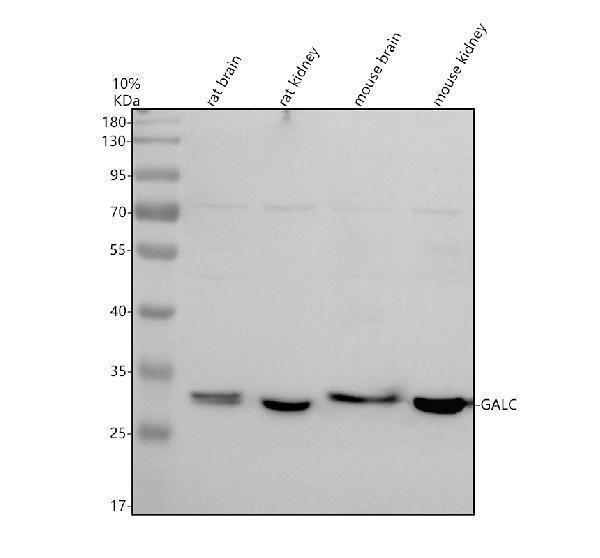
Western blot analysis of Galc using anti-Galc antibody (A01634-2).
Electrophoresis was performed on a 10% SDS-PAGE gel at 80V (Stacking gel) / 120V (Resolving gel) for 2 hours. The sample well of each lane was loaded with 30 ug of sample under reducing conditions.
Lane 1: rat brain tissue lysates,
Lane 2: rat kidney tissue lysates,
Lane 3: mouse brain tissue lysates,
Lane 4: mouse kidney tissue lysates.
After electrophoresis, proteins were transferred to a nitrocellulose membrane at 150 mA for 50-90 minutes. Blocked the membrane with 5% non-fat milk/TBS for 1.5 hour at RT. The membrane was incubated with rabbit anti-Galc antigen affinity purified polyclonal antibody (A01634-2) at 1:1000 overnight at 4°C, then washed with TBS-0.1%Tween 3 times with 5 minutes each and probed with a goat anti-rabbit IgG-HRP secondary antibody at a dilution of 1:5000 for 1.5 hour at RT. The signal is developed using an ECL Plus Western Blotting Substrate (Catalog # AR1196-200) with Tanon 5200 system. A specific band was detected for Galc at approximately 30 kDa. The expected band size for Galc is at 77 kDa.
Specific Publications For Anti-Galc Antibody (A01634-2)
Loading publications
Recommended Resources
Here are featured tools and databases that you might find useful.
- Boster's Pathways Library
- Protein Databases
- Bioscience Research Protocol Resources
- Data Processing & Analysis Software
- Photo Editing Software
- Scientific Literature Resources
- Research Paper Management Tools
- Molecular Biology Software
- Primer Design Tools
- Bioinformatics Tools
- Phylogenetic Tree Analysis
Customer Reviews
Have you used Anti-Galc Antibody?
Share your experimental results or join a short interview to earn up to $1,000 in product credits or other rewards.
0 Reviews For Anti-Galc Antibody
Customer Q&As
Have a question?
Find answers in Q&As, reviews.
Can't find your answer?
Submit your question

