

Click image to see more details
Product Info Summary
| SKU: | A00524 |
|---|---|
| Size: | 100uL |
| Reactive Species: | Human |
| Host: | Rabbit |
| Application: | ELISA, IHC, WB |
Customers Who Bought This Also Bought

Product info
Product Name
Anti-ROC1 RBX1 Antibody
SKU/Catalog Number
A00524
Size
100uL
Form
Liquid (sterile filtered)
Description
Boster Bio Anti-ROC1 RBX1 Antibody (Catalog # A00524). Tested in WB applications. This antibody reacts with Human.
Storage & Handling
Store vial at -20°C prior to opening. Aliquot contents and freeze at -20°C or below for extended storage. Avoid cycles of freezing and thawing. Centrifuge product if not completely clear after standing at room temperature. This product is stable for several weeks at 4°C as an undiluted liquid. Dilute only prior to immediate use. Expiration date is one (1) year from date of opening. (Ship on dry ice.)
Cite This Product
Anti-ROC1 RBX1 Antibody (Boster Biological Technology, Pleasanton CA, USA, Catalog # A00524)
Host
Rabbit
Contents
0.01% (w/v) Sodium Azide
Clonality
Polyclonal
Isotype
Antiserum
Immunogen
This antibody was prepared from whole rabbit serum produced by repeated immunizations with a synthetic peptide corresponding to amino acids 94-108 of Human ROC1 (C-terminal) coupled to KLH.
Cross-reactivity
No cross reactivity with other proteins.
Reactive Species
A00524 is reactive to RBX1 in Human
Observed Molecular Weight
39 kDa
Calculated molecular weight
12.3 kDa
Background of RBX1
ROC1 also known as RING-box protein 1, Rbx1, Regulator of cullins 1, RING finger protein 75, and ZYP protein, is a component of the SCF (SKP1-CUL1-F-box protein) and the CBC(VHL) (CUL2-elonging BC-VHL) E3 ubiquitin ligase complexes, which mediate the ubiquitination and subsequent proteasomal degradation of target proteins involved in cell cycle progression, signal transduction and transcription. ROC1 appears to recruit the E2 ubiquitination enzyme through the RING-type zinc finger in a manner similar to CDC34, and brings it into close proximity to the substrate. The RING-type zinc finger domain is essential for ubiquitin ligase activity. ROC1 probably also stimulates CDC34 autoubiquitination and promotes the neddylation of CUL1 and probably CUL2. ROC1 has a cytoplasmic and nuclear localization and is widely expressed in most tissues.
Antibody Validation
Boster validates all antibodies on WB, IHC, ICC, Immunofluorescence, and ELISA with known positive control and negative samples to ensure specificity and high affinity, including thorough antibody incubations.
Application & Images
Applications
A00524 is guaranteed for ELISA, IHC, WB Boster Guarantee
Recommend Dilution
| Application | Dilution | Species |
|---|---|---|
| ELISA: 1:2 | 000 - 1:10 | 000 |
| WB: 1:500 - 1:1 | 000 | |
| This antibody reacts with human ROC1 by western blot and immunoprecipitation. The antibody immunoprecipitates in vitro translated protein and protein from overexpressing cell lysates (using HeLa and NIH-3T3 | and others). Coimmunoprecipitation of related cullin proteins does occur. Coimmunoprecipitation of ubiquitin ligase activity will also occur. A 12.2 kDa band corresponding to human ROC1 is detected. Most cell lines expressing ROC1 can be used as a positive control. Researchers should determine optimal titers for other applications. |
Validation Images & Assay Conditions
Click image to see more details
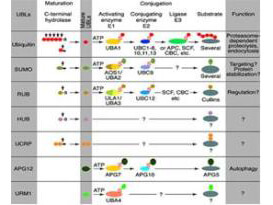
Most modifiers mature by proteolytic processing from inactive precursors (a; amino acid). Arrowheads point to the cleavage sites. Ubiquitin is expressed either as polyubiquitin or as a fusion with ribosomal proteins. Conjugation requires activating (E1) and conjugating (E2) enzymes that form thiolesters (S) with the modifiers. Modification of cullins by RUB involves SCF(SKP1/cullin-1/F-box protein) /CBC(cullin-2/elongin B/elonginC) -like E3 enzymes that are also involved in ubiquitination. In contrast to ubiquitin, the UBLs do not seem to form multi-UBL chains. UCRP(ISG15) resembles two ubiquitin moieties linked head-to-tail. Whether HUB1 functions as a modifier is currently unclear. APG12 and URM1 are distinct from the other modifiers because they are unrelated in sequence to ubiquitin. Data contributed by S.Jentsch.
Specific Publications For Anti-ROC1 RBX1 Antibody (A00524)
Loading publications
Recommended Resources
Here are featured tools and databases that you might find useful.
- Boster's Pathways Library
- Protein Databases
- Bioscience Research Protocol Resources
- Data Processing & Analysis Software
- Photo Editing Software
- Scientific Literature Resources
- Research Paper Management Tools
- Molecular Biology Software
- Primer Design Tools
- Bioinformatics Tools
- Phylogenetic Tree Analysis
Customer Reviews
Have you used Anti-ROC1 RBX1 Antibody?
Share your experimental results or join a short interview to earn up to $1,000 in product credits or other rewards.
0 Reviews For Anti-ROC1 RBX1 Antibody
Customer Q&As
Have a question?
Find answers in Q&As, reviews.
Can't find your answer?
Submit your question

