

Click image to see more details
Product Info Summary
| SKU: | A19764 |
|---|---|
| Size: | 500ug |
| Reactive Species: | Human |
| Host: | Rabbit |
| Application: | ELISA, WB |
Customers Who Bought This Also Bought

Product info
Product Name
Anti-SUMO SUMO1P1 Antibody
SKU/Catalog Number
A19764
Size
500ug
Form
Lyophilized
Description
Boster Bio Anti-SUMO SUMO1P1 Antibody (Catalog # A19764). Tested in WB applications. This antibody reacts with Human.
Storage & Handling
Store vial at 4°C prior to restoration. For extended storage aliquot contents and freeze at -20°C or below. Avoid cycles of freezing and thawing. Centrifuge product if not completely clear after standing at room temperature. This product is stable for several weeks at 4°C as an undiluted liquid. Dilute only prior to immediate use. Expiration date is one (1) year from date of opening. (Ship at ambient temperature.)
Cite This Product
Anti-SUMO SUMO1P1 Antibody (Boster Biological Technology, Pleasanton CA, USA, Catalog # A19764)
Host
Rabbit
Contents
0.02 M Potassium Phosphate, 0.15 M Sodium Chloride, pH 7.2, 0.01% (w/v) Sodium Azide
Clonality
Polyclonal
Isotype
IgG
Immunogen
This purified antibody was prepared from rabbit serum after repeated immunizations with recombinant human SUMO protein.
Reactive Species
A19764 is reactive to SUMO1 in Human
Observed Molecular Weight
68 kDa
Calculated molecular weight
11.6 kDa
Background of SUMO1
Covalent modification of cellular proteins by the ubiquitin-like modifier SUMO (small ubiquitin-like modifier) regulates various cellular processes, such as nuclear transport, signal transduction, stress responses and cell cycle progression. But, in contrast to ubiquination, sumoylation does not tag proteins for degradation by the 26S proteasome, but rather seems to enhance stability or modulate their subcellular compartmentalization. Ubiquitin-like proteins fall into two classes: the first class, ubiquitin-like modifiers (UBLs) function as modifiers in a manner analogous to that of ubiquitin. Examples of UBLs are SUMO, Rub1 (also called Nedd8), Apg8 and Apg12. Proteins of the second class include parkin, RAD23 and DSK2, are designated ubiquitin-domain proteins (UDPs). These proteins contain domains that are related to ubiquitin but are otherwise unrelated to each other. In contrast to UBLs, UDPs are not conjugated to other proteins. Once covalently attached to cellular targets, SUMO regulates protein:protein and protein:DNA interactions, as well as localization and stability of the target protein. Sumoylation occurs in most eukaryotic systems, and SUMO is highly conserved from yeast to humans. Where invertebrates have only a single SUMO gene termed SMT3, three members of the SUMO family have been identified in vertebrates: SUMO-1 and the close homologues SUMO-2 and SUMO-3. SUMO has been called SMT3 (yeast), sentrin, PIC1, GMP1 and UBL1. SUMO has been shown to bind and regulate mammalian SP-RINGs (such as Mdm2, PIAS and PML), RanGAP1, RanBP2, p53, p73, HIPK2, TEL, c-Jun, Fas, Daxx, TNFRI, Topo-I, Topo-II, WRN, Sp100, IkB-a, Androgen receptor (AR), GLUT1/4, Drosophila Ttk69, Dorsal, CaMK, yeast Septins, and viral CMV-IE1/2, EBV-BZLF1, HPV/BPV-E1. These bindings implicate SUMO in the stabilization of the target proteins and/or their localization to subcellular complexes. SUMO has an apparent molecular weight of ~12kDa and human SUMO-1 (a 101 amino acid polypeptide) shares 50% sequence identity with SUMO-2 and SUMO-3 and with yeast SMT3. SUMO and ubiquitin only show about 18% homology, but both possess a common three-dimensional structure characterized by a tightly packed globular fold with b-sheets wrapped around an a-helix.
Antibody Validation
Boster validates all antibodies on WB, IHC, ICC, Immunofluorescence, and ELISA with known positive control and negative samples to ensure specificity and high affinity, including thorough antibody incubations.
Application & Images
Applications
A19764 is guaranteed for ELISA, WB Boster Guarantee
Assay Dilutions Recommendation
The recommendations below provide a starting point for assay optimization. The actual working concentration varies and should be decided by the user.
ELISA: 1:5,000 - 1:25,000
WB: 1:500 - 1:3,000
This purified polyclonal antibody reacts with human SUMO by western blot and ELISA. Although not tested, this antibody is likely functional in immunohistochemistry and immunoprecipitation. This antibody using the specified conditions may recognize other prominent intrinsic bands (UBLs or conjugates). Other intrinsic bands are readily detectable at lower dilutions. For immunoblotting a 1:2,000 dilution is recommended. An 11.6 kDa band corresponding to human SUMO is detected. Most human cell lysates can be used as a positive control without induction or stimulation. For ELISA a 1:4,000 to 1:20,000 dilution is recommended. Researchers should determine optimal titers for other applications.
Validation Images & Assay Conditions
Click image to see more details
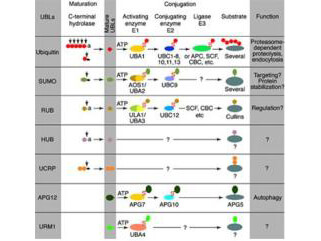
Most modifiers mature by proteolytic processing from inactive precursors (a; amino acid). Arrowheads point to the cleavage sites. Ubiquitin is expressed either as polyubiquitin or as a fusion with ribosomal proteins. Conjugation requires activating (E1) and conjugating (E2) enzymes that form thiolesters (S) with the modifiers. Modification of cullins by RUB involves SCF(SKP1/cullin-1/F-box protein) /CBC(cullin-2/elongin B/elonginC) -like E3 enzymes that are also involved in ubiquitination. In contrast to ubiquitin, the UBLs do not seem to form multi-UBL chains. UCRP(ISG15) resembles two ubiquitin moieties linked head-to-tail. Whether HUB1 functions as a modifier is currently unclear. APG12 and URM1 are distinct from the other modifiers because they are unrelated in sequence to ubiquitin. Data contributed by S.Jentsch.
Click image to see more details
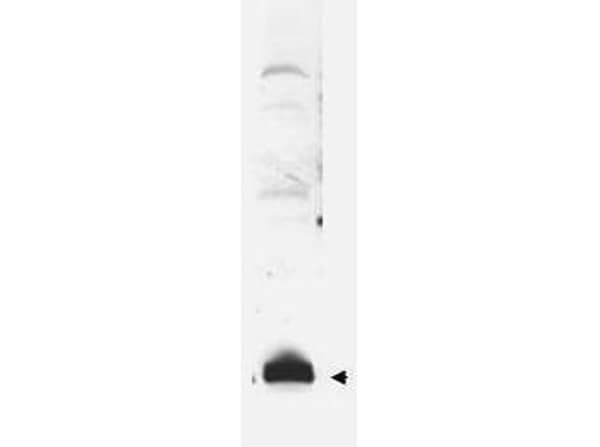
Western blot of hSUMO fusion protein. Anti-SUMO antibody, generated by immunization with recombinant human SUMO, was tested by western blot against a SUMO-GFP fusion protein after cleavage by proteases. Dilution of the antibody between 1:1,000 and 1:5,000 showed strong reactivity specifically with the SUMO portion of the fusion protein ~11.5kDa (arrowhead). In this blot the antibody was used at a 1:2000 dilution incubated overnight at 4° C in 5% BLOTTO in TTBS. Detection occurred using a 1:2000 dilution of HRP-labeled Donkey anti-Rabbit IgG for 1 hour at room temperature. A chemiluminescence system was used for signal detection (Roche). Other detection systems will yield similar results. Data contributed by M. Malakhov, www.lifesensors.com, personal communication.
Specific Publications For Anti-SUMO SUMO1P1 Antibody (A19764)
Loading publications
Recommended Resources
Here are featured tools and databases that you might find useful.
- Boster's Pathways Library
- Protein Databases
- Bioscience Research Protocol Resources
- Data Processing & Analysis Software
- Photo Editing Software
- Scientific Literature Resources
- Research Paper Management Tools
- Molecular Biology Software
- Primer Design Tools
- Bioinformatics Tools
- Phylogenetic Tree Analysis
Customer Reviews
Have you used Anti-SUMO SUMO1P1 Antibody?
Share your experimental results or join a short interview to earn up to $1,000 in product credits or other rewards.
0 Reviews For Anti-SUMO SUMO1P1 Antibody
Customer Q&As
Have a question?
Find answers in Q&As, reviews.
Can't find your answer?
Submit your question
4 Customer Q&As for Anti-SUMO SUMO1P1 Antibody
Question
My question regarding product A19764, anti-SUMO antibody. I was wondering if it would be possible to conjugate this antibody with biotin. I would need it to be without BSA or sodium azide. I am planning on using a buffer exchange of sodium azide with PBS only. Would there be problems for me to conjugate the antibody and store it in -20 degrees in small aliquots?
Verified Customer
Verified customer
Asked: 2020-04-29
Answer
It is not recommended storing this antibody with PBS buffer only in -20 degrees. If you want to store it in -20 degrees it is best to add some cryoprotectant like glycerol. If you want carrier free A19764 anti-SUMO antibody, we can provide it to you in a special formula with trehalose and/or glycerol. These molecules will not interfere with conjugation chemistry and provide a good level of protection for the antibody from degradation. Please be sure to specify this in your purchase order.
Boster Scientific Support
Answered: 2020-04-29
Question
We are currently using anti-SUMO antibody A19764 for human tissue, and we are satisfied with the WB results. The species of reactivity given in the datasheet says human. Is it likely that the antibody can work on canine tissues as well?
Verified Customer
Verified customer
Asked: 2019-08-29
Answer
The anti-SUMO antibody (A19764) has not been tested for cross reactivity specifically with canine tissues, though there is a good chance of cross reactivity. We have an innovator award program that if you test this antibody and show it works in canine you can get your next antibody for free. Please contact me if I can help you with anything.
Boster Scientific Support
Answered: 2019-08-29
Question
Is a blocking peptide available for product anti-SUMO antibody (A19764)?
Verified Customer
Verified customer
Asked: 2019-07-26
Answer
We do provide the blocking peptide for product anti-SUMO antibody (A19764). If you would like to place an order for it please contact support@bosterbio.com and make a special request.
Boster Scientific Support
Answered: 2019-07-26
Question
I see that the anti-SUMO antibody A19764 works with WB, what is the protocol used to produce the result images on the product page?
Verified Customer
Verified customer
Asked: 2018-06-29
Answer
You can find protocols for WB on the "support/technical resources" section of our navigation menu. If you have any further questions, please send an email to support@bosterbio.com
Boster Scientific Support
Answered: 2018-06-29

