

Click image to see more details
Product Info Summary
| SKU: | P00014 |
|---|---|
| Size: | 100ug |
| Reactive Species: | Human |
| Host: | Sheep |
| Application: | ELISA, WB |
Customers Who Bought This Also Bought


Product info
Product Name
Anti-Phospho-ATM S1981 Antibody
SKU/Catalog Number
P00014
Size
100ug
Form
Liquid (sterile filtered)
Description
Boster Bio Anti-Phospho-ATM S1981 Antibody (Catalog # P00014). Tested in ELISA, WB applications. This antibody reacts with Human.
Storage & Handling
Store vial at -20°C prior to opening. Aliquot contents and freeze at -20°C or below for extended storage. Avoid cycles of freezing and thawing. Centrifuge product if not completely clear after standing at room temperature. This product is stable for several weeks at 4°C as an undiluted liquid. Dilute only prior to immediate use. Expiration date is one (1) year from date of opening. (Ship on dry ice.)
Cite This Product
Anti-Phospho-ATM S1981 Antibody (Boster Biological Technology, Pleasanton CA, USA, Catalog # P00014)
Host
Sheep
Contents
0.02 M Potassium Phosphate, 0.15 M Sodium Chloride, pH 7.2, 0.01% (w/v) Sodium Azide
Clonality
Polyclonal
Isotype
IgG
Immunogen
This antibody was affinity purified from whole sheep serum prepared by repeated immunizations with a synthetic peptide corresponding to a region near serine 1981 of human ATM conjugated to KLH using maleimide.
Reactive Species
P00014 is reactive to ATM in Human
Observed Molecular Weight
19 kDa
Calculated molecular weight
350.7 kDa
Background of ATM
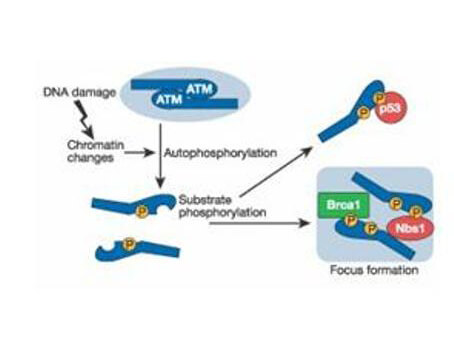
ATM, the gene mutated in the hereditary disease ataxia-telangiectasia, codes for a protein kinase that acts as a master regulator of cellular responses to DNA double-strand breaks. ATM is normally inactive and the question of how it is activated in the event of DNA damage (due to ionizing radiation for instance) is central to understanding its function. ATM protein is now shown to be present in undamaged cells as an inactive dimer. Low doses of ionizing radiation, which induce only a few DNA breaks, activate at least half of the total ATM protein present, possibly in response to changes in chromatin structure. The ATM gene encodes a 370-kDa protein that belongs to the phosphoinositide 3-kinase (PI(3)K) superfamily, but which phosphorylates proteins rather than lipids. The 350-amino-acid kinase domain at the carboxy terminus of this large protein is the only segment of ATM with an assigned function. Exposure of cells to IR triggers ATM kinase activity and this function is required for arrests in G1, S and G2 phases of the cell cycle. Several substrates of the ATM kinase participate in these IR-induced cell-cycle arrests. These include p53, Mdm2 and Chk2 in the G1 checkpoint; Nbs1, Brca1, FancD2 and SMC1 in the transient IR-induced S-phase arrest; and Brca1 and hRad17 in the G2/M checkpoint. This antibody is similar to the rabbit host antibody discussed by Bakkenist, C. J. & Kastan, M. B. in Nature 421, 499-506 (2003).
Antibody Validation
Boster validates all antibodies on WB, IHC, ICC, Immunofluorescence, and ELISA with known positive control and negative samples to ensure specificity and high affinity, including thorough antibody incubations.
Application & Images
Applications
P00014 is guaranteed for ELISA, WB Boster Guarantee
Recommend Dilution
| Application | Dilution | Species |
|---|---|---|
| ELISA: 1:2 | 000 - 1:10 | 000 |
| WB: 1:500 - 1:2 | 000 |
Validation Images & Assay Conditions
Click image to see more details
Schematic of ATM induction by DNA damage.
Click image to see more details
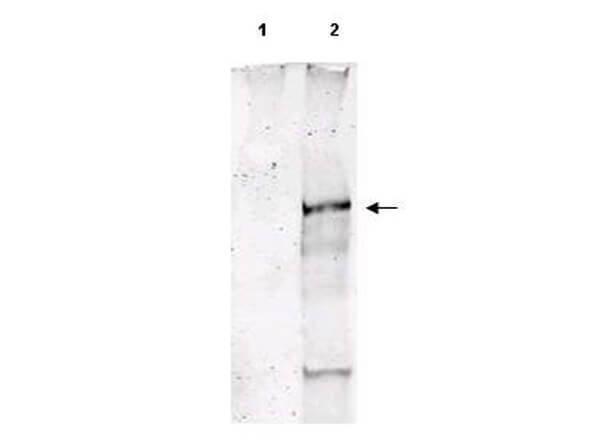
Western Blot of Sheep Anti-ATM pS1981 polyclonal antibody. Lane 1: untreated MCF-7 cell lysate . Lane 2: Hydrogen Peroxide stimulated MCF-7 Whole Cell Lysate . Load: 35 µg per lane. Primary antibody: ATM pS1981 antibody at 1:1000 for 1 h at room temperature. Secondary antibody: IRDye™800 conjugated Donkey anti-Sheep IgG secondary antibody at 1:5,000 for 1h at room temperature. Block: 5% BLOTTO (B501) overnight at 4°C. Predicted/Observed size: 370 kDa, ATM (370 kDa) is indicated by an arrow. Other band(s): ATM splice variants and isoforms.
Specific Publications For Anti-Phospho-ATM S1981 Antibody (P00014)
Loading publications
Recommended Resources
Here are featured tools and databases that you might find useful.
- Boster's Pathways Library
- Protein Databases
- Bioscience Research Protocol Resources
- Data Processing & Analysis Software
- Photo Editing Software
- Scientific Literature Resources
- Research Paper Management Tools
- Molecular Biology Software
- Primer Design Tools
- Bioinformatics Tools
- Phylogenetic Tree Analysis
Customer Reviews
Have you used Anti-Phospho-ATM S1981 Antibody?
Share your experimental results or join a short interview to earn up to $1,000 in product credits or other rewards.
0 Reviews For Anti-Phospho-ATM S1981 Antibody
Customer Q&As
Have a question?
Find answers in Q&As, reviews.
Can't find your answer?
Submit your question
3 Customer Q&As for Anti-Phospho-ATM S1981 Antibody
Question
My team were content with the WB result of your anti-Phospho-ATM S1981 antibody. However we have seen positive staining in cervix carcinoma nucleus using this antibody. Is that expected? Could you tell me where is ATM supposed to be expressed?
Verified Customer
Verified customer
Asked: 2020-03-10
Answer
From what I have seen in literature, cervix carcinoma does express ATM. Generally ATM expresses in nucleus. Regarding which tissues have ATM expression, here are a few articles citing expression in various tissues:
Brain, Pubmed ID: 15489334
Cervix carcinoma, Pubmed ID: 18691976
Cervix carcinoma, and Erythroleukemia, Pubmed ID: 23186163
Embryonic kidney, Pubmed ID: 17525332
Fibroblast, Pubmed ID: 7792600
Liver, Pubmed ID: 24275569
Boster Scientific Support
Answered: 2020-03-10
Question
We are currently using anti-Phospho-ATM S1981 antibody P00014 for human tissue, and we are happy with the WB results. The species of reactivity given in the datasheet says human. Is it true that the antibody can work on feline tissues as well?
W. Banerjee
Verified customer
Asked: 2017-11-16
Answer
The anti-Phospho-ATM S1981 antibody (P00014) has not been validated for cross reactivity specifically with feline tissues, but there is a good chance of cross reactivity. We have an innovator award program that if you test this antibody and show it works in feline you can get your next antibody for free. Please contact me if I can help you with anything.
Boster Scientific Support
Answered: 2017-11-16
Question
We have seen staining in human cervix carcinoma. Are there any suggestions? Is anti-Phospho-ATM S1981 antibody supposed to stain cervix carcinoma positively?
F. Krishna
Verified customer
Asked: 2015-07-30
Answer
From literature cervix carcinoma does express ATM. From Uniprot.org, ATM is expressed in corpus callosum, fibroblast, brain, embryonic kidney, cervix carcinoma, cervix carcinoma erythroleukemia, liver, among other tissues. Regarding which tissues have ATM expression, here are a few articles citing expression in various tissues:
Brain, Pubmed ID: 15489334
Cervix carcinoma, Pubmed ID: 18691976
Cervix carcinoma, and Erythroleukemia, Pubmed ID: 23186163
Embryonic kidney, Pubmed ID: 17525332
Fibroblast, Pubmed ID: 7792600
Liver, Pubmed ID: 24275569
Boster Scientific Support
Answered: 2015-07-30

