



Click image to see more details
-
-

-

-

-
+4
Product Info Summary
| SKU: | PB9928 |
|---|---|
| Size: | 100 μg/vial |
| Reactive Species: | Human, Mouse, Rat |
| Host: | Rabbit |
| Application: | Flow Cytometry, IP, IF, IHC, ICC, WB |
Customers Who Bought This Also Bought

Product info
Product Name
Anti-TCP1 epsilon/CCT5 Antibody Picoband®
SKU/Catalog Number
PB9928
PB1016 is an alternative SKU for this antibody, used in previous lots.
Size
100 μg/vial
Form
Lyophilized
Description
Boster Bio Anti-TCP1 epsilon/CCT5 Antibody Picoband® catalog # PB9928. Tested in Flow Cytometry, IP, IF, IHC, ICC, WB applications. This antibody reacts with Human, Mouse, Rat. The brand Picoband indicates this is a premium antibody that guarantees superior quality, high affinity, and strong signals with minimal background in Western blot applications. Only our best-performing antibodies are designated as Picoband, ensuring unmatched performance.
Storage & Handling
Store at -20˚C for one year from date of receipt. After reconstitution, at 4˚C for one month. It can also be aliquotted and stored frozen at -20˚C for six months. Avoid repeated freeze-thaw cycles.
Cite This Product
Anti-TCP1 epsilon/CCT5 Antibody Picoband® (Boster Biological Technology, Pleasanton CA, USA, Catalog # PB9928)
Host
Rabbit
Contents
Each vial contains antibody formulated with stabilizing components, 0.9mg NaCl, 0.2mg Na2HPO4, 0.01mg NaN3.
*This antibody is supplied in a stabilized formulation.
Compatibility with conjugation reactions depends on the chemistry of the conjugation method used.
For conjugation methods that are not compatible with the stabilizing components present in this formulation, a carrier-free antibody format is required.
Clonality
Polyclonal
Isotype
Rabbit IgG
Immunogen
E. coli-derived human CCT5 recombinant protein (Position: L443-K535). Human CCT5 shares 95.7% amino acid (aa) sequence identity with both mouse and rat CCT5.
Cross-reactivity
No cross-reactivity with other proteins
Reactive Species
PB9928 is reactive to CCT5 in Human, Mouse, Rat
Observed Molecular Weight
60 kDa
Calculated molecular weight
59.7 kDa
Background of CCT5
CCT5 is a molecular chaperone that is a member of the chaperonin containing TCP1 complex (CCT), also known as the TCP1 ring complex (TRiC). This complex consists of two identical stacked rings, each containing eight different proteins. Unfolded polypeptides enter the central cavity of the complex and are folded in an ATP-dependent manner. The complex folds various proteins, including actin and tubulin. Mutations in this gene cause hereditary sensory and autonomic neuropathy with spastic paraplegia (HSNSP). Alternative splicing results in multiple transcript variants. Related pseudogenes have been identified on chromosomes 5 and 13.
Antibody Validation
Boster validates all antibodies on WB, IHC, ICC, Immunofluorescence, and ELISA with known positive control and negative samples to ensure specificity and high affinity, including thorough antibody incubations.
Application & Images
Applications
PB9928 is guaranteed for Flow Cytometry, IP, IF, IHC, ICC, WB Boster Guarantee
Recommend Dilution
| Application | Dilution | Species |
|---|---|---|
| Western blot | 0.1-0.5μg/ml | Human, Mouse, Rat |
| Immunohistochemistry (Paraffin-embedded Section) | 0.5-1μg/ml | Human, Mouse, Rat |
| Immunocytochemistry/Immunofluorescence | 2μg/ml | Human |
| Immunoprecipitation | 0.5-2 μg/ml | Human |
| Flow Cytometry (Fixed) | 1-3μg/1x106 cells | Human |
Note: For flow cytometry (FCM), validated for fixed cells only. Not validated for FACS or surface flow cytometry using live cells.
Tested application
Suggested blocking solution with 5% non-fat milk or BSA; (*)Recommended protein loading: 20-40 µg per lane
Use TE buffer pH 9.0 for antigen retrieval; (*) citrate buffer pH 6.0 is an alternative.
Validation Images & Assay Conditions
Click image to see more details
Western blot analysis of CCT5 using anti-CCT5 antibody (PB9928).
Electrophoresis was performed on a 5-20% SDS-PAGE gel at 70V (Stacking gel) / 90V (Resolving gel) for 2-3 hours. The sample well of each lane was loaded with 30 ug of sample under reducing conditions.
Lane 1: human Hela whole cell lysates,
Lane 2: human MCF-7 whole cell lysates,
Lane 3: human SiHa whole cell lysates,
Lane 4: human A549 whole cell lysates,
Lane 5: human 293T whole cell lysates,
Lane 6: human CACO-2 whole cell lysates,
Lane 7: human PC-3 whole cell lysates,
Lane 8: human U20S whole cell lysates,
Lane 9: rat testis tissue lysates,
Lane 10: mouse testis tissue lysates,
Lane 11: mouse liver tissue lysates.
After electrophoresis, proteins were transferred to a nitrocellulose membrane at 150 mA for 50-90 minutes. Blocked the membrane with 5% non-fat milk/TBS for 1.5 hour at RT. The membrane was incubated with rabbit anti-CCT5 antigen affinity purified polyclonal antibody (Catalog # PB9928) at 0.5 μg/mL overnight at 4°C, then washed with TBS-0.1%Tween 3 times with 5 minutes each and probed with a goat anti-rabbit IgG-HRP secondary antibody at a dilution of 1:5000 for 1.5 hour at RT. The signal is developed using an Enhanced Chemiluminescent detection (ECL) kit (Catalog # EK1002) with Tanon 5200 system. A specific band was detected for CCT5 at approximately 60 kDa. The expected band size for CCT5 is at 60 kDa.
Click image to see more details
IHC analysis of CCT5 using anti-CCT5 antibody (PB9928).
CCT5 was detected in paraffin-embedded section of mouse ovary tissues. Heat mediated antigen retrieval was performed in citrate buffer (pH6, epitope retrieval solution) for 20 mins. The tissue section was blocked with 10% goat serum. The tissue section was then incubated with 1μg/ml rabbit anti-CCT5 Antibody (PB9928) overnight at 4°C. Biotinylated goat anti-rabbit IgG was used as secondary antibody and incubated for 30 minutes at 37°C. The tissue section was developed using Strepavidin-Biotin-Complex (SABC)(Catalog # SA1022) with DAB as the chromogen.
Click image to see more details
IHC analysis of CCT5 using anti-CCT5 antibody (PB9928).
CCT5 was detected in paraffin-embedded section of rat ovary tissues. Heat mediated antigen retrieval was performed in citrate buffer (pH6, epitope retrieval solution) for 20 mins. The tissue section was blocked with 10% goat serum. The tissue section was then incubated with 1μg/ml rabbit anti-CCT5 Antibody (PB9928) overnight at 4°C. Biotinylated goat anti-rabbit IgG was used as secondary antibody and incubated for 30 minutes at 37°C. The tissue section was developed using Strepavidin-Biotin-Complex (SABC)(Catalog # SA1022) with DAB as the chromogen.
Click image to see more details
IHC analysis of CCT5 using anti-CCT5 antibody (PB9928).
CCT5 was detected in paraffin-embedded section of human intestinal cancer tissues. Heat mediated antigen retrieval was performed in citrate buffer (pH6, epitope retrieval solution) for 20 mins. The tissue section was blocked with 10% goat serum. The tissue section was then incubated with 1μg/ml rabbit anti-CCT5 Antibody (PB9928) overnight at 4°C. Biotinylated goat anti-rabbit IgG was used as secondary antibody and incubated for 30 minutes at 37°C. The tissue section was developed using Strepavidin-Biotin-Complex (SABC)(Catalog # SA1022) with DAB as the chromogen.

Click image to see more details
IHC analysis of TCP1 epsilon using anti-TCP1 epsilon antibody (PB9928).
TCP1 epsilon was detected in immunocytochemical section of LOVO cell. Enzyme antigen retrieval was performed using IHC enzyme antigen retrieval reagent (AR0022) for 15 mins. The cells were blocked with 10% goat serum. And then incubated with 1μg/ml rabbit anti-TCP1 epsilon Antibody (PB9928) overnight at 4°C. Biotinylated goat anti-rabbit IgG was used as secondary antibody and incubated for 30 minutes at 37°C. The section was developed using Strepavidin-Biotin-Complex (SABC)(Catalog # SA1022) with DAB as the chromogen.

Click image to see more details
IF analysis of CCT5 using anti-CCT5 antibody (PB9928).
CCT5 was detected in immunocytochemical section of U20S cell. Enzyme antigen retrieval was performed using IHC enzyme antigen retrieval reagent (AR0022) for 15 mins. The cells were blocked with 10% goat serum. And then incubated with 2μg/mL rabbit anti-CCT5 Antibody (PB9928) overnight at 4°C. DyLight®488 Conjugated Goat Anti-Rabbit IgG (BA1127) was used as secondary antibody at 1:100 dilution and incubated for 30 minutes at 37°C. Visualize using a fluorescence microscope and filter sets appropriate for the label used.
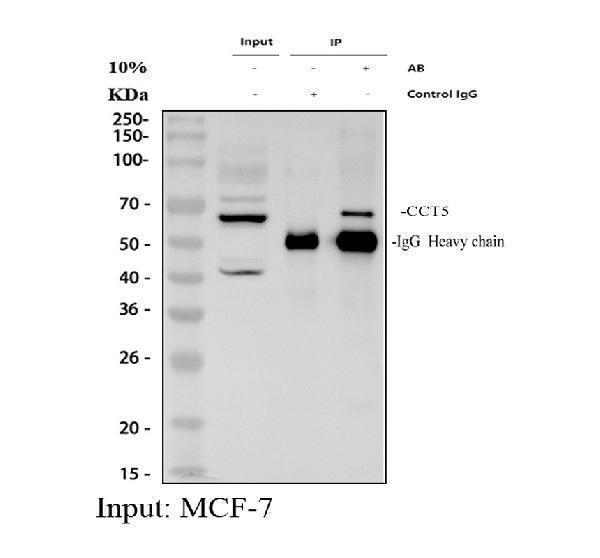
Click image to see more details
Immunoprecipitating (IP) CCT5 in MCF-7 whole cell lysate.
Western blot analysis of CCT5 using anti-CCT5 antibody (PB9928);
Lane 1: MCF-7 whole cell lysates (30ug);
Lane 2: Rabbit control IgG instead of anti-CCT5 antibody in MCF-7 whole cell lysate;
Lane 3: anti-CCT5 antibody (2μg) + MCF-7 whole cell lysate (500μg).
After electrophoresis, proteins were transferred to a membrane. Then the membrane was incubated with rabbit anti-CCT5 antigen affinity purified polyclonal antibody (PB9928) at a dilution of 0.5 μg/mL and probed with a goat anti-rabbit IgG-HRP secondary antibody (Catalog # BA1054). The signal is developed using ECL Plus Western Blotting Substrate (Catalog # AR1196-200). A specific band was detected for CCT5 at approximately 60 kDa. The expected band size for CCT5 is at 60 kDa.

Click image to see more details
Flow Cytometry analysis of A431 cells using anti-CCT5 antibody (PB9928).
Overlay histogram showing A431 cells stained with PB9928 (Blue line). To facilitate intracellular staining, cells were fixed with 4% paraformaldehyde and permeabilized with permeabilization buffer. The cells were blocked with 10% normal goat serum. And then incubated with rabbit anti-CCT5 Antibody (PB9928,1μg/1x106 cells) for 30 min at 20°C. DyLight®488 conjugated goat anti-rabbit IgG (BA1127, 5-10μg/1x106 cells) was used as secondary antibody for 30 minutes at 20°C. Isotype control antibody (Green line) was rabbit IgG (1μg/1x106) used under the same conditions. Unlabelled sample without incubation with primary antibody and secondary antibody (Red line) was used as a blank control.
Specific Publications For Anti-TCP1 epsilon/CCT5 Antibody Picoband® (PB9928)
Loading publications
Recommended Resources
Here are featured tools and databases that you might find useful.
- Boster's Pathways Library
- Protein Databases
- Bioscience Research Protocol Resources
- Data Processing & Analysis Software
- Photo Editing Software
- Scientific Literature Resources
- Research Paper Management Tools
- Molecular Biology Software
- Primer Design Tools
- Bioinformatics Tools
- Phylogenetic Tree Analysis
Customer Reviews
Have you used Anti-TCP1 epsilon/CCT5 Antibody Picoband®?
Share your experimental results or join a short interview to earn up to $1,000 in product credits or other rewards.
0 Reviews For Anti-TCP1 epsilon/CCT5 Antibody Picoband®
Customer Q&As
Have a question?
Find answers in Q&As, reviews.
Can't find your answer?
Submit your question
5 Customer Q&As for Anti-TCP1 epsilon/CCT5 Antibody Picoband®
Question
My question regarding product PB9928, anti-TCP1 epsilon/CCT5 antibody. I was wondering if it would be possible to conjugate this antibody with biotin. I would need it to be without BSA or sodium azide. I am planning on using a buffer exchange of sodium azide with PBS only. Would there be problems for me to conjugate the antibody and store it in -20 degrees in small aliquots?
Verified Customer
Verified customer
Asked: 2019-11-14
Answer
It is not recommended storing this antibody with PBS buffer only in -20 degrees. If you want to store it in -20 degrees it is best to add some cryoprotectant like glycerol. If you want carrier free PB9928 anti-TCP1 epsilon/CCT5 antibody, we can provide it to you in a special formula with trehalose and/or glycerol. These molecules will not interfere with conjugation chemistry and provide a good level of protection for the antibody from degradation. Please be sure to specify this in your purchase order.
Boster Scientific Support
Answered: 2019-11-14
Question
My question regards to test anti-TCP1 epsilon/CCT5 antibody PB9928 on human liver for research purposes, then I may be interested in using anti-TCP1 epsilon/CCT5 antibody PB9928 for diagnostic purposes as well. Is the antibody suitable for diagnostic purposes?
Verified Customer
Verified customer
Asked: 2019-10-09
Answer
The products we sell, including anti-TCP1 epsilon/CCT5 antibody PB9928, are only intended for research use. They would not be suitable for use in diagnostic work. If you have the means to develop a product into diagnostic use, and are interested in collaborating with us and develop our product into an IVD product, please contact us for more discussions.
Boster Scientific Support
Answered: 2019-10-09
Question
Do you have information regarding the localization of the IF staining for PB9928?
Verified customer
Asked: 2019-03-26
Answer
The localization of the IF staining for Anti-TCP1 Epsilon/CCT5 Antibody Picoband™ (PB9928) our lab technicians obtained is mainly in nuclear. CCT5 expressed in both nuclear and cytoplasm. “Antibody staining consistent with RNA expression data. Nuclear positivity in CNS viewed as off target and disregarded.” this is just for CNS.
Boster Scientific Support
Answered: 2019-03-29
Question
Is this PB9928 anti-TCP1 epsilon/CCT5 antibody reactive to the isotypes of CCT5?
Verified Customer
Verified customer
Asked: 2017-09-18
Answer
The immunogen of PB9928 anti-TCP1 epsilon/CCT5 antibody is E. coli-derived human CCT5 recombinant protein (Position: L443-K535). Human CCT5 shares 95.7% amino acid (aa) sequence identity with both mouse and rat CCT5. Could you tell me which isotype you are interested in so I can help see if the immunogen is part of this isotype?
Boster Scientific Support
Answered: 2017-09-18
Question
We are currently using anti-TCP1 epsilon/CCT5 antibody PB9928 for rat tissue, and we are satisfied with the IHC-P results. The species of reactivity given in the datasheet says human, mouse, rat. Is it true that the antibody can work on canine tissues as well?
A. Li
Verified customer
Asked: 2015-11-12
Answer
The anti-TCP1 epsilon/CCT5 antibody (PB9928) has not been tested for cross reactivity specifically with canine tissues, though there is a good chance of cross reactivity. We have an innovator award program that if you test this antibody and show it works in canine you can get your next antibody for free. Please contact me if I can help you with anything.
Boster Scientific Support
Answered: 2015-11-12

