Product Info Summary
| SKU: | M01202 |
|---|---|
| Size: | 100 μl |
| Reactive Species: | Human, Mouse, Rat |
| Host: | Rabbit |
| Application: | Flow Cytometry, IP, IF, IHC, ICC, WB |
Customers Who Bought This Also Bought
Product info
Product Name
Anti-CD9 Rabbit Monoclonal Antibody
SKU/Catalog Number
M01202
BM4212 is an alternative SKU for this antibody, used in previous lots.
Size
100 μl
Form
Liquid
Description
Boster Bio Anti-CD9 Rabbit Monoclonal Antibody catalog # M01202. Tested in WB, IHC, ICC/IF, IP, Flow Cytometry applications. This antibody reacts with Human, Mouse, Rat.
Storage & Handling
Store at -20°C for one year. For short term storage and frequent use, store at 4°C for up to one month. Avoid repeated freeze-thaw cycles.
Cite This Product
Anti-CD9 Rabbit Monoclonal Antibody (Boster Biological Technology, Pleasanton CA, USA, Catalog # M01202)
Host
Rabbit
Contents
Rabbit IgG in stabilizing components, phosphate buffered saline, pH 7.4, 150mM NaCl, 0.02% sodium azide and 50% glycerol.
*This antibody is supplied in a stabilized formulation.
Compatibility with conjugation reactions depends on the chemistry of the conjugation method used.
For conjugation methods that are not compatible with the stabilizing components present in this formulation, a carrier-free antibody format is required.
Clonality
Monoclonal
Clone Number
CED-3
Isotype
Rabbit IgG
Immunogen
A synthesized peptide derived from human CD9
Reactive Species
M01202 is reactive to CD9 in Human, Mouse, Rat
Observed Molecular Weight
23 kDa
Calculated molecular weight
25.4 kDa
Antibody Validation
Boster validates all antibodies on WB, IHC, ICC, Immunofluorescence, and ELISA with known positive control and negative samples to ensure specificity and high affinity, including thorough antibody incubations.
Application & Images
Applications
M01202 is guaranteed for Flow Cytometry, IP, IF, IHC, ICC, WB Boster Guarantee
Assay Dilutions Recommendation
The recommendations below provide a starting point for assay optimization. The actual working concentration varies and should be decided by the user.
WB 1:500-2000
IHC 1:50-200
ICC/IF 1:50-200
IP 1:20
FC 1:20
Positive Control
IHC: human tonsil tissue, human colon cancer tissue, human prostate cancer tissue, mouse brain tissue, rat brain tissue
ICC/IF: Hela cell
Validation Images & Assay Conditions
Click image to see more details
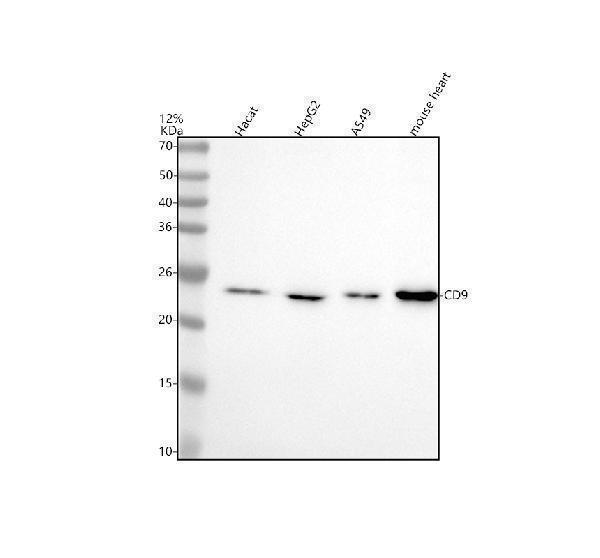
Western blot analysis of CD9 using anti-CD9 antibody (M01202).
Electrophoresis was performed on a 12% SDS-PAGE gel at 80V (Stacking gel) / 120V (Resolving gel) for 2 hours. The sample well of each lane was loaded with 30 ug of sample under reducing conditions.
Lane 1: human Hacat whole cell lysates,
Lane 2: human HepG2 whole cell lysates,
Lane 3: human A549 whole cell lysates,
Lane 4: mouse heart tissue lysates.
After electrophoresis, proteins were transferred to a nitrocellulose membrane at 150 mA for 50-90 minutes. Blocked the membrane with 5% non-fat milk/TBS for 1.5 hour at RT. The membrane was incubated with rabbit anti-CD9 antigen affinity purified monoclonal antibody (M01202) at 1:1000 overnight at 4°C, then washed with TBS-0.1%Tween 3 times with 5 minutes each and probed with a goat anti-rabbit IgG-HRP secondary antibody at a dilution of 1:5000 for 1.5 hour at RT. The signal is developed using an ECL Plus Western Blotting Substrate (Catalog # AR1196-200) with Tanon 5200 system. A specific band was detected for CD9 at approximately 23 kDa. The expected band size for CD9 is at 25 kDa.
Click image to see more details
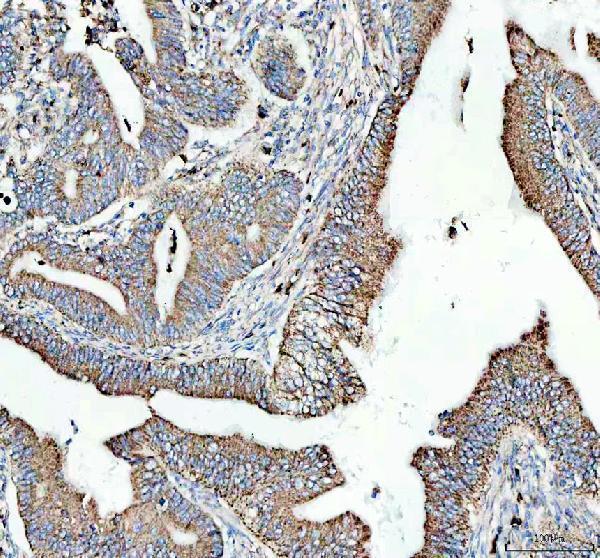
IHC analysis of CD9 using anti-CD9 antibody (M01202).
CD9 was detected in a paraffin-embedded section of human colon cancer tissue. Heat mediated antigen retrieval was performed in EDTA buffer (pH 8.0, epitope retrieval solution). The tissue section was blocked with 10% goat serum. The tissue section was then incubated with 1:100 rabbit anti-CD9 Antibody (M01202) overnight at 4°C. Peroxidase Conjugated Goat Anti-rabbit IgG was used as secondary antibody and incubated for 30 minutes at 37°C. The tissue section was developed using HRP Conjugated Rabbit IgG Super Vision Assay Kit (Catalog # SV0002) with DAB as the chromogen.
Click image to see more details
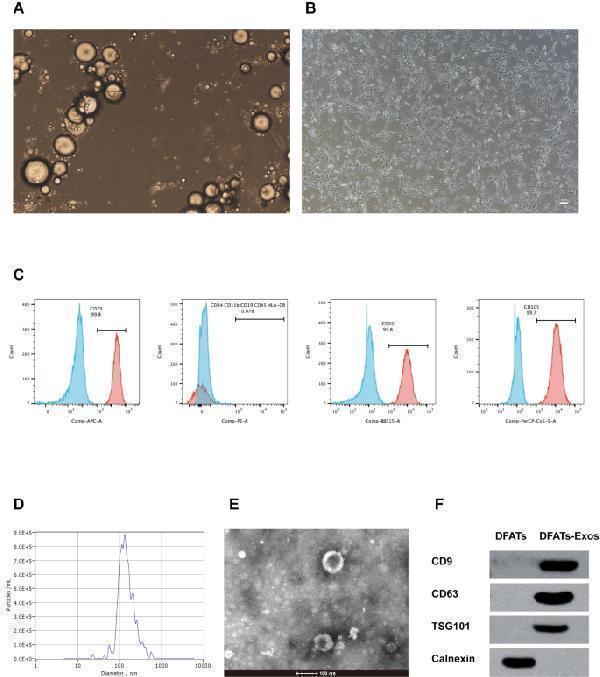
Illustrates the characterization of DFATs and exosomes. DFATs exhibited a spindle-shaped morphology ( A-B ). Flow cytometry analysis showed that DFATs were positive for markers CD90, CD105, and CD73, and negative for CD34, CD11b, CD19, CD45, and HLA-DR ( C ). NTA showed that the average diameter of the exosomes was 136.3 nm ( D ). TEM showed that DFATs-Exos exhibited a typical bilayer membrane structure ( E ). Western blot analysis revealed that DFATs exosomes were enriched in markers such as CD63, CD9, and TSG101, while lacking the marker Calnexin ( F ). Full-length blots are presented in Supplementary Digital Material 1
Index in PubMed under a CC BY license. PMID: 40022232
Click image to see more details
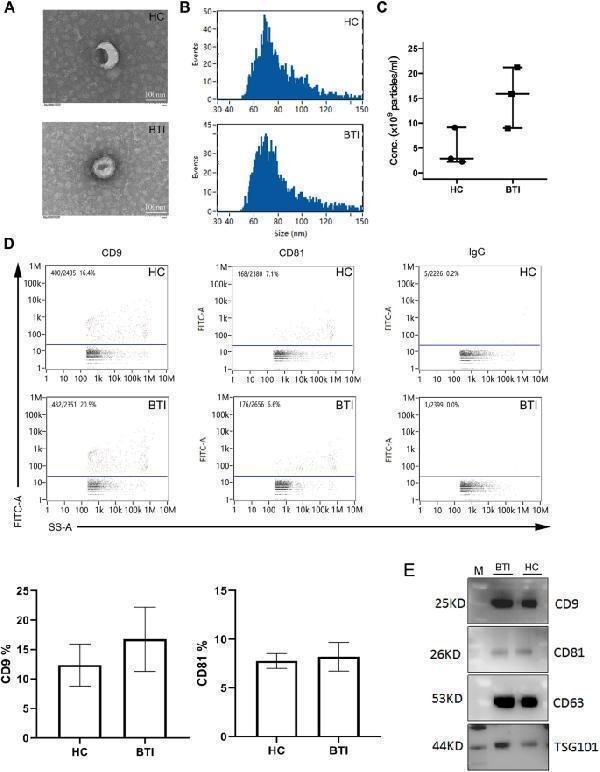
Characterization of EVs (extracellular vesicles) from HC (healthy control) and BTI (biliary tract infection) samples. ( A ) Representative images of EVs, which were captured by TEM (Transmission Electron Microscope), from HC or BTI samples (bar = 100 nm). ( B , C , D ) Plot showing the sizes ( B ) or concentrations (Conc.; C ) and cell surface expression of CD9/CD81/IgG ( D ) of EVs which were measured by the NFCM (Nano-Flow Cytometry Measurement). ( E ) CD9, CD81, CD63 and TSG101 were detectable by Western blot (WB) analysis.
Index in PubMed under a CC BY license. PMID: 38459197
Click image to see more details
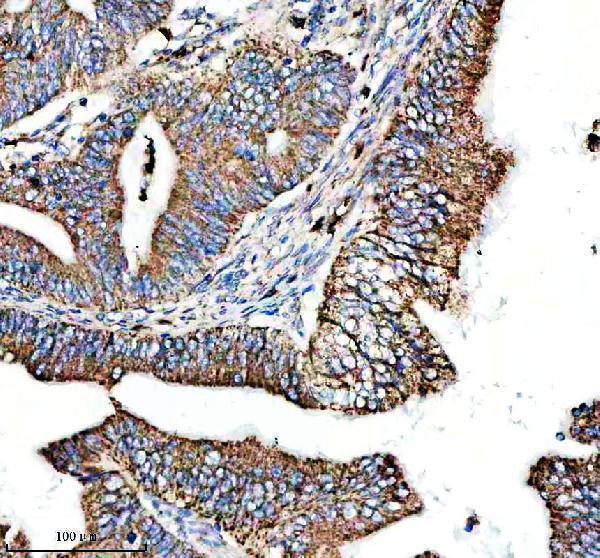
IHC analysis of CD9 using anti-CD9 antibody (M01202).
CD9 was detected in a paraffin-embedded section of human colon cancer tissue. Heat mediated antigen retrieval was performed in EDTA buffer (pH 8.0, epitope retrieval solution). The tissue section was blocked with 10% goat serum. The tissue section was then incubated with a dilution of 1:100 rabbit anti-CD9 Antibody (M01202) overnight at 4°C. Peroxidase Conjugated Goat Anti-rabbit IgG was used as secondary antibody and incubated for 30 minutes at 37°C. The tissue section was developed using HRP Conjugated Rabbit IgG Super Vision Assay Kit (Catalog # SV0002) with DAB as the chromogen.
Click image to see more details
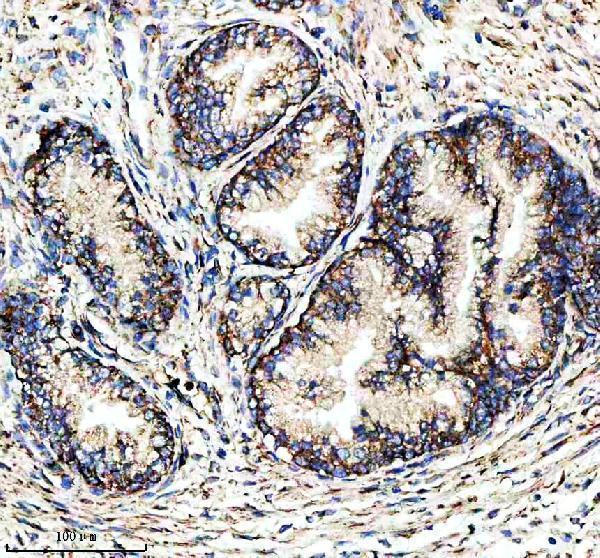
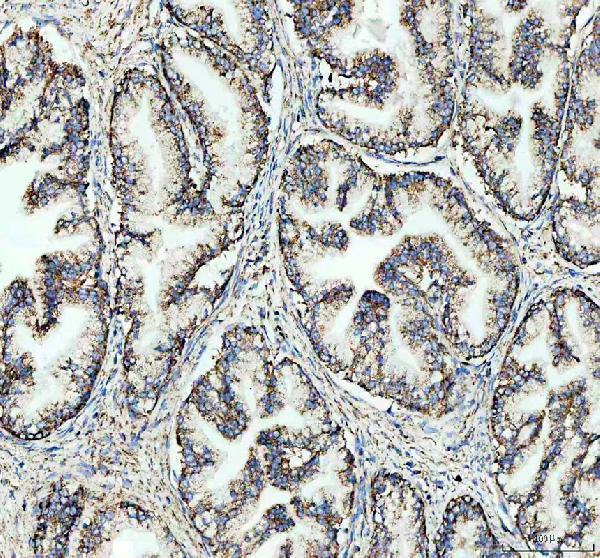
IHC analysis of CD9 using anti-CD9 antibody (M01202).
CD9 was detected in a paraffin-embedded section of human prostate cancer tissue. Heat mediated antigen retrieval was performed in EDTA buffer (pH 8.0, epitope retrieval solution). The tissue section was blocked with 10% goat serum. The tissue section was then incubated with a dilution of 1:100 rabbit anti-CD9 Antibody (M01202) overnight at 4°C. Peroxidase Conjugated Goat Anti-rabbit IgG was used as secondary antibody and incubated for 30 minutes at 37°C. The tissue section was developed using HRP Conjugated Rabbit IgG Super Vision Assay Kit (Catalog # SV0002) with DAB as the chromogen.
Click image to see more details
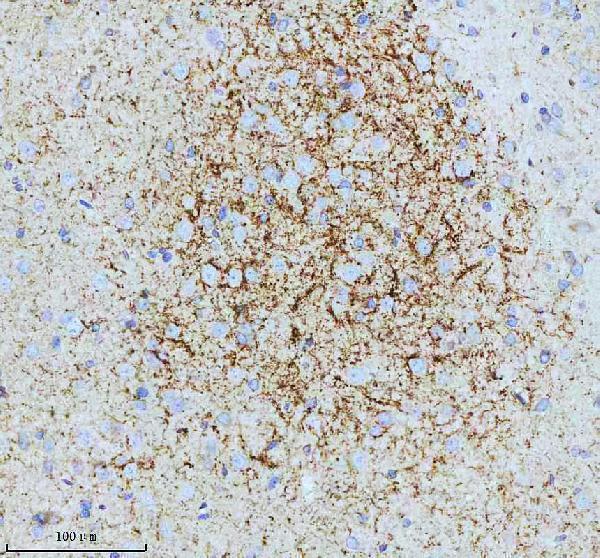
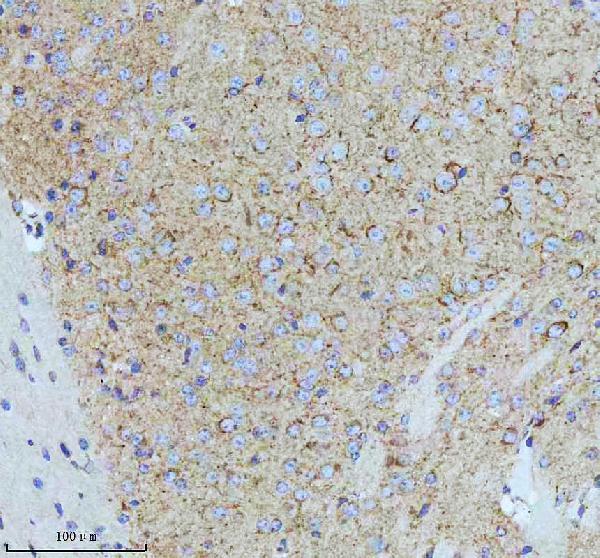
IHC analysis of CD9 using anti-CD9 antibody (M01202).
CD9 was detected in a paraffin-embedded section of rat brain tissue. Heat mediated antigen retrieval was performed in EDTA buffer (pH 8.0, epitope retrieval solution). The tissue section was blocked with 10% goat serum. The tissue section was then incubated with a dilution of 1:100 rabbit anti-CD9 Antibody (M01202) overnight at 4°C. Peroxidase Conjugated Goat Anti-rabbit IgG was used as secondary antibody and incubated for 30 minutes at 37°C. The tissue section was developed using HRP Conjugated Rabbit IgG Super Vision Assay Kit (Catalog # SV0002) with DAB as the chromogen.
Click image to see more details
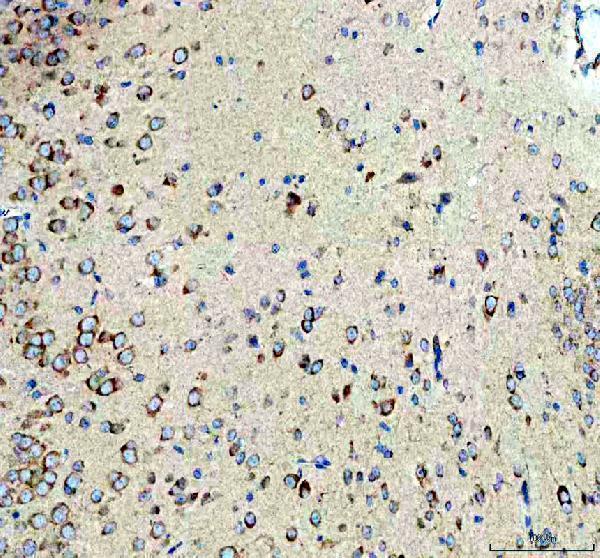
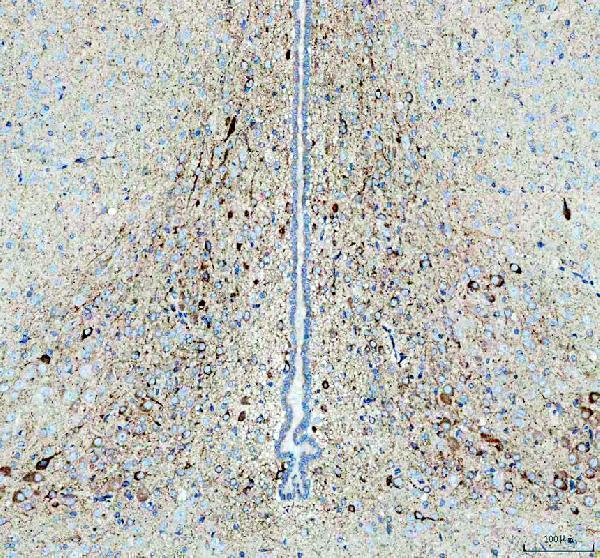
IHC analysis of CD9 using anti-CD9 antibody (M01202).
CD9 was detected in a paraffin-embedded section of mouse brain tissue. Heat mediated antigen retrieval was performed in EDTA buffer (pH 8.0, epitope retrieval solution). The tissue section was blocked with 10% goat serum. The tissue section was then incubated with a dilution of 1:100 rabbit anti-CD9 Antibody (M01202) overnight at 4°C. Peroxidase Conjugated Goat Anti-rabbit IgG was used as secondary antibody and incubated for 30 minutes at 37°C. The tissue section was developed using HRP Conjugated Rabbit IgG Super Vision Assay Kit (Catalog # SV0002) with DAB as the chromogen.
Click image to see more details
IHC analysis of CD9 using anti-CD9 antibody (M01202).
CD9 was detected in a paraffin-embedded section of human prostate cancer tissue. Heat mediated antigen retrieval was performed in EDTA buffer (pH 8.0, epitope retrieval solution). The tissue section was blocked with 10% goat serum. The tissue section was then incubated with 1:100 rabbit anti-CD9 Antibody (M01202) overnight at 4°C. Peroxidase Conjugated Goat Anti-rabbit IgG was used as secondary antibody and incubated for 30 minutes at 37°C. The tissue section was developed using HRP Conjugated Rabbit IgG Super Vision Assay Kit (Catalog # SV0002) with DAB as the chromogen.
Click image to see more details
IHC analysis of CD9 using anti-CD9 antibody (M01202).
CD9 was detected in a paraffin-embedded section of mouse brain tissue. Heat mediated antigen retrieval was performed in EDTA buffer (pH 8.0, epitope retrieval solution). The tissue section was blocked with 10% goat serum. The tissue section was then incubated with 1:100 rabbit anti-CD9 Antibody (M01202) overnight at 4°C. Peroxidase Conjugated Goat Anti-rabbit IgG was used as secondary antibody and incubated for 30 minutes at 37°C. The tissue section was developed using HRP Conjugated Rabbit IgG Super Vision Assay Kit (Catalog # SV0002) with DAB as the chromogen.
Click image to see more details
IHC analysis of CD9 using anti-CD9 antibody (M01202).
CD9 was detected in a paraffin-embedded section of rat brain tissue. Heat mediated antigen retrieval was performed in EDTA buffer (pH 8.0, epitope retrieval solution). The tissue section was blocked with 10% goat serum. The tissue section was then incubated with 1:100 rabbit anti-CD9 Antibody (M01202) overnight at 4°C. Peroxidase Conjugated Goat Anti-rabbit IgG was used as secondary antibody and incubated for 30 minutes at 37°C. The tissue section was developed using HRP Conjugated Rabbit IgG Super Vision Assay Kit (Catalog # SV0002) with DAB as the chromogen.
Click image to see more details
Immunofluorescent analysis of Hela cells, using CD9 Antibody .
Specific Publications For Anti-CD9 Rabbit Monoclonal Antibody (M01202)
Loading publications
Recommended Resources
Here are featured tools and databases that you might find useful.
- Boster's Pathways Library
- Protein Databases
- Bioscience Research Protocol Resources
- Data Processing & Analysis Software
- Photo Editing Software
- Scientific Literature Resources
- Research Paper Management Tools
- Molecular Biology Software
- Primer Design Tools
- Bioinformatics Tools
- Phylogenetic Tree Analysis
Customer Reviews
Have you used Anti-CD9 Rabbit Monoclonal Antibody?
Share your experimental results or join a short interview to earn up to $1,000 in product credits or other rewards.
0 Reviews For Anti-CD9 Rabbit Monoclonal Antibody
Customer Q&As
Have a question?
Find answers in Q&As, reviews.
Can't find your answer?
Submit your question
5 Customer Q&As for Anti-CD9 Rabbit Monoclonal Antibody
Question
We are interested in using your anti-CD9 Rabbit Monoclonal antibody for negative regulation of platelet aggregation studies. Has this antibody been tested with western blotting on hela cells? We would like to see some validation images before ordering.
Verified Customer
Verified customer
Asked: 2020-03-31
Answer
Thank you for your inquiry. This M01202 anti-CD9 Rabbit Monoclonal antibody is tested on hela cells. It is guaranteed to work for Flow Cytometry, IP, IF, IHC, ICC, WB in human, mouse, rat. Our Boster guarantee will cover your intended experiment even if the sample type has not been be directly tested.
Boster Scientific Support
Answered: 2020-03-31
Question
We ordered your anti-CD9 Rabbit Monoclonal antibody for Flow Cytometry on platelet in a previous project. I am using rat, and We want to use the antibody for WB next. Our lab want to know about examining platelet as well as trigeminal ganglion in our next experiment. Do you have any suggestion on which antibody would work the best for WB?
Verified Customer
Verified customer
Asked: 2019-06-27
Answer
I looked at the website and datasheets of our anti-CD9 Rabbit Monoclonal antibody and it seems that M01202 has been tested on rat in both Flow Cytometry and WB. Thus M01202 should work for your application. Our Boster satisfaction guarantee will cover this product for WB in rat even if the specific tissue type has not been validated. We do have a comprehensive range of products for WB detection and you can check out our website bosterbio.com to find out more information about them.
Boster Scientific Support
Answered: 2019-06-27
Question
Our lab were satisfied with the WB result of your anti-CD9 Rabbit Monoclonal antibody. However we have seen positive staining in leukocyte cell membrane using this antibody. Is that expected? Could you tell me where is CD9 supposed to be expressed?
M. Jha
Verified customer
Asked: 2015-02-20
Answer
From literature, leukocyte does express CD9. Generally CD9 expresses in cell membrane. Regarding which tissues have CD9 expression, here are a few articles citing expression in various tissues:
Leukocyte, Pubmed ID: 8486348
Ovary, Pubmed ID: 15489334
Platelet, Pubmed ID: 2358073
Boster Scientific Support
Answered: 2015-02-20
Question
We are currently using anti-CD9 Rabbit Monoclonal antibody M01202 for human tissue, and we are content with the WB results. The species of reactivity given in the datasheet says human, mouse, rat. Is it likely that the antibody can work on bovine tissues as well?
K. Yang
Verified customer
Asked: 2014-09-29
Answer
The anti-CD9 Rabbit Monoclonal antibody (M01202) has not been tested for cross reactivity specifically with bovine tissues, but there is a good chance of cross reactivity. We have an innovator award program that if you test this antibody and show it works in bovine you can get your next antibody for free. Please contact me if I can help you with anything.
Boster Scientific Support
Answered: 2014-09-29
Question
We have seen staining in human leukocyte. What should we do? Is anti-CD9 Rabbit Monoclonal antibody supposed to stain leukocyte positively?
A. Jackson
Verified customer
Asked: 2013-04-15
Answer
Based on literature leukocyte does express CD9. Based on Uniprot.org, CD9 is expressed in trigeminal ganglion, leukocyte, ovary, platelet, among other tissues. Regarding which tissues have CD9 expression, here are a few articles citing expression in various tissues:
Leukocyte, Pubmed ID: 8486348
Ovary, Pubmed ID: 15489334
Platelet, Pubmed ID: 2358073
Boster Scientific Support
Answered: 2013-04-15