



Click image to see more details
-
-
-
-
-
+8
Product Info Summary
| SKU: | A03563-1 |
|---|---|
| Size: | 100 μg/vial |
| Reactive Species: | Human, Mouse, Rat |
| Host: | Rabbit |
| Application: | ELISA, Flow Cytometry, IHC, WB |
Customers Who Bought This Also Bought

Product info
Product Name
Anti-FOXF1 Picoband® Antibody
SKU/Catalog Number
A03563-1
Size
100 μg/vial
Form
Lyophilized
Description
Boster Bio Anti-FOXF1 Picoband® Antibody catalog # A03563-1. Tested in ELISA, Flow Cytometry, IHC, WB applications. This antibody reacts with Human, Mouse, Rat. The brand Picoband indicates this is a premium antibody that guarantees superior quality, high affinity, and strong signals with minimal background in Western blot applications. Only our best-performing antibodies are designated as Picoband, ensuring unmatched performance.
Storage & Handling
Store at -20˚C for one year from date of receipt. After reconstitution, at 4˚C for one month. It can also be aliquotted and stored frozen at -20˚C for six months. Avoid repeated freeze-thaw cycles.
Cite This Product
Anti-FOXF1 Picoband® Antibody (Boster Biological Technology, Pleasanton CA, USA, Catalog # A03563-1)
Host
Rabbit
Contents
Each vial contains 4mg Trehalose, 0.9mg NaCl, 0.2mg Na2HPO4, 0.05mg NaN3.
Clonality
Polyclonal
Isotype
Rabbit IgG
Immunogen
E.coli-derived human FOXF1 recombinant protein (Position: R44-M379).
Cross-reactivity
No cross-reactivity with other proteins.
Reactive Species
A03563-1 is reactive to FOXF1 in Human, Mouse, Rat
Observed Molecular Weight
38-40 kDa
Calculated molecular weight
40.1 kDa
Background of FOXF1
Forkhead box protein F1 is a protein that in humans is encoded by the FOXF1 gene. It is mapped to 16q24.1. This gene belongs to the forkhead family of transcription factors which is characterized by a distinct forkhead domain. The specific function of this gene has not yet been determined; however, it may play a role in the regulation of pulmonary genes as well as embryonic development.
Antibody Validation
Boster validates all antibodies on WB, IHC, ICC, Immunofluorescence, and ELISA with known positive control and negative samples to ensure specificity and high affinity, including thorough antibody incubations.
Application & Images
Applications
A03563-1 is guaranteed for ELISA, Flow Cytometry, IHC, WB Boster Guarantee
Recommend Dilution
| Application | Dilution | Species |
|---|---|---|
| Western blot | 0.25-0.5μg/ml | Human, Mouse |
| Immunohistochemistry (Paraffin-embedded Section) | 0.5-1μg/ml | Human, Rat |
| Flow Cytometry (Fixed) | 1-3μg/1x106 cells | Human |
| ELISA | 0.1-0.5μg/ml | - |
Note: For flow cytometry (FCM), validated for fixed cells only. Not validated for FACS or surface flow cytometry using live cells.
Tested application
Suggested blocking solution with 5% non-fat milk or BSA; (*)Recommended protein loading: 20-40 µg per lane
Use TE buffer pH 9.0 for antigen retrieval; (*) citrate buffer pH 6.0 is an alternative.
Validation Images & Assay Conditions
Click image to see more details
Western blot analysis of FOXF1 using anti-FOXF1 antibody (A03563-1).
Electrophoresis was performed on a 5-20% SDS-PAGE gel at 70V (Stacking gel) / 90V (Resolving gel) for 2-3 hours. The sample well of each lane was loaded with 50ug of sample under reducing conditions.
Lane 1: human A549 whole cell lysates,
Lane 2: human Hela whole cell lysates,
Lane 3: human PC-3 whole cell lysates,
Lane 4: human U2OS whole cell lysates,
Lane 5: mouse liver tissue lysates,
Lane 6: mouse SP20 whole cell lysates.
After Electrophoresis, proteins were transferred to a Nitrocellulose membrane at 150mA for 50-90 minutes. Blocked the membrane with 5% Non-fat Milk/ TBS for 1.5 hour at RT. The membrane was incubated with rabbit anti-FOXF1 antigen affinity purified polyclonal antibody (Catalog # A03563-1) at 0.5 μg/mL overnight at 4°C, then washed with TBS-0.1%Tween 3 times with 5 minutes each and probed with a goat anti-rabbit IgG-HRP secondary antibody at a dilution of 1:5000 for 1.5 hour at RT. The signal is developed using an Enhanced Chemiluminescent detection (ECL) kit (Catalog # EK1002) with Tanon 5200 system. A specific band was detected for FOXF1 at approximately 38-40KD. The expected band size for FOXF1 is at 40KD.
Click image to see more details
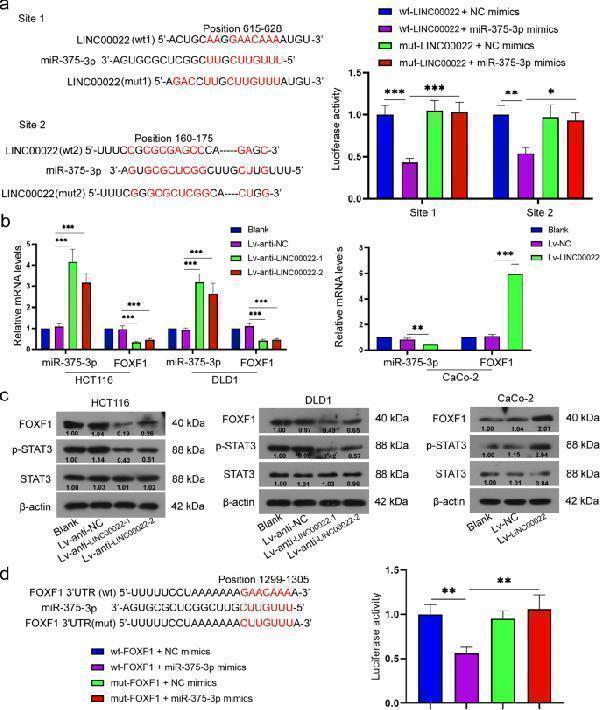
LINC00022 upregulated FOXF1 expression through sponging miR-375-3p. ( a ) The binding sites between LINC00022 and miR-375-3p were predicted by LncBase v.2 and verified by dual luciferase assay. * P < 0.05, ** P < 0.01 and *** P < 0.001 vs wt-LINC00022 + miR-375-3p mimics group. After HCT116, DLD1, and CaCo-2 cells were infected with LINC00022 low expression lentivirus or high expression lentivirus, the relative mRNA levels of miR-375-3p and FOXF1 were assessed by qRT-PCR ( b ); ** P < 0.01, and *** P < 0.001 vs Lv-anti-NC group or Lv-NC group. Relative protein levels of FOXF1, STAT3, and p-STAT3 were calculated using Western blot ( c ). β-actin served as the internal control. ( d ) The binding sites between miR-375-3p and FOXF1 were predicted by TargetScanHuman 7.2 and verified by dual luciferase assay. ** P < 0.01 vs wt-FOXF1 + miR-375-3p mimics group. Data were presented as mean ± standard deviation (SD). N = 3. FOXF1, Forkhead Box F1; STAT3, signal transducer and activator of transcription 3, and qRT-PCR, quantitative Real-time PCR
Index in PubMed under a CC BY license. PMID: 35468741
Click image to see more details
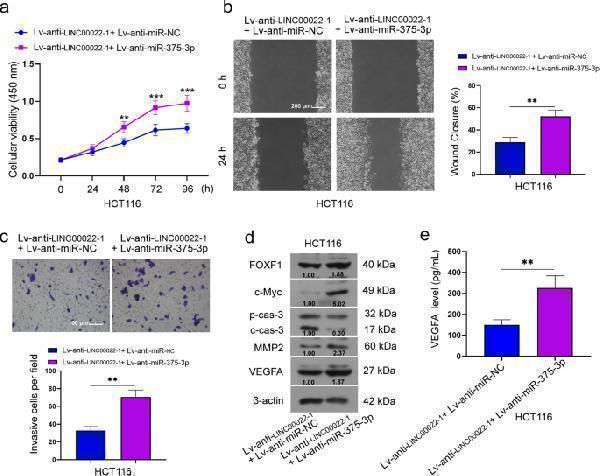
miR-375-3p knockdown reversed the effects of LINC00022 down-regulation on cell function in CRC. After LINC00022-silenced HCT116 cells were infected with Lv-anti-miR-375-3p mimic or Lv-anti-miR-NC, the viability of HCT116 cells was measured by CCK-8 assay ( a ); The migration (Scale bar = 200 μm) and invasion (Scale bar = 100 μm) of HCT116 cells were measured using Wound-healing assay and Transwell assay, respectively ( b and c ); Relative protein levels of FOXF1, c-Myc, pro caspase 3, cleaved caspase 3, MMP2, and VEGFA were assessed by Western blot ( d ). β-actin served as internal control. The content of VEGFA in cell supernatant was measured by detection kit ( e ). Data were presented as mean ± standard deviation (SD). N = 3. ** P < 0.01 vs Lv-anti-LINC00022 + Lv-anti-miR-NC group. NC, negative control; FOXF1, Forkhead Box F1; MMP2, matrix metalloproteinase 2; VEGFA, vascular endothelial growth factor-A
Index in PubMed under a CC BY license. PMID: 35468741
Click image to see more details
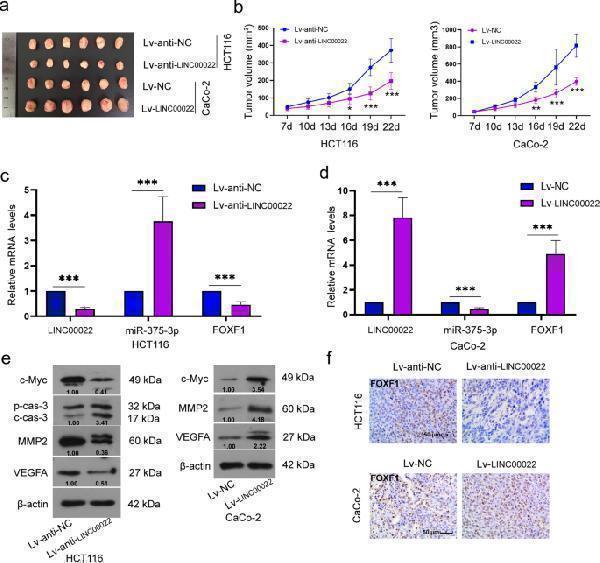
LINC00022 promoted the development of CRC in vivo. HCT116 cells with stable low expression of LINC00022 or CaCo-2 cells with stable overexpression of LINC00022 were injected subcutaneously into nude mice. ( a ) Representative images of tumor tissues in nude mice. ( b ) The volumes were calculated after being injected with LINC00022-silenced cells or -overexpressed cells. ( c and d ) The mRNA levels of LINC00022, miR-375-3p, and FOXF1 were detected in tumor tissues. ( e ) Relative protein levels of c-Myc, pro caspase 3, cleaved caspase 3, MMP2, and VEGFA in tumor tissues. ( f ) Immunohistochemical staining of FOXF1 in tumor tissues. Scale bar = 50 μm. β-actin served as the internal control. Data were presented as mean ± standard deviation (SD). N = 6. * P < 0.05, ** P < 0.01, and *** P < 0.001 vs Lv-anti-NC group or Lv-NC group. FOXF1, Forkhead Box F1; MMP2, matrix metalloproteinase 2; VEGFA, vascular endothelial growth factor-A
Index in PubMed under a CC BY license. PMID: 35468741
Click image to see more details
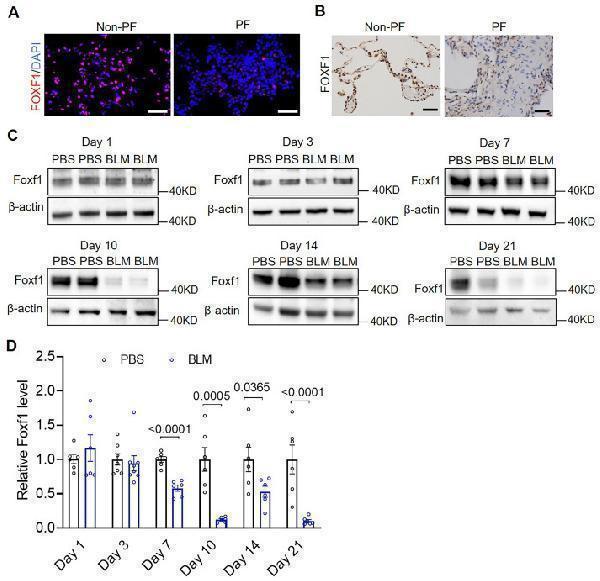
FOXF1 expression is reduced in fibrotic lungs. A and B, Representative immunofluorescence images of FOXF1 (A) and immunohistochemistry images (B) from non-PF and PF lung sections. Scale bars, 50 μm. C and D, Mouse lungs were collected at days 1, 3, 7, 10, 14, and 21 post-BLM instillation, and FOXF1 protein levels were analyzed by Western blot (C) and quantified using ImageJ (D). n = 6–8/group. Statistical analyses were performed using t-tests.
Index in PubMed under a CC BY license. PMID: 41101211
Click image to see more details
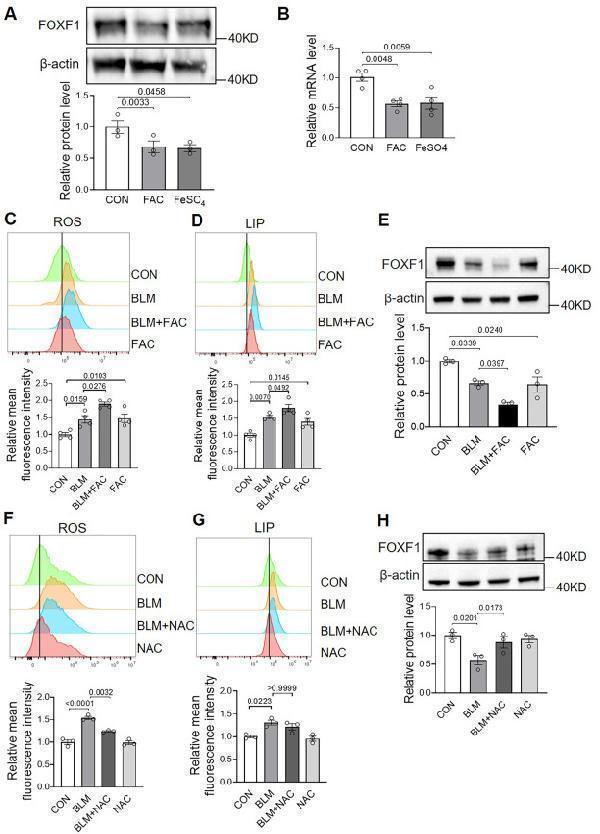
Iron and ROS synergistically suppress FOXF1 levels in human lung fibroblasts. Cells were treated under the indicated conditions for 24 h. A, FOXF1 protein expression and quantification following FAC or FeSO4 treatment. B, FOXF1 mRNA levels determined by RT-PCR using 18S rRNA as an internal control. C, Intracellular ROS levels measured by DCFH-DA following BLM + FAC treatment. D, LIP levels measured using FeRhoNox-1. E, FOXF1 protein expression and quantification with the indicated treatments. F, ROS levels analyzed by flow cytometry with DCFH-DA following BLM + NAC treatment. G, LIP levels determined using FeRhoNox-1 by flow cytometry. H, FOXF1 protein expression and quantification with indicated treatments. FAC (200 μM), FeSO4 (100 μM), BLM (40 μg/mL), NAC (2 mM); n ≥ 3/group.
Index in PubMed under a CC BY license. PMID: 41101211
Click image to see more details
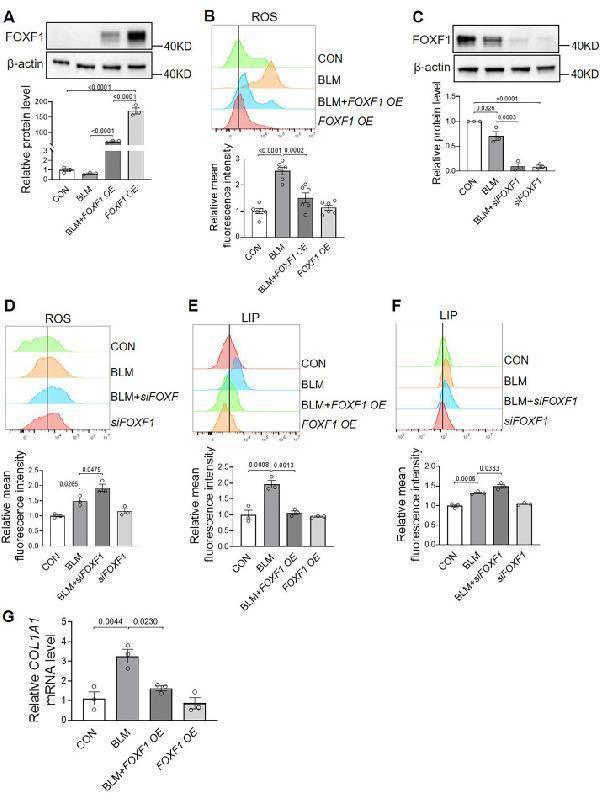
FOXF1 reduces ROS, iron levels, and COL1A1 transcripts in BLM-treated human lung fibroblasts. Cells were treated for 24 h with BLM combined with either FOXF1 overexpression or FOXF1 silencing (by siFOXF1-1), and ROS and LIP levels were analyzed by flow cytometry using DCFH-DA and FeRhoNox-1, respectively. A, FOXF1 protein expression and quantification following FOXF1 overexpression. B, Intracellular ROS levels measured by flow cytometry. C, FOXF1 protein expression and quantification following FOXF1 silencing. D, ROS levels following FOXF1 silencing. E, LIP levels after FOXF1 overexpression. F, LIP levels after FOXF1 silencing. G, COL1A1 mRNA levels analyzed by real-time PCR using β-actin as an internal control. BLM, 40 μg/mL. n ≥ 3/group.
Index in PubMed under a CC BY license. PMID: 41101211
Click image to see more details
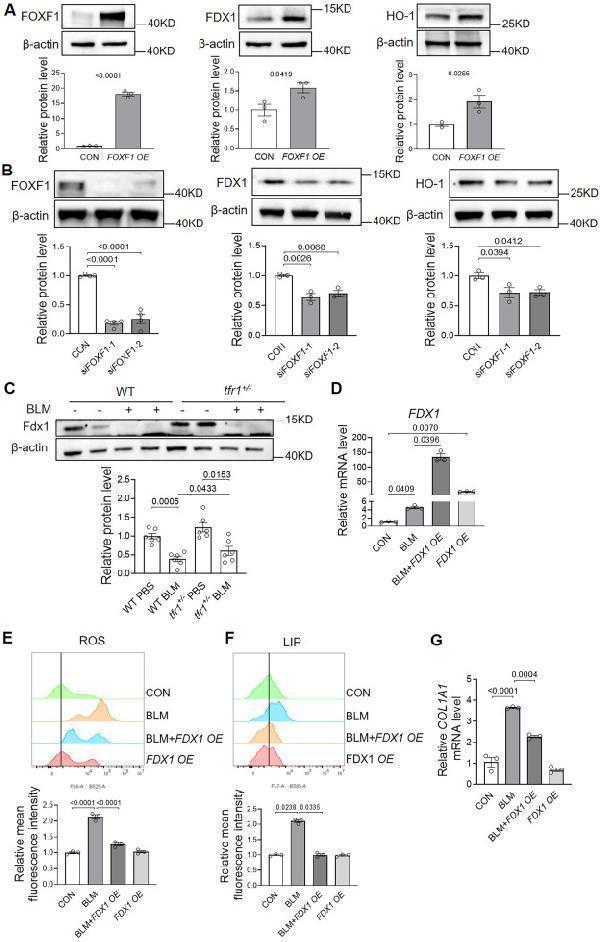
FOXF1 promotes antioxidant protein expression, and FDX1 decreases ROS, Fe2+ levels, and COL1A1 in BLM-treated human primary lung fibroblasts. A, The protein levels of FDX1 and HO-1 were analyzed by Western blot in FOXF1-overexpressing fibroblasts. n = 3/group. B, Protein expression following FOXF1 silencing. n = 3–4/group. C, Western blot analysis of FDX1 protein levels in lungs from BLM-treated WT and tfr1+/− mice with t-test. n = 6/group. D–G, Human fibroblasts treated for 24 h with BLM and FDX1 overexpression were analyzed for FDX1 mRNA levels by RT-PCR with β-actin as the internal control (D), ROS levels by DCFH-DA probe and flow cytometry (E), LIP levels by FeRhoNox-1 and flow cytometry (F), and COL1A1 mRNA levels by real-time PCR with β-actin as the internal control (G). BLM, 40 μg/mL n = 3/group.
Index in PubMed under a CC BY license. PMID: 41101211

Click image to see more details
IHC analysis of FOXF1 using anti-FOXF1 antibody (A03563-1).
FOXF1 was detected in paraffin-embedded section of human oesophagus squama cancer tissue. Heat mediated antigen retrieval was performed in EDTA buffer (pH8.0, epitope retrieval solution). The tissue section was blocked with 10% goat serum. The tissue section was then incubated with 1μg/ml rabbit anti-FOXF1 Antibody (A03563-1) overnight at 4°C. Biotinylated goat anti-rabbit IgG was used as secondary antibody and incubated for 30 minutes at 37°C. The tissue section was developed using Strepavidin-Biotin-Complex (SABC) (Catalog # SA1022) with DAB as the chromogen.
Click image to see more details
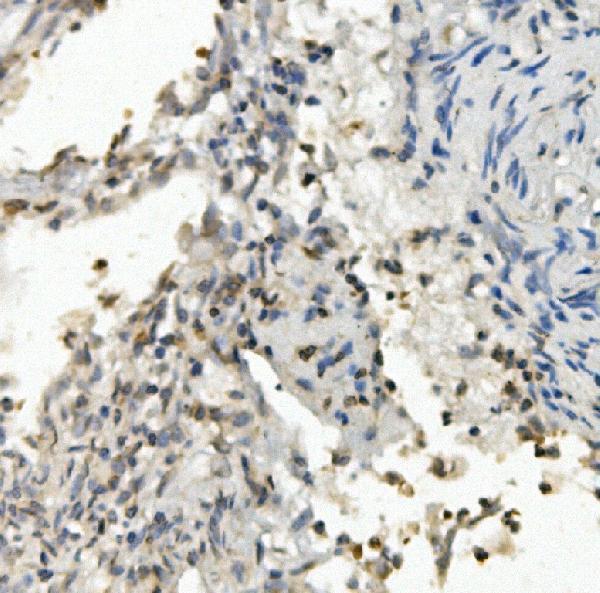
IHC analysis of FOXF1 using anti-FOXF1 antibody (A03563-1).
FOXF1 was detected in paraffin-embedded section of human rectal cancer tissue. Heat mediated antigen retrieval was performed in EDTA buffer (pH8.0, epitope retrieval solution). The tissue section was blocked with 10% goat serum. The tissue section was then incubated with 1μg/ml rabbit anti-FOXF1 Antibody (A03563-1) overnight at 4°C. Biotinylated goat anti-rabbit IgG was used as secondary antibody and incubated for 30 minutes at 37°C. The tissue section was developed using Strepavidin-Biotin-Complex (SABC) (Catalog # SA1022) with DAB as the chromogen.
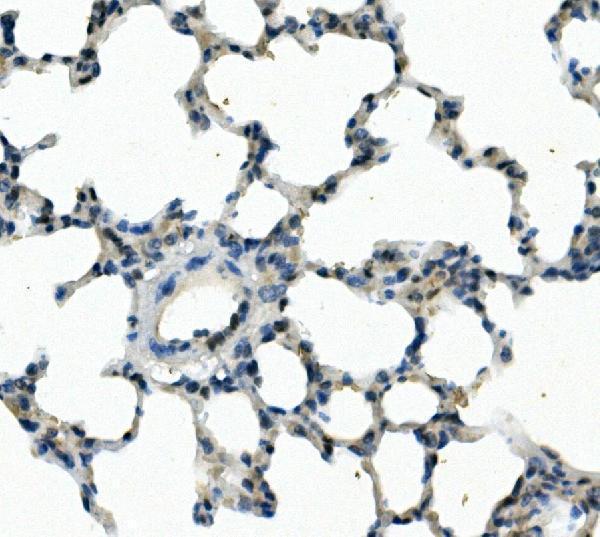
Click image to see more details
IHC analysis of FOXF1 using anti-FOXF1 antibody (A03563-1).
FOXF1 was detected in paraffin-embedded section of rat lung tissue. Heat mediated antigen retrieval was performed in EDTA buffer (pH8.0, epitope retrieval solution). The tissue section was blocked with 10% goat serum. The tissue section was then incubated with 1μg/ml rabbit anti-FOXF1 Antibody (A03563-1) overnight at 4°C. Biotinylated goat anti-rabbit IgG was used as secondary antibody and incubated for 30 minutes at 37°C. The tissue section was developed using Strepavidin-Biotin-Complex (SABC) (Catalog # SA1022) with DAB as the chromogen.
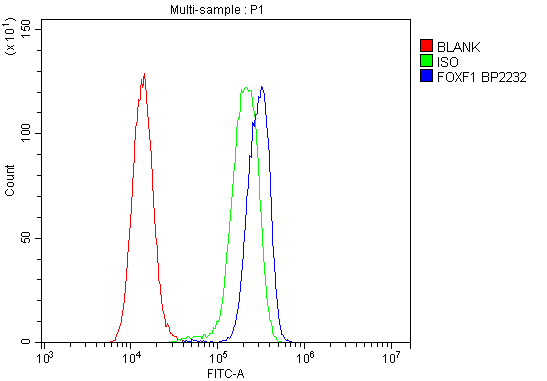
Click image to see more details
Flow Cytometry analysis of Jurkat cells using anti-FOXF1 antibody (A03563-1).
Overlay histogram showing Jurkat cells stained with A03563-1 (Blue line).The cells were blocked with 10% normal goat serum. And then incubated with rabbit anti-FOXF1 Antibody (A03563-1, 1μg/1x106 cells) for 30 min at 20°C. DyLight®488 conjugated goat anti-rabbit IgG (BA1127, 5-10μg/1x106 cells) was used as secondary antibody for 30 minutes at 20°C. Isotype control antibody (Green line) was rabbit IgG (1μg/1x106) used under the same conditions. Unlabelled sample (Red line) was also used as a control.
Specific Publications For Anti-FOXF1 Picoband® Antibody (A03563-1)
Loading publications
Recommended Resources
Here are featured tools and databases that you might find useful.
- Boster's Pathways Library
- Protein Databases
- Bioscience Research Protocol Resources
- Data Processing & Analysis Software
- Photo Editing Software
- Scientific Literature Resources
- Research Paper Management Tools
- Molecular Biology Software
- Primer Design Tools
- Bioinformatics Tools
- Phylogenetic Tree Analysis
Customer Reviews
Have you used Anti-FOXF1 Picoband® Antibody?
Share your experimental results or join a short interview to earn up to $1,000 in product credits or other rewards.
0 Reviews For Anti-FOXF1 Picoband® Antibody
Customer Q&As
Have a question?
Find answers in Q&As, reviews.
Can't find your answer?
Submit your question

