Product Info Summary
| SKU: | PA1599 |
|---|---|
| Size: | 100 μg/vial |
| Reactive Species: | Human |
| Host: | Rabbit |
| Application: | IHC, WB |
Customers Who Bought This Also Bought
Product info
Product Name
Anti-Haptoglobin/HP Antibody Picoband®
SKU/Catalog Number
PA1599
BA3744 is an alternative SKU for this antibody, used in previous lots.
Size
100 μg/vial
Form
Lyophilized
Description
Boster Bio Anti-Haptoglobin/HP Antibody catalog # PA1599. Tested in IHC, WB applications. This antibody reacts with Human. The brand Picoband indicates this is a premium antibody that guarantees superior quality, high affinity, and strong signals with minimal background in Western blot applications. Only our best-performing antibodies are designated as Picoband, ensuring unmatched performance.
Storage & Handling
Store at -20˚C for one year from date of receipt. After reconstitution, at 4˚C for one month. It can also be aliquotted and stored frozen at -20˚C for six months. Avoid repeated freeze-thaw cycles.
Cite This Product
Anti-Haptoglobin/HP Antibody Picoband® (Boster Biological Technology, Pleasanton CA, USA, Catalog # PA1599)
Host
Rabbit
Contents
Each vial contains antibody formulated with stabilizing components, 0.9mg NaCl, 0.2mg Na2HPO4, 0.05mg Thimerosal, 0.05mg NaN3.
*This antibody is supplied in a stabilized formulation.
Compatibility with conjugation reactions depends on the chemistry of the conjugation method used.
For conjugation methods that are not compatible with the stabilizing components present in this formulation, a carrier-free antibody format is required.
Clonality
Polyclonal
Isotype
Rabbit IgG
Immunogen
A synthetic peptide corresponding to a sequence in the middle region of human Haptoglobin.
Cross-reactivity
No cross-reactivity with other proteins
Reactive Species
PA1599 is reactive to HP in Human
Observed Molecular Weight
45 kDa
Calculated molecular weight
45.2 kDa
Background of HP
Haptoglobin (HP), is a protein that in humans is encoded by the HP gene. Haptoglobin, a plasma glycoprotein that binds free hemoglobin, has a tetrameric structure of 2 alpha and 2 beta polypeptides that are covalently associated by disulfide bonds. Haptoglobin is homologous to serine proteases of the chymotrypsinogen family. In the chimpanzee, there are 3 genes in the haptoglobin family (haptoglobin, HP; haptoglobin-related, HPR; and haptoglobin-primate, HPP), whereas only 2 genes exist in humans (HP and HPR). There are similarities between the primary structures of the alpha chain and of light chains of gamma globulins. The alpha haptoglobin locus is on the long arm of chromosome 16, where its exact cytogenetic location is 16q22.2. A major function of haptoglobin is to bind hemoglobin (Hb) to form a stable Hp-Hb complex and thereby prevent Hb-induced oxidative tissue damage. Haptoglobin is an unusual secretory protein in that it is proteolytically processed in the endoplasmic reticulum and not in the Golgi. The human haptoglobin HP*2 allele contains a 1.7-kb intragenic duplication that arose after a unique nonhomologous recombination between the prototype HP*1 alleles.
Antibody Validation
Boster validates all antibodies on WB, IHC, ICC, Immunofluorescence, and ELISA with known positive control and negative samples to ensure specificity and high affinity, including thorough antibody incubations.
Application & Images
Applications
PA1599 is guaranteed for IHC, WB Boster Guarantee
Assay Dilutions Recommendation
The recommendations below provide a starting point for assay optimization. The actual working concentration varies and should be decided by the user.
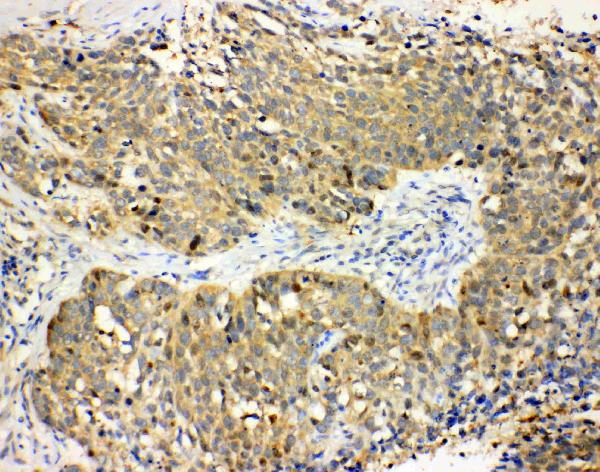
Immunohistochemistry (Paraffin-embedded Section), 0.5-1μg/ml, Human
Western blot, 0.1-0.5μg/ml, Human
Positive Control
WB: human placenta tissue, human HepG2 whole cell
IHC: Human Lung Cancer Tissue
Validation Images & Assay Conditions
Click image to see more details
Western blot analysis of Haptoglobin/HP using anti-Haptoglobin/HP antibody (PA1599).
Electrophoresis was performed on a 5-20% SDS-PAGE gel at 70V (Stacking gel) / 90V (Resolving gel) for 2-3 hours. The sample well of each lane was loaded with 30 ug of sample under reducing conditions.
Lane 1: human placenta tissue lysates,
Lane 2: human HepG2 whole cell lysates.
After electrophoresis, proteins were transferred to a nitrocellulose membrane at 150 mA for 50-90 minutes. Blocked the membrane with 5% non-fat milk/TBS for 1.5 hour at RT. The membrane was incubated with rabbit anti-Haptoglobin/HP antigen affinity purified polyclonal antibody (Catalog # PA1599) at 0.5 μg/mL overnight at 4°C, then washed with TBS-0.1%Tween 3 times with 5 minutes each and probed with a goat anti-rabbit IgG-HRP secondary antibody at a dilution of 1:5000 for 1.5 hour at RT. The signal is developed using an Enhanced Chemiluminescent detection (ECL) kit (Catalog # EK1002) with Tanon 5200 system. A specific band was detected for Haptoglobin/HP at approximately 45 kDa. The expected band size for Haptoglobin/HP is at 42 kDa.
Click image to see more details
Anti-Haptoglobin antibody, PA1599, IHC(P)
IHC(P): Human Lung Cancer Tissue
Click image to see more details
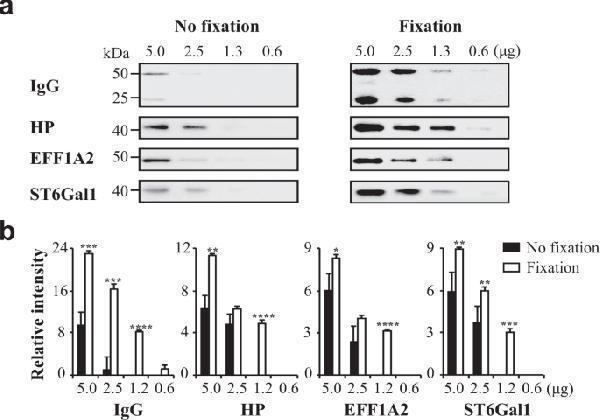
Effects of sample fixation on the retention of proteins of the method using PVDF membranes. ( a ) Indicated numerals are amounts (5.0, 2.5, 1.3, and 0.6 μg) of the pooled serum proteins were subjected to 10% SDS-PAGE. The blotted membranes were treated using the traditional (left panel) or optimised fixation protocol (right). ( b ) Staining intensities were statistically analyzed (n = 3 individual experiments). Solid bar, no fixation; White bar, optimised fixation protocol. The exposure times were the same in all procedures. Band intensities were analysed and compared using Image Lab software (Bio-Rad Laboratories) and GraphPad Prism version 6. * Significantly different p < 0.05, ** p < 0.01, *** p < 0.001, **** p < 0.0001. All values are means ± S.E. (error bars).
Index in PubMed under a CC BY license. PMID: 31040299
Click image to see more details
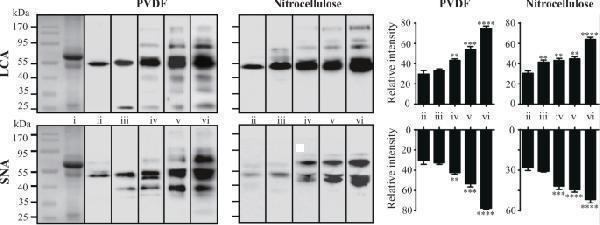
Fixation-dependent differences in lectin staining intensities when using PVDF and nitrocellulose membranes. Pooled human serum proteins (3 μg) were separated on 10% SDS-PAGE, and the proteins were transferred onto PVDF and nitrocellulose membranes, the whole membrane was cutted into five pieces for subsequently fixation treatments and followed by staining with lectins (LCA and SNA). Lane i, CBB staining; lane ii, no fixation; lane iii, drying at room temperature; lane iv, sample heating at 100 °C; lane v, organic solvent (acetone and 50% methanol for PVDF and nitrocellulose membranes, respectively) treatments at room temperature; lane vi, organic solvent treatments followed by sample heating at 100 °C. All treatments were applied for 30 min. Left, WB pattern; right, quantitative analysis (n = 3 individual experiments). The exposure times were the same in all procedures. Band intensities were analysed and compared using Image Lab software (Bio-Rad Laboratories) and GraphPad Prism version 6. ** Significantly different p < 0.01, *** p < 0.001, **** p < 0.0001. All values are means ± S.E. (error bars).
Index in PubMed under a CC BY license. PMID: 31040299
Click image to see more details
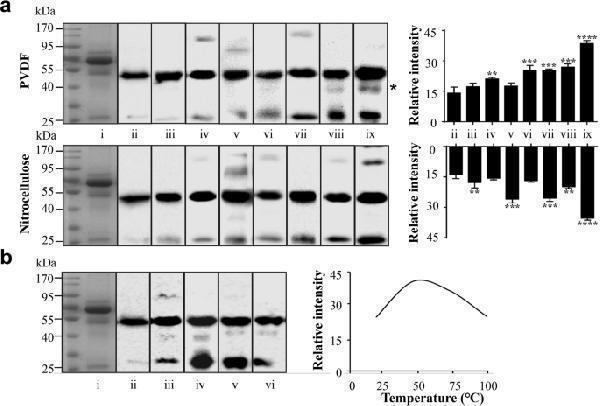
Fixation method-dependent differences in the immunostaining intensity. ( a ) Pooled human serum samples (10 μg) were analysed by 10% SDS-PAGE, and the separated proteins were transferred onto PVDF (top) and nitrocellulose (bottom) membranes, the whole membrane was cutted into eight pieces for subsequently fixation treatments. Representative images, showing anti-human IgG antibody staining after the following treatments: lane i, Coomassie Brilliant Blue (CBB) staining; lane ii, no fixation; lane iii, drying at room temperature; lane iv, heating at 50 °C; lane v, heating at 100 °C; lane vi, immersion into the organic solvents (acetone and 50% methanol for PVDF and nitrocellulose membranes, respectively) at room temperature; lane vii, immersion into the organic solvents at 0 °C; lane viii, immersion into the organic solvents at 0 °C followed by sample heating at 100 °C; lane ix, immersion into the organic solvents at 0 °C followed by sample heating at 50 °C. All treatments were performed for 30 min. The relative intensity was shown on the right (n = 3 individual experiments). ( b ) Proteins were separated by 10% SDS-PAGE, and transferred onto PVDF membranes, the whole membrane was cutted into five pieces for subsequently fixation treatments. Fixed in acetone at 0 °C, and heated at different temperatures for 30 min prior to the immunostaining. Lane i, CBB staining; lane ii, no fixation; lane iii, heating at 25 °C; lane iv, heating at 50 °C; lane v, heating at 75 °C; lane vi, heating at 100 °C. Right panel shows the relative intensity at different temperatures. The exposure times were the same in all procedures. Band intensities were analysed and compared using Image Lab software (Bio-Rad Laboratories) and GraphPad Prism version 6. ** Significantly different p < 0.01, *** p < 0.001, **** p < 0.0001. All values are means ± S.E. (error bars).
Index in PubMed under a CC BY license. PMID: 31040299
Click image to see more details
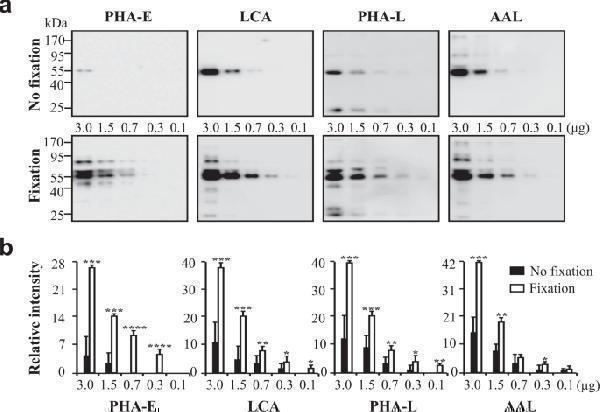
Sensitivity of the LB method coupled with the fixation step, when using PVDF membranes. Indicated numerals are amounts (3.0, 1.5, 0.7, 0.3, and 0.1 μg) of the pooled serum proteins were subjected to 10% SDS-PAGE. ( a ) The blotted membranes were treated using the traditional (top panel) or optimised fixation protocol (bottom panel). ( b ) Quantification of band intensities were statistically analyzed (n = 3 individual experiments). Solid bar, no fixation; White bar, sample fixation. The exposure times were the same for the same lectin blotting using fixation or no fixation. Band intensities were analysed and compared using Image Lab software (Bio-Rad Laboratories) and GraphPad Prism version 6. * Significantly different p < 0.05, ** p < 0.01, *** p < 0.001, **** p < 0.0001. All values are means ± S.E. (error bars).
Index in PubMed under a CC BY license. PMID: 31040299
Click image to see more details
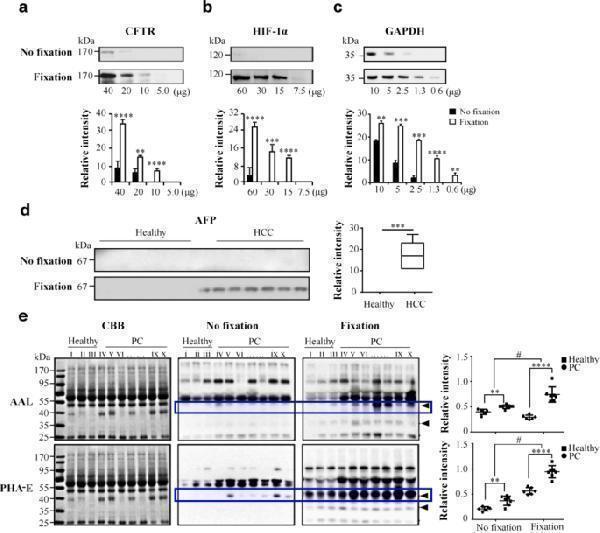
Application of the optimised immunostaining and lectin staining methods. ( a ) CFTR levels in HT-29 cells. ( b ) HIF-1α levels in HEK-293T cells. ( c ) GAPDH levels in liver tissue of mouse. Various amounts (quantity represented in μg) of total cellular proteins analysed using 8% SDS-PAGE and immunostained using PVDF membrane and treated with or without fixation treatments. ( d ) AFP levels in the sera of healthy volunteers (n = 6) and HCC patients (n = 7), with different sample volumes using the PVDF membranes, with or without the fixation. ** Significantly different p < 0.01, *** p < 0.001, **** p < 0.0001. All values are means ± S.E. (error bars). ( e ) AAL and PHA-E staining, using 6 μg of proteins from the sera of healthy volunteers (n = 6) and prostate cancer patients (PC, n = 10), blotted on PVDF membranes, with or without fixation. Three representative healthy samples (lane i, ii, iii) and seven representative prostate cancer samples (lane iv-x) are presented (left). Boxplot provides the quantification of the total band intensities (right). Circle, healthy subjects; square, prostate cancer patients. Student’s t-test. ** P < 0.01 and **** P < 0.0001, healthy subjects vs. PC patients; # P < 0.0001, No fixation vs fixation groups. Band intensities were compared using Image Lab software (Bio-Rad Laboratories) and GraphPad Prism version 6.
Index in PubMed under a CC BY license. PMID: 31040299
Specific Publications For Anti-Haptoglobin/HP Antibody Picoband® (PA1599)
Loading publications
Recommended Resources
Here are featured tools and databases that you might find useful.
- Boster's Pathways Library
- Protein Databases
- Bioscience Research Protocol Resources
- Data Processing & Analysis Software
- Photo Editing Software
- Scientific Literature Resources
- Research Paper Management Tools
- Molecular Biology Software
- Primer Design Tools
- Bioinformatics Tools
- Phylogenetic Tree Analysis
Customer Reviews
Have you used Anti-Haptoglobin/HP Antibody Picoband®?
Share your experimental results or join a short interview to earn up to $1,000 in product credits or other rewards.
0 Reviews For Anti-Haptoglobin/HP Antibody Picoband®
Customer Q&As
Have a question?
Find answers in Q&As, reviews.
Can't find your answer?
Submit your question