

Click image to see more details
Product Info Summary
| SKU: | M08842 |
|---|---|
| Size: | 100uL |
| Reactive Species: | Human |
| Host: | Mouse |
| Application: | ELISA, WB |
Customers Who Bought This Also Bought

Product info
Product Name
Anti-MTBP Monoclonal Antibody
SKU/Catalog Number
M08842
Size
100uL
Form
Liquid (sterile filtered)
Description
Boster Bio Anti-MTBP Monoclonal Antibody (Catalog # M08842). Tested in ELISA, WB applications. This antibody reacts with Human.
Storage & Handling
Store vial at -20°C prior to opening. Aliquot contents and freeze at -20°C or below for extended storage. Avoid cycles of freezing and thawing. Centrifuge product if not completely clear after standing at room temperature. This product is stable for several weeks at 4°C as an undiluted liquid. Dilute only prior to immediate use. Expiration date is one (1) year from date of opening. (Ship on dry ice.)
Cite This Product
Anti-MTBP Monoclonal Antibody (Boster Biological Technology, Pleasanton CA, USA, Catalog # M08842)
Host
Mouse
Contents
0.02 M Potassium Phosphate, 0.15 M Sodium Chloride, pH 7.2, 0.01% (w/v) Sodium Azide
Clonality
Monoclonal
Clone Number
Clone: PHL-1
Isotype
IgG1 kappa
Immunogen
This monoclonal antibody was produced by repeated immunizations with a recombinant amino-terminal HIS6X-tagged polypeptide corresponding to amino acid residues 667-812 of human MTBP protein.
Cross-reactivity
No cross reactivity with other proteins.
Reactive Species
M08842 is reactive to MTBP in Human
Observed Molecular Weight
47 kDa
Calculated molecular weight
102.2 kDa
Background of MTBP
The MDM2 onco-protein is over expressed in human cancer cells and it promotes tumorigenesis by directly blocking the function of the p53 tumor suppressor. Studies also indicate that MDM2 regulates cell proliferation via p53 independent mechanisms. MTBP (Mdm2 [Two] Binding Protein) was identified by a yeast two-hybrid screen as an MDM2 binding protein (1). MTBP has been reported to modulate cell cycle progression by a p53 independent mechanism and suppress MDM2-mediated p53 degradation when ectopically expressed in cells (1,2). The human MTBP gene localizes to 8q24 (3) and MTBP RNA is expressed in a wide range of tissues, with highest being in the thymus, testes and ovaries (1).
Antibody Validation
Boster validates all antibodies on WB, IHC, ICC, Immunofluorescence, and ELISA with known positive control and negative samples to ensure specificity and high affinity, including thorough antibody incubations.
Application & Images
Applications
M08842 is guaranteed for ELISA, WB Boster Guarantee
Recommend Dilution
| Application | Dilution | Species |
|---|---|---|
| ELISA: 1:2 | 000 - 1:20 | 000 |
| WB: 1:200 - 1:2 | 000 |
Validation Images & Assay Conditions
Click image to see more details
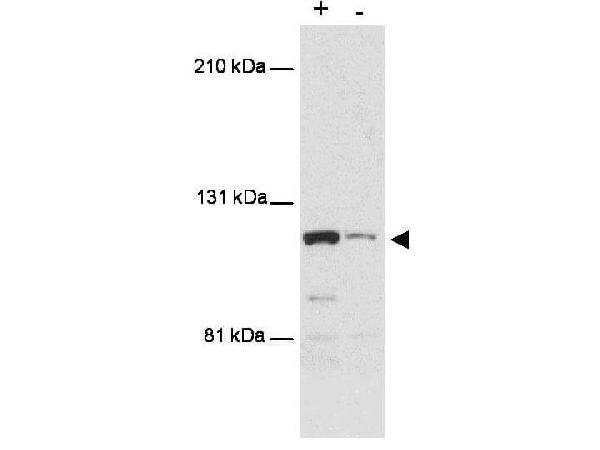
Western blot using Boster's anti-MTBP antibody shows detection of a band ~110 kDa corresponding to human MTBP (arrowhead). Lanes represent human 293 cell lysates with (+) and without (-) transfection with a full-length human expression MTBP construct. The transfected cell extract was diluted 30 fold in extract lacking transfected MTBP. Proteins were separated by SDS-PAGE and transferred onto PDVF membrane. After blocking, the membrane was probed with the primary antibody diluted to 1:500 for 2h at room temperature followed by detection using a Lumi-LightPlus Western Blotting Kit (Roche).
Specific Publications For Anti-MTBP Monoclonal Antibody (M08842)
Loading publications
Recommended Resources
Here are featured tools and databases that you might find useful.
- Boster's Pathways Library
- Protein Databases
- Bioscience Research Protocol Resources
- Data Processing & Analysis Software
- Photo Editing Software
- Scientific Literature Resources
- Research Paper Management Tools
- Molecular Biology Software
- Primer Design Tools
- Bioinformatics Tools
- Phylogenetic Tree Analysis
Customer Reviews
Have you used Anti-MTBP Monoclonal Antibody?
Share your experimental results or join a short interview to earn up to $1,000 in product credits or other rewards.
0 Reviews For Anti-MTBP Monoclonal Antibody
Customer Q&As
Have a question?
Find answers in Q&As, reviews.
Can't find your answer?
Submit your question
5 Customer Q&As for Anti-MTBP Monoclonal Antibody
Question
Will anti-MTBP Monoclonal antibody M08842 work on dog WB with cervix carcinoma?
Verified Customer
Verified customer
Asked: 2019-11-13
Answer
Our lab technicians have not tested anti-MTBP Monoclonal antibody M08842 on dog. You can run a BLAST between dog and the immunogen sequence of anti-MTBP Monoclonal antibody M08842 to see if they may cross-react. If the sequence homology is close, then you can perform a pilot test. Keep in mind that since we have not validated dog samples, this use of the antibody is not covered by our guarantee. However we have an innovator award program that if you test this antibody and show it works in dog cervix carcinoma in WB, you can get your next antibody for free.
Boster Scientific Support
Answered: 2019-11-13
Question
I have attached the WB image, lot number and protocol we used for prostate using anti-MTBP Monoclonal antibody M08842. Please let me know if you require anything else.
Verified Customer
Verified customer
Asked: 2019-07-02
Answer
Thank you very much for the data. Our lab team are working to resolve this as quickly as possible, and we appreciate your patience and understanding! You have provided everything we needed. Please let me know if there is anything you need in the meantime.
Boster Scientific Support
Answered: 2019-07-02
Question
Will M08842 anti-MTBP Monoclonal antibody work on parafin embedded sections? If so, which fixation method do you recommend we use (PFA, paraformaldehyde, other)?
Verified Customer
Verified customer
Asked: 2018-09-05
Answer
It shows on the product datasheet, M08842 anti-MTBP Monoclonal antibody as been tested on WB. It is best to use PFA for fixation because it has better tissue penetration ability. PFA needs to be prepared fresh before use. Long term stored PFA turns into formalin, as the PFA molecules congregate and become formalin.
Boster Scientific Support
Answered: 2018-09-05
Question
Our lab want to know about to test anti-MTBP Monoclonal antibody M08842 on human prostate for research purposes, then I may be interested in using anti-MTBP Monoclonal antibody M08842 for diagnostic purposes as well. Is the antibody suitable for diagnostic purposes?
Verified Customer
Verified customer
Asked: 2018-07-30
Answer
The products we sell, including anti-MTBP Monoclonal antibody M08842, are only intended for research use. They would not be suitable for use in diagnostic work. If you have the means to develop a product into diagnostic use, and are interested in collaborating with us and develop our product into an IVD product, please contact us for more discussions.
Boster Scientific Support
Answered: 2018-07-30
Question
We are currently using anti-MTBP Monoclonal antibody M08842 for human tissue, and we are well pleased with the WB results. The species of reactivity given in the datasheet says human. Is it likely that the antibody can work on dog tissues as well?
T. Anderson
Verified customer
Asked: 2017-08-08
Answer
The anti-MTBP Monoclonal antibody (M08842) has not been validated for cross reactivity specifically with dog tissues, though there is a good chance of cross reactivity. We have an innovator award program that if you test this antibody and show it works in dog you can get your next antibody for free. Please contact me if I can help you with anything.
Boster Scientific Support
Answered: 2017-08-08

