

Click image to see more details
Product Info Summary
| SKU: | BA1001 |
|---|---|
| Size: | 0.5ml |
| Reactive Species: | Mouse |
| Host: | Goat |
| Application: | ELISA, IHC |
Product info
Product Overview
| Product Name | Goat Anti-Mouse IgG (H+L) Secondary Antibody, Biotin Conjugate |
|---|---|
| Synonyms | Biotin-conjugated goat anti-mouse IgG; Goat Anti-Mouse IgG Biotinylated Antibody; Biotinylated Goat Anti-Mouse IgG Secondary Antibody |
| Description | Goat Anti-Mouse IgG (H+L) Secondary Antibody, Biotin Conjugate, for indirect sensitive immunodetection and/or quantification of low-abundancy target proteins through ELISA or IHC |
| Label | Biotin |
| Host | Goat |
| Target Species | Mouse |
| Antibody Class | IgG |
| Clonality | Polyclonal |
| Immunogen | Whole molecule mouse IgG |
| Purification | Immunoaffinity chromatography |
| Specificity | Mouse IgG specific; no cross-reactivity with human/bovine/rabbit IgG |
| Form Supplied | Liquid: concentrated buffered stock solution |
| Formulation | 0.5 mg biotin-conjugated secondary antibody
0.01 M PBS (PH 7.4) 50% glycerol |
| Pack Size | 0.5 ml |
| Concentration | 1 mg/ml |
| Application | ELISA, IHC |
| Storage | At -20˚C for one year from date of receipt. Avoid repeated freezing and thawing. |
| Shipping | Ships with gel ice. |
| Precautions | FOR RESEARCH USE ONLY. NOT FOR DIAGNOSTIC OR CLINICAL USE |
Assay Information
| Sample Type | SDS-PAGE separated-, membrane-immobilized-, mouse primary-antibody-probed proteins from cell/tissue lysates |
|---|---|
| Assay Type | Immunoassay |
| Assay Purpose | Protein detection/quantification |
| Technique | Immunodetection of target protein via reporter-labeled biotin-binding (detection) systems |
| Equipment Needed | WB/Dot blot/ELISA/IHC instrumentation; X-ray film cassette or a charge-coupled device (CCD) imager; Spectrophotometer; fluorescent or electron microscope |
Main Advantages
| Specificity | High signal-to-noise ratio |
|---|---|
| Sensitive | High reporter-to-antibody ratio |
| High Signal Amplification | Multiple secondary antibodies can bind to a single primary antibody;Secondary antibodies Fc regions provide further binding locations for biotin, or enable the use of ABC and SABC |
| Fast | Generates strong signals in a relatively short time span |
| Quantifieable | Allows quantification of detected signal |
| Easy to Use | Supplied in a workable liquid format |
| Flexible | Biotin-Avidin system can be coupled with various types of reporters (enzymes, fluorochromes, fluorophores, chromophores, etc.) |
| Convenient | Biotin's small size renders no interference with enzymatic catalysis or antibody binding |
Background
Most commonly, secondary antibodies are generated by immunizing the host animal with a pooled population of immunoglobulins from the target species. The host antiserum is then purified through immunoaffinity chromatography to remove all host serum proteins, except the specific antibody of interest, and then modified with antibody fragmentation, label conjugation, etc. to achieve highly specific reagents for molecular detection. Secondary antibodies can be conjugated to a large number of labels, including enzymes, biotin, and fluorescent dyes/proteins. Here, the antibody provides the specificity to locate the protein of interest by recognizing a primary antibody that targets a particular antigen, and the label generates a detectable signal in the area of the formed immune complexes. The label of choice depends upon the experimental application.
Biotinylated antibodies are widely used in systems where signal amplification is desired. Often 15-20 biotin moieties are coupled to a single IgG secondary antibody. Biotin binds avidin, streptavidin, or neutravidin with a high degree of affinity and specificity. In immunoassays avidin/streptavidin-biotin binding is used as a bridge between antibodies and reporters like enzymes (HRP, AP), fluorophores, chromophores, etc. Both avidin and streptavidin are tetrameric proteins capable of binding 4 biotin groups to each molecule of avidin or streptavidin, thus amplifying the signal intensity and detection sensitivity by increasing the concentration of reporters at the antigenic site. Two main biotin-binding detection systems have been widely utilized: Avidin-Biotin Complex (ABC) and Labeled Streptavidin Biotin (LSAB) methods. In the ABC method free avidin (or streptavidin) is used as a bridge/link between the biotinylated antibody and а biotinylated reporter molecule, resulting in three reporter molecules coupled to the biotinylated antibody. The LSAB method employs a reporter-labeled streptavidin (avidin or neutravidin can alternatively be used) to detect the bound biotinylated-secondary antibody on the tissue section, blotting membrane or ELISA plate, improving the sensitivity of detection by 8-fold. The LSAB method is used when the avidin-biotin-enzyme complex in the ABC method becomes too large to penetrate the tissue.
Images
Product Images
Click image to see more details
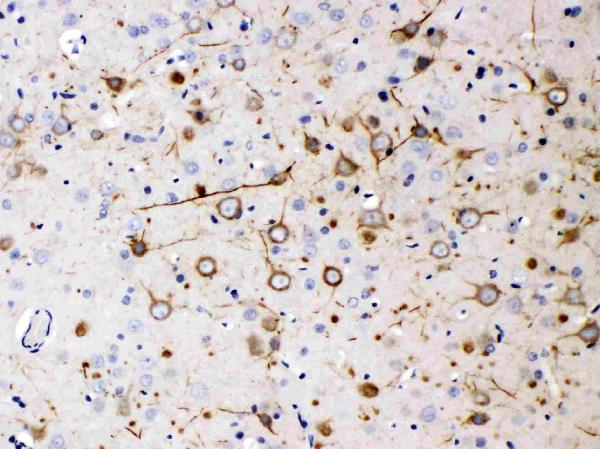
NEFH was detected in paraffin-embedded sections of rat brain tissues using mouse anti-NEFH Antigen Affinity purified monoclonal antibody (Catalog # MA1071) at 1 μg/mL. Biotin Conjugated goat anti-mouse IgG (H+L) secondary antibody (Catalog # BA1001) was used to detect the primary antibody at 10μg/mL.

Click image to see more details
PCNA was detected in paraffin-embedded sections of human intestinal cancer tissues using mouse anti-PCNA Antigen Affinity purified monoclonal antibody (Catalog # MA1083) at 1 μg/mL. Biotin Conjugated goat anti-mouse IgG (H+L) secondary antibody (Catalog # BA1001) was used to detect the primary antibody at 10μg/mL.
Specific Publications For Goat Anti-Mouse IgG (H+L) Secondary Antibody, Biotin Conjugated (BA1001)
Loading publications
Customer Reviews
Have you used Goat Anti-Mouse IgG (H+L) Secondary Antibody, Biotin Conjugated?
Share your experimental results or join a short interview to earn up to $1,000 in product credits or other rewards.
0 Reviews For Goat Anti-Mouse IgG (H+L) Secondary Antibody, Biotin Conjugated
Customer Q&As
Have a question?
Find answers in Q&As, reviews.
Can't find your answer?
Submit your question
1 Customer Q&As for Goat Anti-Mouse IgG (H+L) Secondary Antibody, Biotin Conjugated
Question
Does the goat species used for BA1001 follow the CITES regulation?
Verified Customer
Verified customer
Asked: 2013-03-29
Answer
The goat species used for the Goat Anti-Mouse IgG (H+L) Secondary Antibody, Biotin Conjugate BA1001 are domesticated form which are are not subject to the Regulation.
Boster Scientific Support
Answered: 2013-03-29

