

Click image to see more details
Product Info Summary
| SKU: | A18881 |
|---|---|
| Size: | 100μl |
| Reactive Species: | Human |
| Host: | Rabbit |
| Application: | ELISA, IF, WB |
Customers Who Bought This Also Bought

Product info
Product Name
Anti-Olfactory receptor 9Q2 Antibody
SKU/Catalog Number
A18881
Size
100μl
Form
Liquid
Description
Boster Bio Anti-Olfactory receptor 9Q2 Antibody catalog # A18881. Tested in WB, IF, ELISA applications. This antibody reacts with Human.
Storage & Handling
Store at -20°C for one year. For short term storage and frequent use, store at 4°C for up to one month. Avoid repeated freeze-thaw cycles.
Cite This Product
Anti-Olfactory receptor 9Q2 Antibody (Boster Biological Technology, Pleasanton CA, USA, Catalog # A18881)
Host
Rabbit
Contents
Liquid in PBS containing 50% glycerol, 0.5% stabilizing protein and 0.02% sodium azide.
This antibody is supplied in a stabilized formulation.
Compatibility with conjugation reactions depends on the chemistry of the conjugation method used.
For conjugation methods that are not compatible with the stabilizing components present in this formulation, a carrier-free antibody format is required.
Clonality
Polyclonal
Isotype
IgG
Immunogen
The antiserum was produced against synthesized peptide derived from human OR9Q2. AA range:232-281
Reactive Species
A18881 is reactive to OR9Q2 in Human
Calculated molecular weight
35.4 kDa
Antibody Validation
Boster validates all antibodies on WB, IHC, ICC, Immunofluorescence, and ELISA with known positive control and negative samples to ensure specificity and high affinity, including thorough antibody incubations.
Application & Images
Applications
A18881 is guaranteed for ELISA, IF, WB Boster Guarantee
Recommend Dilution
WB 1:500-1:2000
IF 1:200-1:1000
ELISA 1:20000
Validation Images & Assay Conditions
Click image to see more details
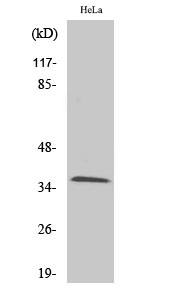
Western Blot analysis of various cells using Olfactory receptor 9Q2 Polyclonal Antibody
Click image to see more details
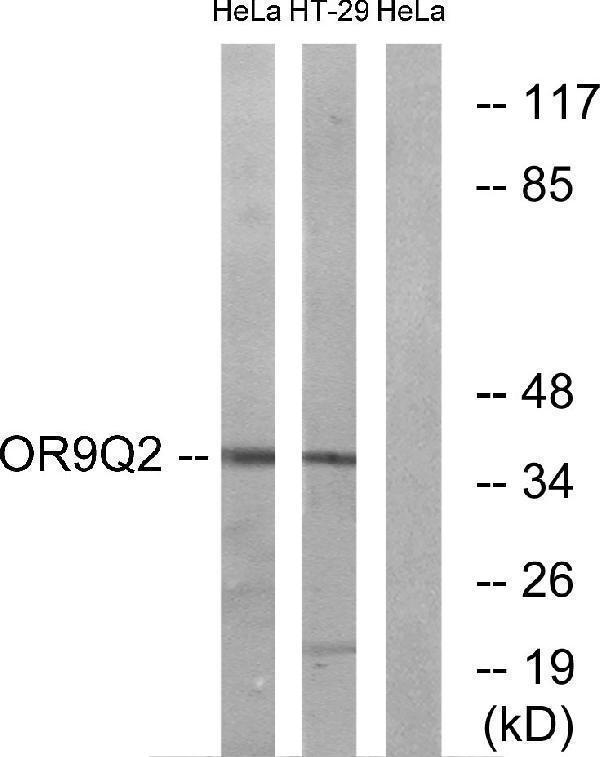
Western blot analysis of lysates from HeLa and HT-29 cells, using OR9Q2 Antibody. The lane on the right is blocked with the synthesized peptide.
Specific Publications For Anti-Olfactory receptor 9Q2 Antibody (A18881)
Loading publications
Recommended Resources
Here are featured tools and databases that you might find useful.
- Boster's Pathways Library
- Protein Databases
- Bioscience Research Protocol Resources
- Data Processing & Analysis Software
- Photo Editing Software
- Scientific Literature Resources
- Research Paper Management Tools
- Molecular Biology Software
- Primer Design Tools
- Bioinformatics Tools
- Phylogenetic Tree Analysis
Customer Reviews
Have you used Anti-Olfactory receptor 9Q2 Antibody?
Share your experimental results or join a short interview to earn up to $1,000 in product credits or other rewards.
0 Reviews For Anti-Olfactory receptor 9Q2 Antibody
Customer Q&As
Have a question?
Find answers in Q&As, reviews.
Can't find your answer?
Submit your question
6 Customer Q&As for Anti-Olfactory receptor 9Q2 Antibody
Question
Is this A18881 anti-Olfactory receptor 9Q2 antibody reactive to the isotypes of OR9Q2?
Verified Customer
Verified customer
Asked: 2019-12-11
Answer
The immunogen of A18881 anti-Olfactory receptor 9Q2 antibody is Synthesized peptide derived from the C-terminal region of human Olfactory receptor 9Q2. at AA rangle: 200-280. Could you tell me which isotype you are interested in so I can help see if the immunogen is part of this isotype?
Boster Scientific Support
Answered: 2019-12-11
Question
you antibody to test anti-Olfactory receptor 9Q2 antibody A18881 on human testis for research purposes, then I may be interested in using anti-Olfactory receptor 9Q2 antibody A18881 for diagnostic purposes as well. Is the antibody suitable for diagnostic purposes?
J. Patel
Verified customer
Asked: 2019-06-27
Answer
The products we sell, including anti-Olfactory receptor 9Q2 antibody A18881, are only intended for research use. They would not be suitable for use in diagnostic work. If you have the means to develop a product into diagnostic use, and are interested in collaborating with us and develop our product into an IVD product, please contact us for more discussions.
Boster Scientific Support
Answered: 2019-06-27
Question
Here is the WB image, lot number and protocol we used for testis using anti-Olfactory receptor 9Q2 antibody A18881. Please let me know if you require anything else.
Verified Customer
Verified customer
Asked: 2019-06-19
Answer
Thank you very much for the data. Our lab team are working to resolve this as quickly as possible, and we appreciate your patience and understanding! You have provided everything we needed. Please let me know if there is anything you need in the meantime.
Boster Scientific Support
Answered: 2019-06-19
Question
We are currently using anti-Olfactory receptor 9Q2 antibody A18881 for human tissue, and we are happy with the WB results. The species of reactivity given in the datasheet says human. Is it possible that the antibody can work on goat tissues as well?
J. Rodriguez
Verified customer
Asked: 2019-05-06
Answer
The anti-Olfactory receptor 9Q2 antibody (A18881) has not been tested for cross reactivity specifically with goat tissues, though there is a good chance of cross reactivity. We have an innovator award program that if you test this antibody and show it works in goat you can get your next antibody for free. Please contact me if I can help you with anything.
Boster Scientific Support
Answered: 2019-05-06
Question
Is a blocking peptide available for product anti-Olfactory receptor 9Q2 antibody (A18881)?
T. Miller
Verified customer
Asked: 2019-04-11
Answer
We do provide the blocking peptide for product anti-Olfactory receptor 9Q2 antibody (A18881). If you would like to place an order for it please contact support@bosterbio.com and make a special request.
Boster Scientific Support
Answered: 2019-04-11
Question
Would A18881 anti-Olfactory receptor 9Q2 antibody work on parafin embedded sections? If so, which fixation method do you recommend we use (PFA, paraformaldehyde, other)?
J. Anderson
Verified customer
Asked: 2016-08-22
Answer
You can see on the product datasheet, A18881 anti-Olfactory receptor 9Q2 antibody as been tested on WB. It is best to use PFA for fixation because it has better tissue penetration ability. PFA needs to be prepared fresh before use. Long term stored PFA turns into formalin, as the PFA molecules congregate and become formalin.
Boster Scientific Support
Answered: 2016-08-22

