

Click image to see more details
-

-
-
-
-
+2
Product Info Summary
| SKU: | M06232-1 |
|---|---|
| Size: | 100 µl |
| Reactive Species: | Human, Monkey, Mouse |
| Host: | Mouse |
| Application: | Flow Cytometry, IF, IHC, WB |
Customers Who Bought This Also Bought

Product info
Product Name
Anti-SH2D2A Mouse Monoclonal Antibody [Clone ID: OTI3C7]
SKU/Catalog Number
M06232-1
Size
100 µl
Description
Boster Bio SH2D2A mouse monoclonal antibody, clone OTI3C7 (formerly 3C7). Catalog# M06232-1. Tested in FC, IF, IHC, WB. This antibody reacts with Human, Monkey, Mouse.
Storage & Handling
Store at -20°C as received.
Cite This Product
Anti-SH2D2A Mouse Monoclonal Antibody [Clone ID: OTI3C7] (Boster Biological Technology, Pleasanton CA, USA, Catalog # M06232-1)
Host
Mouse
Contents
PBS (pH 7.3) containing 1% stabilizing protein, 50% glycerol and 0.02% sodium azide.
This antibody is supplied in a stabilized formulation.
Compatibility with conjugation reactions depends on the chemistry of the conjugation method used.
For conjugation methods that are not compatible with the stabilizing components present in this formulation, a carrier-free antibody format is required.
Clonality
Monoclonal
Clone Number
OTI3C7
Isotype
IgG1
Immunogen
Full length human recombinant protein of human SH2D2A (NP_003966) produced in HEK293T cell.
Reactive Species
M06232-1 is reactive to SH2D2A in Human, Monkey, Mouse
Calculated molecular weight
42.9 kDa
Antibody Validation
Boster validates all antibodies on WB, IHC, ICC, Immunofluorescence, and ELISA with known positive control and negative samples to ensure specificity and high affinity, including thorough antibody incubations.
Application & Images
Applications
M06232-1 is guaranteed for Flow Cytometry, IF, IHC, WB Boster Guarantee
Assay Dilutions Recommendation
The recommendations below provide a starting point for assay optimization. The actual working concentration varies and should be decided by the user.
WB 1:500~2000
IF 1:100
Flow Cytometry 1:100
Validation Images & Assay Conditions
Click image to see more details
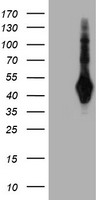
HEK293T cells were transfected with the pCMV6-ENTRY control (Left lane) or pCMV6-ENTRY SH2D2A (Right lane) cDNA for 48 hrs and lysed. Equivalent amounts of cell lysates (5 ug per lane) were separated by SDS-PAGE and immunoblotted with anti-SH2D2A.
Click image to see more details
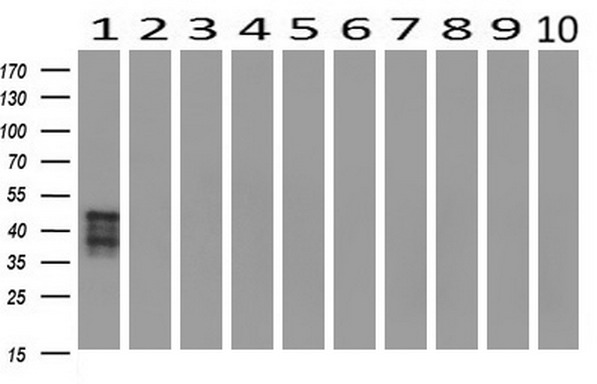
Western blot analysis of extracts (10ug) from 10 Human tissue by using anti-SH2D2A monoclonal antibody at 1:200 (1: Testis; 2: Omentum; 3: Uterus; 4: Breast; 5: Brain; 6: Liver; 7: Ovary; 8: Thyroid gland; 9: colon;10: spleen).
Click image to see more details
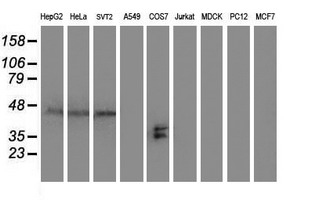
Western blot analysis of extracts (35ug) from 9 different cell lines by using anti-SH2D2A monoclonal antibody.
Click image to see more details
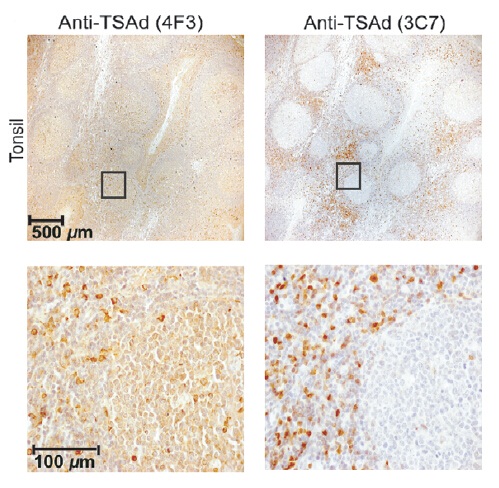
Figure from citation: Comparison of IHC on tonsil with clone 4F3 and clone 3C7 (M06232-1) SH2D2A mAb and HRP-conjugated secondary antibodies.
Click image to see more details
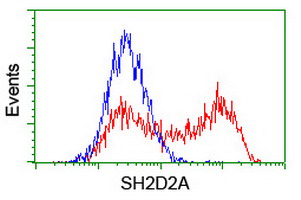
HEK293T cells transfected with either SH2D2A (Myc-DDK-tagged) overexpress plasmid (Red) or empty vector control plasmid (Blue) were immunostained by anti-SH2D2A antibody (M06232-1)
Click image to see more details
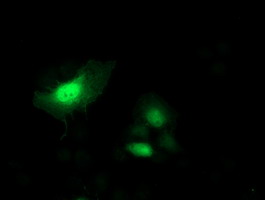
Anti-SH2D2A mouse monoclonal antibody (M06232-1) immunofluorescent staining of COS7 cells transiently transfected by pCMV6-ENTRY SH2D2A.
Specific Publications For Anti-SH2D2A Mouse Monoclonal Antibody [Clone ID: OTI3C7] (M06232-1)
Loading publications
Recommended Resources
Here are featured tools and databases that you might find useful.
- Boster's Pathways Library
- Protein Databases
- Bioscience Research Protocol Resources
- Data Processing & Analysis Software
- Photo Editing Software
- Scientific Literature Resources
- Research Paper Management Tools
- Molecular Biology Software
- Primer Design Tools
- Bioinformatics Tools
- Phylogenetic Tree Analysis
Customer Reviews
Have you used Anti-SH2D2A Mouse Monoclonal Antibody [Clone ID: OTI3C7]?
Share your experimental results or join a short interview to earn up to $1,000 in product credits or other rewards.
0 Reviews For Anti-SH2D2A Mouse Monoclonal Antibody [Clone ID: OTI3C7]
Customer Q&As
Have a question?
Find answers in Q&As, reviews.
Can't find your answer?
Submit your question

