What we test for ELISA

Below are the 7 core QC checks we verify for ELISA kits before batch release. Click any metric to jump to full criteria, methods, and examples.
Lot-to-lot consistency
between-lot CV control
Intra- & inter-assay CV
repeatability and run-to-run control
Observed/Expected across dilutions
quantitation stays reliable
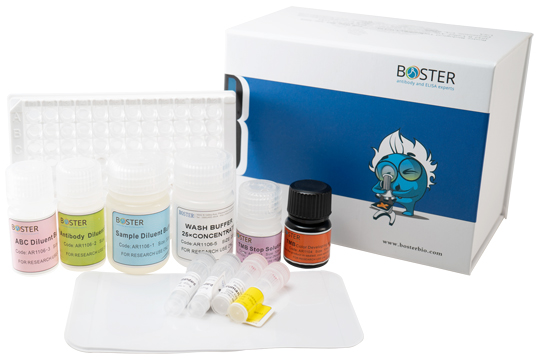
Boster ELISA kit
Spike & recovery in matrices
accuracy under real samples
20× zero-standard (Mean + 2SD)
mapped to curve for MDD
Related-protein assessment
minimize cross-reactivity
Performance tracked over time
within deviation window

Charts below are representative examples. Actual values may vary by target and matrix, but every lot must meet defined release criteria.

Core QC Checks & Validation Metrics

Definitions, test approach, and acceptance criteria for the 7 QC checks used to verify ELISA kit performance before batch release.

Specificity

Cross-reactivity is assessed to confirm the signal is driven by the intended target—not related proteins.

  • Definition: Ability to detect the intended analyte without interference from related proteins.
  • How we test: Evaluate related-protein panels and confirm no detectable cross-reactivity under defined conditions.
  • Acceptance criteria: No detectable cross-reactivity/interference under defined test conditions.

Example kit: Human Cathepsin D ELISA Kit PicoKine® (EK0672)
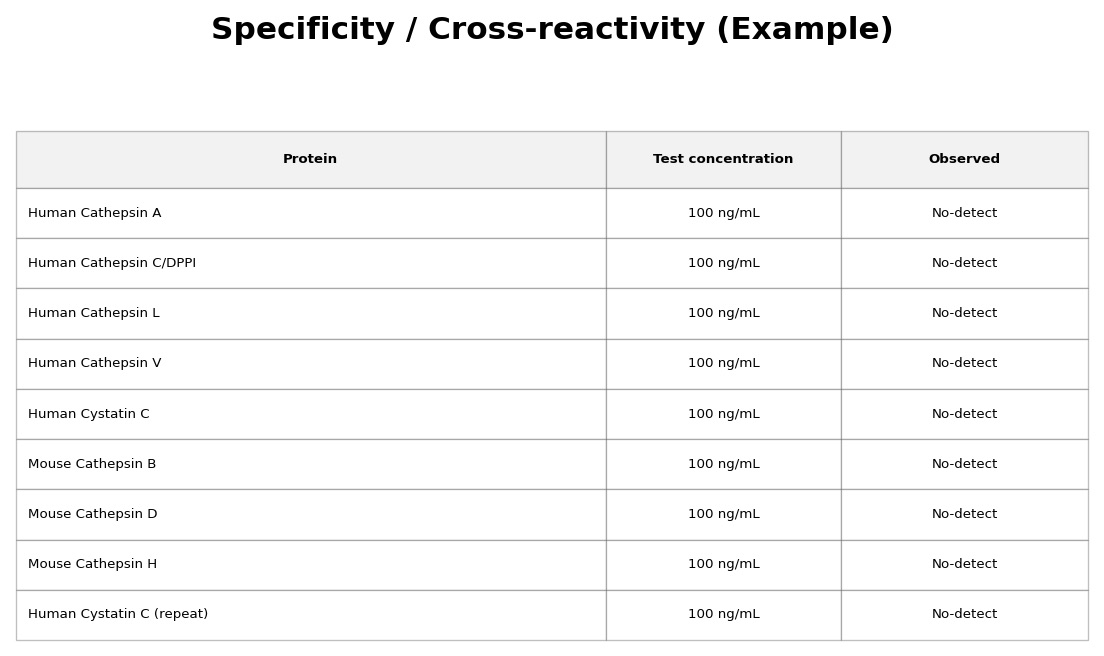
ELISA specificity: cross-reactivity check against related proteins

Representative QC snapshot. Click to open full-size chart.

Sensitivity (MDD)

MDD is determined from 20× zero-standard replicates (Mean + 2SD) and mapped to the standard curve.

  • Definition: Minimum Detectable Dose (MDD) estimates the lowest analyte level distinguishable from background.
  • How we test: 20× zero standard → compute OD threshold (Mean + 2SD) → map to standard curve to obtain MDD.
  • Acceptance criteria: Meets the kit’s validated sensitivity specification for its intended range/sample types.

Example kit: Human IL-6/Interleukin-6 ELISA Kit PicoKine® (EK0410)
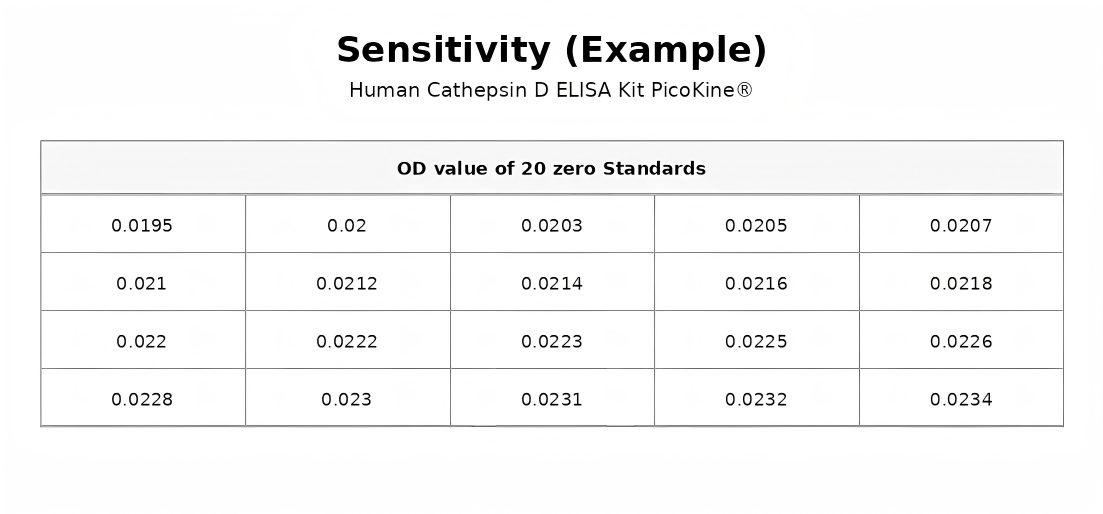
ELISA sensitivity (MDD): mean plus 2SD of 20 zero-standard OD readings mapped to standard curve

Representative QC snapshot. Click to open full-size chart.

Precision (Intra/Inter-assay CV)

CV is calculated from real runs to verify repeatability within an assay and consistency across runs.

  • Definition: Intra-assay and inter-assay consistency reflect the coefficient of variation (CV%) of the same batch of ELISA Kit within a single plate and across different plates.
  • How we test: ELISA intra-assay consistency is measured using wells from the same plate/assay kit. ELISA inter-assay consistency is measured using wells from different plates from the same batch production/lot.
  • Acceptance criteria: Intra-assay CV < 10%; inter-assay CV verified per internal release criteria.

Example kit: Mouse TNF Alpha/Tumor necrosis factor ELISA Kit PicoKine® (EK0527)
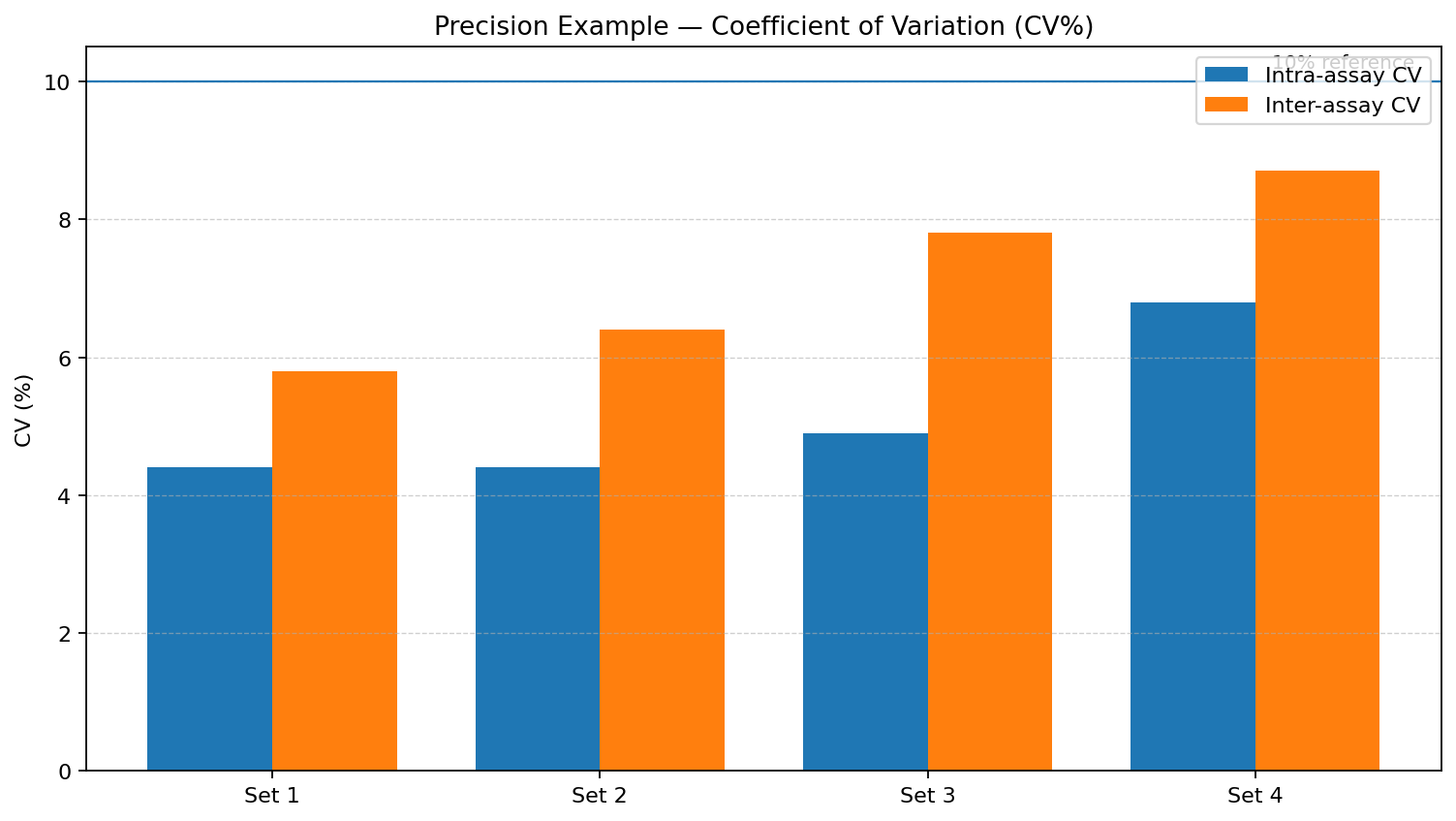
ELISA precision: intra-assay and inter-assay CV example

Representative QC snapshot. Click to open full-size chart.

Dilution Linearity

Verifies quantitation stays reliable across a dilution series (Observed vs Expected).

  • Definition: Dilutions should derive the same final analyte concentration for a sample.
  • How we test: Run a dilution series using kit diluents across the assay range; express results as % observed from expected.
  • Acceptance criteria: 80–120% (Observed/Expected).

Example kit: Human EGF ELISA Kit PicoKine® (EK0539)
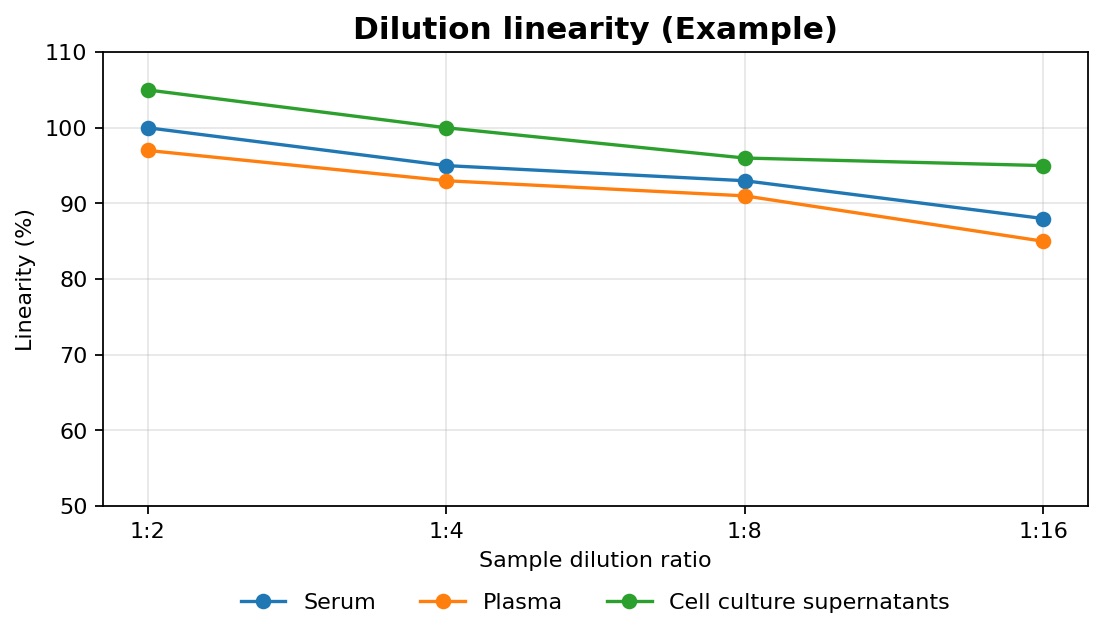
ELISA dilution linearity: recovery across a dilution series

Representative QC snapshot. Click to open full-size chart.

Recovery (Spike Recovery)

Evaluates assay accuracy in relevant sample matrices (e.g., serum/plasma).

  • Definition: Add known analyte levels into matrices and evaluate % recovered.
  • How we test: Spike low/medium/high levels into validated matrices and calculate recovery.
  • Acceptance criteria: 80–120%.

Example kit: Human TFF1/PS2 ELISA Kit PicoKine® (EK1232)
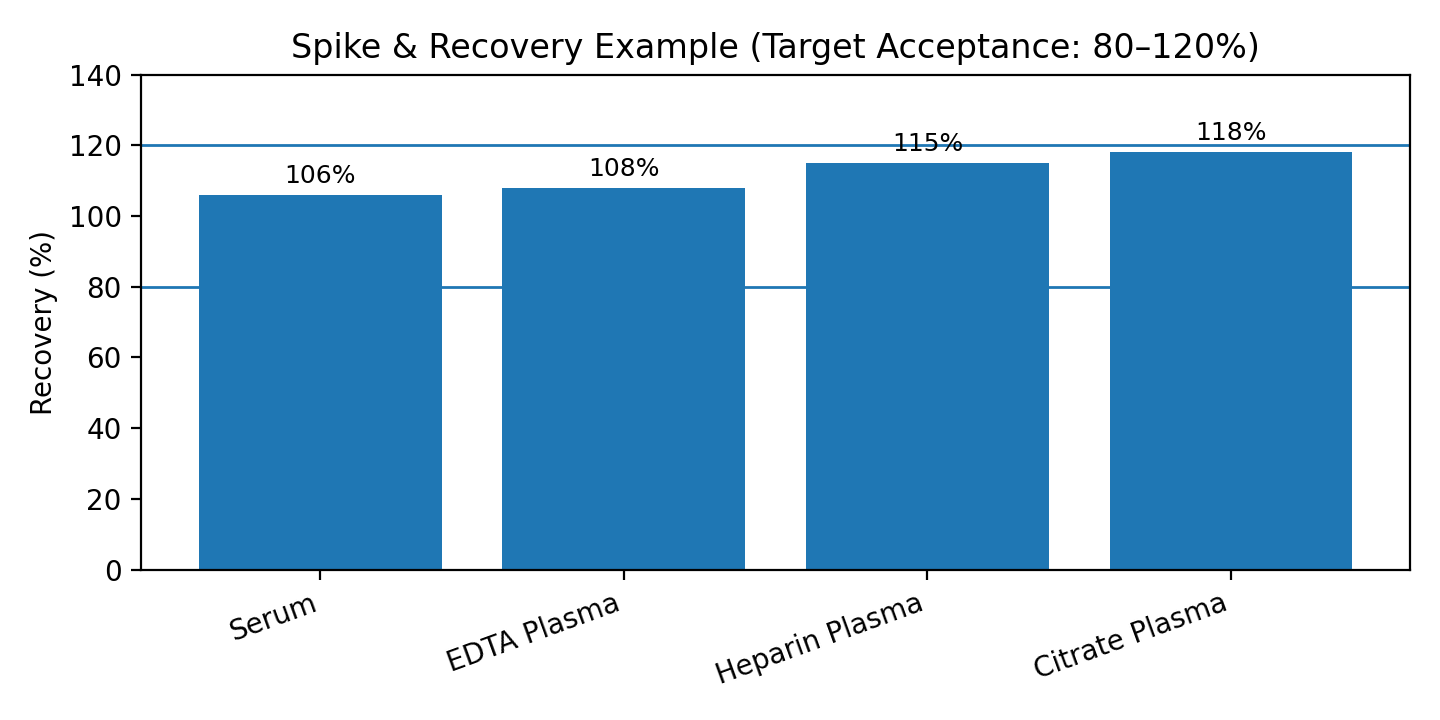
ELISA recovery: spike-and-recovery across sample matrices

Representative QC snapshot. Click to open full-size chart.

Reproducibility (Lot-to-lot)

Monitors between-lot variation to support consistent results across kit lots.

  • Definition: Between-lot reproducibility evaluates variation across different kit lots.
  • How we test: Assay multiple lots using samples at different target concentrations and calculate between-lot CV%.
  • Acceptance criteria: Lot-to-lot CV < 15%.

Example kit: Human MPO/Myeloperoxidase ELISA Kit PicoKine® (EK0850)
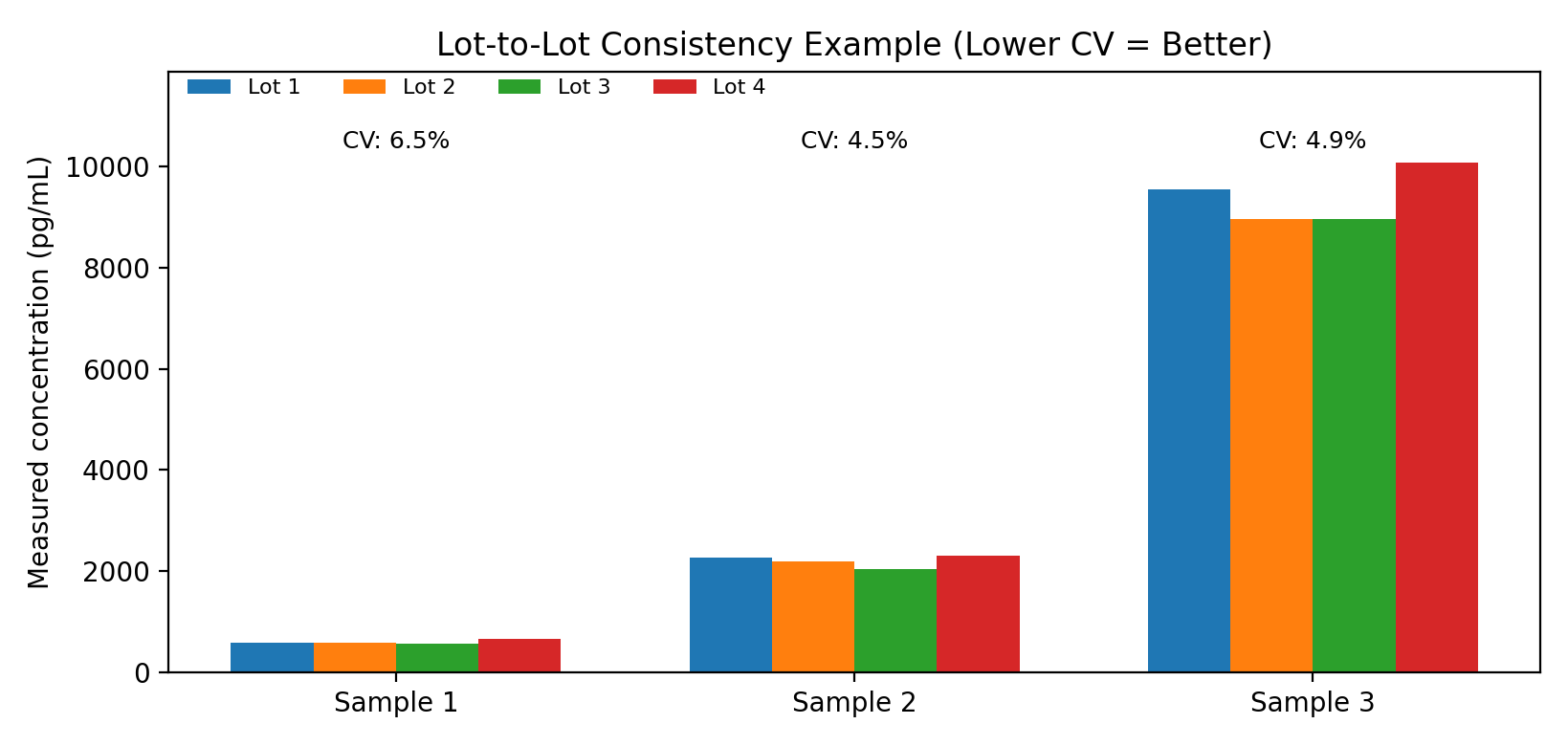
ELISA lot-to-lot consistency: between-lot CV across kit lots

Representative QC snapshot. Click to open full-size chart.

Stability

Tracks kit performance over time to ensure results remain within the defined deviation window.

  • Definition: Stability confirms performance remains acceptable during storage/handling over time.
  • How we test: Re-test defined samples at multiple time points using the same lot and evaluate deviation versus baseline.
  • Acceptance criteria: Performance remains within the defined deviation window.

Example kit: Human EGF ELISA Kit PicoKine® (EK0325)
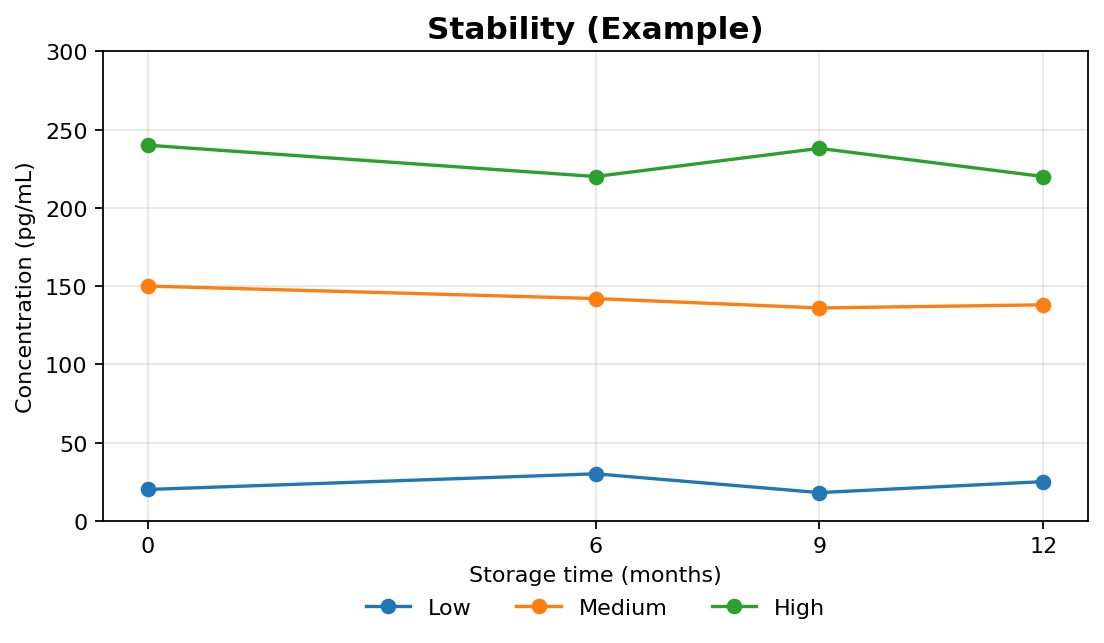
ELISA stability: signal deviation over time

Representative QC snapshot. Click to open full-size chart.

FAQs

Answers to common questions about ELISA QC, validation methods, and acceptance criteria.

Q1. What is MDD (Minimum Detectable Dose)?

MDD estimates the lowest analyte amount distinguishable from background. We calculate it from 20× zero-standard replicates (Mean + 2SD) and map that threshold to the standard curve.

Q2. Why are charts shown as “representative examples”?

Examples illustrate typical QC outputs. Actual values can vary by target, matrix, and assay range, but every lot must meet defined release criteria.

Q3. What’s the difference between precision and lot-to-lot reproducibility?

Precision measures variation within a run (intra-assay) and across runs (inter-assay). Lot-to-lot reproducibility measures variation across production lots (between-lot CV).

Q4. What does 80–120% mean for linearity and recovery?

It indicates observed results are within 80–120% of expected values, supporting reliable quantitation (linearity) and acceptable accuracy (recovery).

Q5. Do all kits share the same acceptance criteria?

Core targets are consistent across kits, and some kits may apply tighter internal criteria depending on the target, matrix, and working range.

Q6. What if my results differ from the examples?

Differences may arise from sample handling, matrix effects, or protocol variations. Contact technical support with your protocol details for troubleshooting.

Support

Need help or have questions?

Email us and we’ll route your message to the right team. Response times and detailed terms are listed in the guarantee section below.

