IHC Protocols

We provide the step-by-step protocols for IHC-P, IHC-F, and ICC/IF to help you improve your assay performance and obtain clear result images.

Overview of IHC Protocols

Boster Bio provides step-by-step protocols for IHC-Paraffin (IHC-P), IHC-Frozen (IHC-F), and Immunocytochemistry/Immunofluorescence (ICC/IF) to support high-quality staining outcomes. These protocols cover sample preparation, reagent handling, and staining workflows.


Boster Protocols for IHC

Standardization is one of the most challenging aspects for the implementation of successful biospecimen staining. In an effort to accelerate your immunostaining of tissue sections and cell climbing slices, we have developed and validated our step-by-step IHC/ICC/IF protocols to cover biospecimen preparation and assay procedures. We believe these protocols will be a useful resource for your staining workflow or at least a good starting point for further protocol optimization if necessary. For each of the protocols, we also provide a summary flow chart with the applicable Boster’s reagents to enhance your product search on our website.

Best Practices for IHC Protocols

Get a unique combination of service quality, subject expertise and cost savings, when it comes to IHC service.

IHC-Paraffin (IHC-P) Workflow Overview

Boster manufactures IHC reagents that are used in our own validation processes. See the IHC protocol below with available Boster products highlighted.

IHC-P protocol for paraffin-embedded tissue

IHC Workflow (Paraffin-Embedded Sections) with Applicable Boster Reagents

Boster IHC Reagents

You can save up to 90% on the above reagents if you buy them from Boster Bio

IHC-P Protocol Details

Step-by-step guide for IHC-P protocol with reagent recommendations

  • Tissue Preparation

    Paraformaldehyde Cooling And Dehydration

    • Harvest fresh tissue and place it in a dish filled with ice-cold PBS buffer
    • Wash the tissue thoroughly with PBS to remove blood (Use forceps to remove connective tissues)
    • Cut the tissue into slices of thickness of 3 mm or less
    • Immerse the slices in 4% Paraformaldehyde at room temperature for 8 min
    • Immerse the slices in 4% Paraformaldehyde (pre-cool at 4°C) for 6 to 7 hrs. The paraformaldehyde volume should be 20X greater than the tissue volume by weight
    • Wash the tissue 3X with PBS (1 min each)
    • Dehydrate the tissue by immersing the tissue sequentially as follows:
      • Immerse the tissue in 70% ethanol overnight (around 15hours) at room temperature.
      • Immerse the tissue in 75% ethanol two times for 30 minutes each at room temperature.
      • Immerse the tissue in 85% ethanol two times for 30 minutes each at room temperature.
      • Immerse the tissue in 95% ethanol two times for 30 minutes each at room temperature.
      • Immerse the tissue in 100% ethanol two times for 30 minutes each at room temperature.

    • Prepare the first portion of liquid paraffin in a suitable bath and allow the paraffin to reach and maintain at 60°C
    • Immerse the tissue 2X into the paraffin bath (2 hrs each)
    • Prepare the second portion of liquid paraffin in a suitable bath and allow the paraffin to reach and maintain at 60°C
    • Pour the second portion of paraffin into a mold
    • Quickly transport the tissue from the paraffin bath to the mold with paraffin
    • Incubate the tissue at room temperature until it coagulates
    • Store the tissue at 4°C

    • Secure the paraffin section on slicer
    • Slice one to two pieces of section to adjust the slicer so that the section and blade are parallel
    • Slice the remaining section carefully with ~5 µm thick
    • Incubate the sliced section in 40 to 50°C water to unfold
    • Mount the tissue section onto Poly-Lysine or APES coated glass slides
    • Incubate the slides overnight at 37°C

    Note: This fixation procedure using paraformaldehyde and formalin fixatives may cause autofluorescence in the green spectrum. In this case, you may try fluorophores in the (i) red range or (ii) infrared range if you have an infrared detection system.

  • Dewaxing/Deparaffinization

    Prepare the following reagents:

    • Immerse the slides in xylene 2 times for 10 minutes each.
    • Immerse the slides in 100% ethanol 2 times for 10 minutes each.
    • Immerse the slides in 95% ethanol for 5 minutes.
    • Immerse the slides in 70% ethanol for 5 minutes.
    • Immerse the slides in 50% ethanol for 5 minutes.
    • Rinse the slides with running cold tap water. Drain the excess water.

    To quench endogenous peroxidase activity, incubate the tissue with peroxidase reagent (1:10 30%H2O2: water) for 10 minutes at room temperature. Wash the slides with distilled water three times.

  • Inactivation

    Used Products: 3% Hydrogen Peroxide

    • Immerse dewaxed paraffin section into the 3% H2O2 at room temperature for 10 min
    • Wash the section 3X to 5X with distilled water (total 3 to 5 min)
  • Antigen Retrieval (Heat Induced Epitope Retrieval: HIER)

    Used Products: Citrate Buffer Powder , EDTA

    Heat-induced epitope retrieval: Immerse the slides in antigen retrieval buffer (EDTA buffer, pH 8.0). Microwave the solution at Medium-high power for 8 minutes. Cool the slides for 5 minutes. Then microwave the solution at High power for 4 minutes. Cool the slides to room temperature.


    Read on how you can effectively select the right antigen retrieval method
  • Blocking

    Used Products: Normal Rabbit Serum

    • Add 5% BSA blocking solution or normal goat serum to the HIER treated samples
    • Incubate the samples at 37°C for 30 min
    • Discard extra liquid (No washing required)
  • Primary Antibody Incubation

    Used Products: Antibody Diluent ,PBS Buffer

    • Dilute primary antibody with antibody diluent to the concentration recommended by the antibody manufacturer
    • Add the diluted antibody to the samples and incubate overnight at 4℃ or at 37℃ for 1 hour
    • Wash the samples 2X with PBS (20 min each)
  • Secondary Antibody Incubation

    Used Products: Antibody Diluent

  • Staining

    Used Products: DAB Chromogenic Substrate Kit (BrownDAB Chromogenic Substrate Kit (Blue) ,AEC Substrate Kit , Hematoxylin , Nuclear Fast Red

    • Add Strept-Avidin Biotin Complex (SABC) HRP-conjugated reagents to the samples
    • Incubate the samples at 37°C for 30 min
    • Wash the samples 3X with PBS (20 min each)
    • Add a suitable amount of DAB reagent to the samples and incubate in dark at room temperature for 10 to 30 min
    • Monitor the tissue staining intensity under a bright-field microscope*
    • Wash the samples 3X to 5X with distilled water
    • Counterstain (if necessary)
      • Add hematoxylin to the sample
      • Dehydrate
      • Immerse the paraffin sections 2X in dimethylbenzene (7 min each)
    • Check the tissue staining intensity under a bright-field microscope

    *If the staining background is too high, wash the section 4X with 0.01-0.02% TWEEN 20 PBS and 2X with pure PBS after the SABC reaction and before DAB staining. Then use DAB to stain the samples.

    Learn the probable causes and solutions of weak or no staining

IHC-Frozen (IHC-F) Workflow Overview

Boster manufactures IHC reagents that are used in our own validation processes. See the IHC protocol below with available Boster products highlighted.
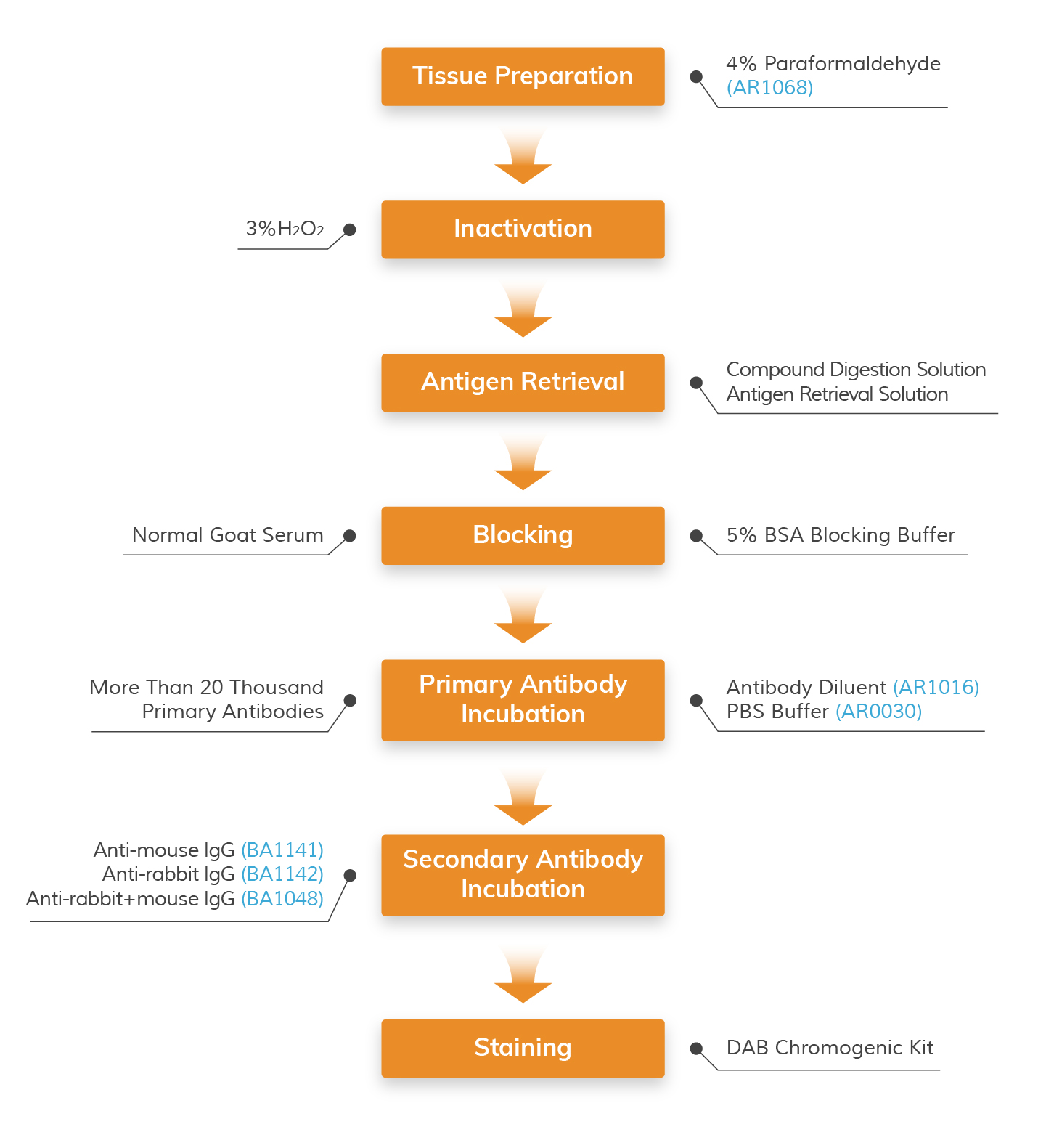
IHC-F protocol for frozen tissue staining

IHC Workflow (Frozen Sections) with Applicable Boster Reagents

IHC-F Protocol Details

Step-by-step guide for IHC-F protocol with reagent recommendations

  • Snap Freezing and OCT Embedding

    Products Listed: - 4% Paraformaldehyde

    1. Harvest fresh tissue and place it in a dish filled with ice-cold PBS buffer
    2. Wash the tissue thoroughly with PBS to remove blood (Use forceps to remove connective tissues)
    3. Cut the tissue into slices of thickness of 3 mm or less
    4. Immediately snap freeze the tissue in iso-pentane cooled in dry ice and keep the tissue at -70°C (Do not allow frozen tissue to thaw before cutting)
    5. Prior to cryostat sectioning, position the tissue in a mold* and cover the tissue completely in Optimal Cutting Temperature (OCT) embedding medium

      * The mold can simply be made by using tin foil

    6. Use forceps to take the bottom part of mold into liquid nitrogen for 1 to 2 min (The OCT should change to white)
  • Inactivation

    Products Listed: 3% H2O2

    • Mix 3% H2O2 with distilled water (v/v: 1:50)
    • Immerse frozen section or cell climbing slice into the diluted H2O2 at room temperature for 10 min
    • Wash the section 3X distilled water (1 min each)
  • Antigen Retrieval (Proteolytic Induced Epitope Retrieval: PIER)

    Products Listed: Enzyme Antigen Retrieval Reagent - PBS Buffer

    • Dry the frozen sections with filter paper
    • Add target="_blank">compound digestion solution (e.g. Trypsin solution or other enzymatic antigen retrieval solution) to the sections or slices
    • Incubate the sections at room temperature for 3 to 5 min
    • Wash the sections with 3X PBS Buffer(5 min each)
  • Blocking

    Products Listed: 5% BSA blocking solution

    • Add 5% BSA blocking solution or normal goat serum to the PIER treated samples
    • Incubate the samples at 37°C for 30 min
    • Shake off extra liquid and dry the samples with filter paper (No washing required)
  • Primary Antibody Incubation

    Products Listed: Antibody Diluent - PBS Buffer

    • Dilute primary antibody with antibody diluent to the concentration recommended by the antibody manufacturer
    • Add the diluted antibody to the samples and incubate at 37°C for 30 min
    • Wash the samples 2X with PBS (20 min each)
  • Secondary Antibody Incubation

    Products Listed: Antibody Diluent - PBS Buffer

  • IHC Frozen Sections Staining Protocol

    DAB Chromogenic Substrate Kit (BrownDAB Chromogenic Substrate Kit (Blue) ,AEC Substrate Kit , Hematoxylin , Nuclear Fast Red ,PBS

    • Add Strept-Avidin Biotin Complex (SABC) HRP- or AP-conjugated reagents to the samples
    • Incubate the samples at 37°C for 30 min
    • Wash the samples 3X with PBS (20 min each)
    • Add a suitable amount of DAB reagent to the samples and incubate in dark at room temperature for 10 to 30 min
    • Monitor the tissue staining intensity under a bright-field microscope*
    • Wash the samples 3X to 5X with distilled water
    • Counterstain (if necessary)
    • Add Haematoxylin to the sample
    • Dehydrate
    • Immerse the paraffin sections 2X in dimethyl benzene (7 min each)
    • Check the tissue staining intensity under a bright-field microscope
      * If the staining background is too high, wash the section 4X with 0.01-0.02% TWEEN 20 PBS and 2X with pure PBS after the SABC reaction and before DAB staining. Then use DAB to stain the samples.

ICC/IF Workflow Overview

Boster offers the full range of reagents one needs for performing smooth immunohistochemistry (IHC), immunofluorescence (IF), and immunocytochemistry (ICC) assays. See the protocol below with available Boster products highlighted.
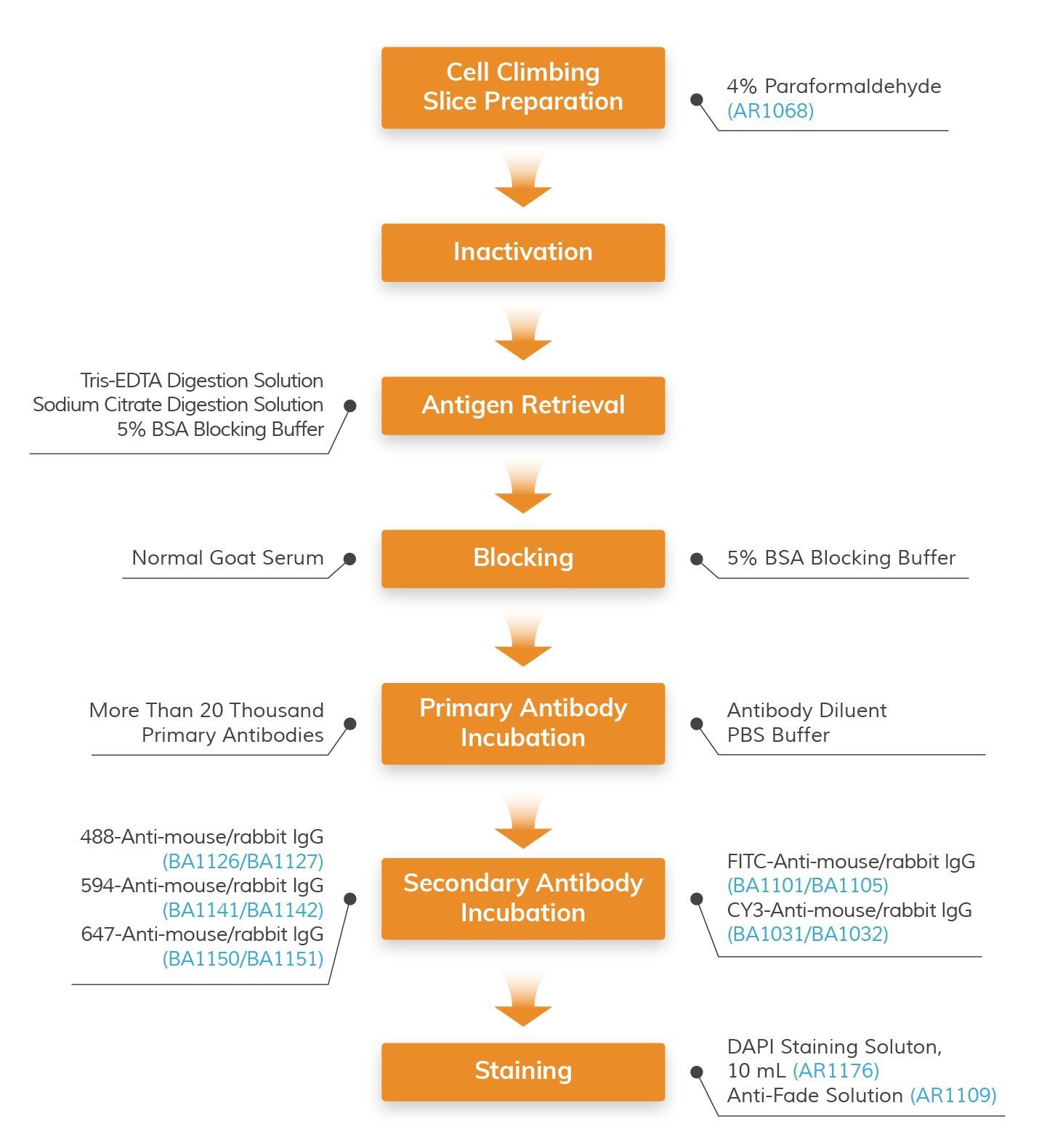
IHC-IF protocol for immunofluorescence staining

Immunocytochemistry (ICC) Workflow with Applicable Boster’s Reagents

ICC/IF Protocol Details

Step-by-step guide for ICC/IF protocol with reagent recommendations

  • Cell Climbing Slice Preparation

    Products Listed: 4% Paraformaldehyde

    • Place settled coverslip in culture bottle or perforated plate
    • Take out coverslip after cell growth has reached 60%
    • Wash the coverslip 3X with PBS to remove culture medium
    • Immerse the coverslip (cells face up) into cold acetone or 4% Paraformaldehyde or neutral formalin for 10 to 20 min (Close the lid to prevent evaporation)
    • Wash the coverslip 3X with PBS
    • Put the coverslip on filter paper (cells face up)
    • Remove the liquid on the coverslip and allow it to dry for 8-10 hrs
    • To thaw the slice, wash with neutral PBS at room temperature for 10-15 min (The cell climbing slice can be stored in gelatin at -20°C for one week.)
    • Note: This fixation procedure using paraformaldehyde and formalin fixatives may cause autofluorescence in the green spectrum. In this case, you may try fluorophores in the (i) red range or (ii) infrared range if you have an infrared detection system.
  • Inactivation

    Products Listed: 3% H2O2

    • Mix 3% H2O2 with distilled water (v/v: 1:50)
    • Immerse frozen section or cell climbing slice into the diluted H2O2 at room temperature for 10 min
    • Wash the section 3X distilled water (1 min each)
  • Antigen Retrieval (Proteolytic Induced Epitope Retrieval: PIER)

    Products Listed: Enzyme Antigen Retrieval Reagent -

    • Antigen retrieval (AR) is the process of breaking protein cross-links that mask antigens in formalin-fixed tissue sections. Antigen retrieval breaks the protein cross-links, enhancing staining intensity by unmasking the antigens and epitopes in formalin-fixed and paraffin embedded tissue sections. Read on how you can effectively select the right antigen retrieval method
    • Dry the cell slices with filter paper
    • Add compound digestion solution (e.g. Trypsin solution or other enzymatic antigen retrieval solution) to the slices (We recommend the addition of 0.1% Triton to the samples before the digestion. This reduces surface tension and allows reagents to easily cover the entire sample.)
    • Incubate the slices at room temperature for 10 min
    • Wash with 3X PBS Buffer < (10 min each)
    • Problems encountered in this step can result in a weak signal. Find out how you can troubleshoot the antigen retrieval protocol here

    Read on how you can effectively select the right antigen retrieval method

  • Blocking

    Products Listed:5% BSA blocking solution

    • Add 5% BSA blocking solution or normal goat serum to the PIER treated samples
    • Incubate the samples at 37°C for 30 min
    • Shake off extra liquid and dry the samples with filter paper (No washing required)
  • Primary Antibody Incubation

    Products Listed: Antibody Diluent - PBS Buffer

    • Dilute primary antibody with antibody diluent to the concentration recommended by the antibody manufacturer
    • Add the diluted antibody (Recommended concentration: 0.4 µg to 2 µg) to the samples and incubate at 4°C overnight
    • Wash the samples 3X with PBS Buffer (15 min each)
  • Secondary Antibody Incubation

    Products Listed: Antibody Diluent - PBS Buffer

    • Dilute biotinylated secondary antibody with antibody diluent to the concentration recommended by the antibody manufacturer
    • Add the diluted antibody to the samples and incubate at 37°C for 30 min
    • Wash the samples 3X with PBS Buffer (8 min each)
  • Immunocytochemistry (ICC) Staining

    • Add Strept-Avidin Biotin Complex – Fluorescence Iso-Thio-Cyanate (SABC-FITC) or Strept-Avidin Biotin Complex – Cyanine-3 (SABC-Cy3) reagents to the samples
    • Incubate the samples at 37°C for 30 min (Avoid light)
    • Wash the samples 2X with PBS (Total 2 hrs)
    • Seal the slices with water-soluble sealing reagent
    • Monitor the staining intensity under a fluorescence microscope
    • Counterstain by adding DAPI staining solution to the sample
    • Check again the staining intensity under a fluorescence microscope
    • For slide storage without significant decay in fluorescence signal, add 20 µL of the anti-fade solution to the sample followed by a cover glass (Avoid bubbles)

    Learn the probable causes and solutions of weak or no staining

Uncover the complexity of tissue microenvironments with multiplex IHC! By examining multiple biomarkers in the same tissue sample, our multiplex immunohistochemistry approach allows you to unravel intricate cellular interactions and gain deeper insights into the tumor microenvironment.

Related Pages or IHC Protocols

IHC Principle

Learn the basic principle of immunohistochemistry (IHC), including how antibodies bind specifically to antigens in tissue sections for target detection.

Learn More

IHC Optimization Tips

Explore key IHC optimization tips for antigen retrieval, fixation, and embedding to improve staining quality and experimental consistency.

Learn More

IHC Troubleshooting Tips

Review practical IHC troubleshooting tips for weak staining, high background, and non-specific staining to improve result interpretation.

Learn More

IHC Sample Preparation

Learn sample preparation methods for IHC and ICC/IF, including preserved tissue handling steps that support high-quality staining results.

Learn More

Multiplex IF Troubleshooting

Troubleshoot multiplex IF issues such as bleed-through, weak signal, and high background with practical controls and quick checks.

Learn More

Weak or No Staining in IHC

When an IHC slide looks weak or unexpectedly blank, start with the stain—not the antibody.

Learn More

How to Troubleshoot High Background in DAB Staining

High background in DAB staining usually shows up as one of three patterns: a global brown/gray haze, edge-darkening, or granular brown speckling.

Learn More

Choosing Fluorophores for Multiplex IF

Learn how to choose fluorophores for multiplex IF based on marker abundance, brightness, and channel planning for cleaner panel design.

Learn More

