Product Info Summary
| SKU: | PA1483 |
|---|---|
| Size: | 100 μg/vial |
| Reactive Species: | Human, Mouse, Rat |
| Host: | Rabbit |
| Application: | IHC, IHC-F, WB |
Customers Who Bought This Also Bought
Product info
Product Name
Anti-MTA1 Antibody Picoband®
SKU/Catalog Number
PA1483
BA2749 is an alternative SKU for this antibody, used in previous lots.
Size
100 μg/vial
Form
Lyophilized
Description
Boster Bio Anti-MTA1 Antibody catalog # PA1483. Tested in IHC, IHC-F, WB applications. This antibody reacts with Human, Mouse, Rat. The brand Picoband indicates this is a premium antibody that guarantees superior quality, high affinity, and strong signals with minimal background in Western blot applications. Only our best-performing antibodies are designated as Picoband, ensuring unmatched performance.
Storage & Handling
Store at -20˚C for one year from date of receipt. After reconstitution, at 4˚C for one month. It can also be aliquotted and stored frozen at -20˚C for six months. Avoid repeated freeze-thaw cycles.
Cite This Product
Anti-MTA1 Antibody Picoband® (Boster Biological Technology, Pleasanton CA, USA, Catalog # PA1483)
Host
Rabbit
Contents
Each vial contains antibody formulated with stabilizing components, 0.9mg NaCl, 0.2mg Na2HPO4, 0.05mg Thimerosal, 0.05mg NaN3.
*This antibody is supplied in a stabilized formulation.
Compatibility with conjugation reactions depends on the chemistry of the conjugation method used.
For conjugation methods that are not compatible with the stabilizing components present in this formulation, a carrier-free antibody format is required.
Clonality
Polyclonal
Isotype
Rabbit IgG
Immunogen
A synthetic peptide corresponding to a sequence at the C-terminus of human MTA1, identical to the related mouse and rat sequences.
Cross-reactivity
No cross-reactivity with other proteins
Reactive Species
PA1483 is reactive to MTA1 in Human, Mouse, Rat
Observed Molecular Weight
80 kDa
Calculated molecular weight
80.8 kDa
Background of MTA1
Metastasis-associated protein MTA1 is a protein that in humans is encoded by the MTA1 gene. This gene encodes a protein that was identified in a screen for genes expressed in metastatic cells, specifically, mammary adenocarcinoma cell lines. Expression of this gene has been correlated with the metastatic potential of at least two types of carcinomas although it is also expressed in many normal tissues.By fluorescence in situ hybridization, mapped the MTA1gene to chromosome 14q32.3. MTA1 is a component of the chromatin remodeling complex that influences gene transcription by modulating target gene chromatin. MTA1 is widely upregulated in many carcinomas.
Antibody Validation
Boster validates all antibodies on WB, IHC, ICC, Immunofluorescence, and ELISA with known positive control and negative samples to ensure specificity and high affinity, including thorough antibody incubations.
Application & Images
Applications
PA1483 is guaranteed for IHC, IHC-F, WB Boster Guarantee
Assay Dilutions Recommendation
The recommendations below provide a starting point for assay optimization. The actual working concentration varies and should be decided by the user.
Immunohistochemistry (Frozen Section), 0.5-1μg/ml, Mouse, Rat, Human
Immunohistochemistry (Paraffin-embedded Section), 0.5-1μg/ml, Human, Mouse, Rat
Western blot, 0.1-0.5μg/ml, Human, Rat, Mouse
Positive Control
WB: human MCF-7 whole cell, human HEK293 whole cell, human HELA whole cell, human PC-3 whole cell, human Raji whole cell, human K562 whole cell, rat brain tissue, mouse brain tissue
IHC: Human Rectal Cancer Tissue, rat ovary tissue, rat ovary tissue, mouse brain tissue, human ovarian cancer tissue, human pancrease cancer tissue
IHC-F: Rat Ovary Tissue, mouse brain tissue
Validation Images & Assay Conditions
Click image to see more details
Western blot analysis of MTA1 using anti-MTA1 antibody (PA1483).
Electrophoresis was performed on a 5-20% SDS-PAGE gel at 70V (Stacking gel) / 90V (Resolving gel) for 2-3 hours. The sample well of each lane was loaded with 50ug of sample under reducing conditions.
Lane 1: human MCF-7 whole cell lysates,
Lane 2: human HEK293 whole cell lysates,
Lane 3: human HELA whole cell lysates,
Lane 4: human PC-3 whole cell lysates,
Lane 5: human Raji whole cell lysates,
Lane 6: human K562 whole cell lysates,
Lane 7: rat brain tissue lysates,
Lane 8: mouse brain tissue lysates.
After Electrophoresis, proteins were transferred to a Nitrocellulose membrane at 150mA for 50-90 minutes. Blocked the membrane with 5% Non-fat Milk/ TBS for 1.5 hour at RT. The membrane was incubated with rabbit anti-MTA1 antigen affinity purified polyclonal antibody (Catalog # PA1483) at 0.5 μg/mL overnight at 4°C, then washed with TBS-0.1%Tween 3 times with 5 minutes each and probed with a goat anti-rabbit IgG-HRP secondary antibody at a dilution of 1:5000 for 1.5 hour at RT. The signal is developed using an Enhanced Chemiluminescent detection (ECL) kit (Catalog # EK1002) with Tanon 5200 system. A specific band was detected for MTA1 at approximately 80KD. The expected band size for MTA1 is at 80KD.
Click image to see more details
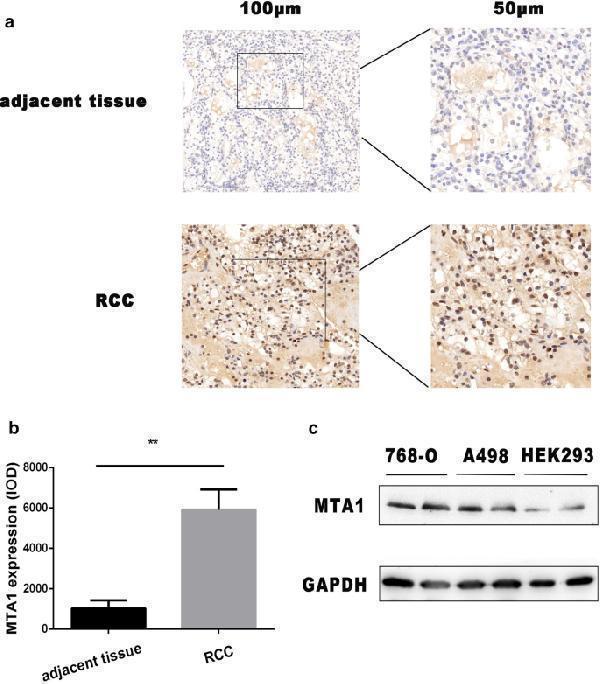
The expression of MTA1 is up-regulated in RCCs. a Immunohistochemistry was used to characterize the expression of MTA1 in RCC and adjacent tissues. MTA1 was highly expressed in ccRCCs, compared to very weak staining in adjacent tissue. b Image Pro Plus was used for the statistical analysis of the positive signal (IOD) of MTA1 expression in ccRCCs and the adjacent tissue. The expression of MTA1 was significantly up-regulated in ccRCCs. ** p < 0.01; scale bar: 100 µm and 50 µm. c The expression of MTA1 in RCC cell lines. Normal renal cell line HEK293T and RCC cell lines A498 and 768-O cell lysates were used in western blotting analysis with MTA1 and GAPDH antibodies. The bands of MTA1 were from Additional file : and gapdh were from Additional file :
Index in PubMed under a CC BY license. PMID: 33059651
Click image to see more details
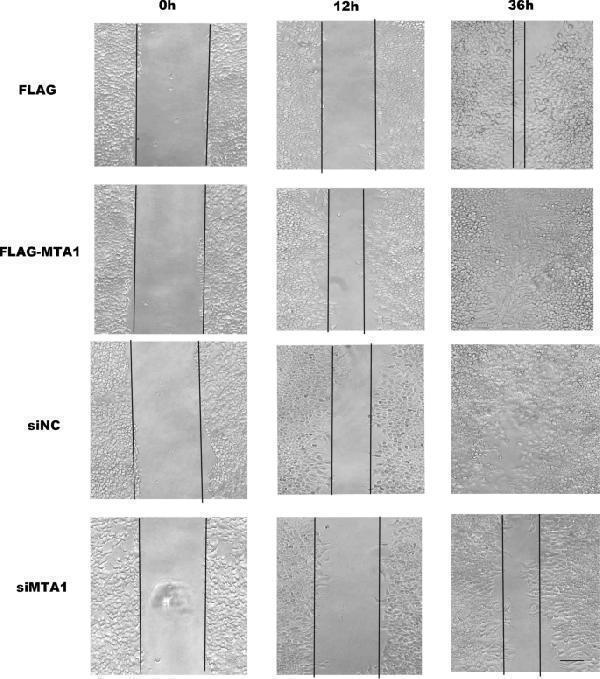
MTA1 promotes A498 cell migration. A498 cells were transfected with pcDNA3.1-Flag, Flag-MTA1, siNC, and si-MTA1. After 24 h, cells in the four conditions were subjected to the wound healing assay. Macrographs were taken under ×100 magnification
Index in PubMed under a CC BY license. PMID: 33059651
Click image to see more details
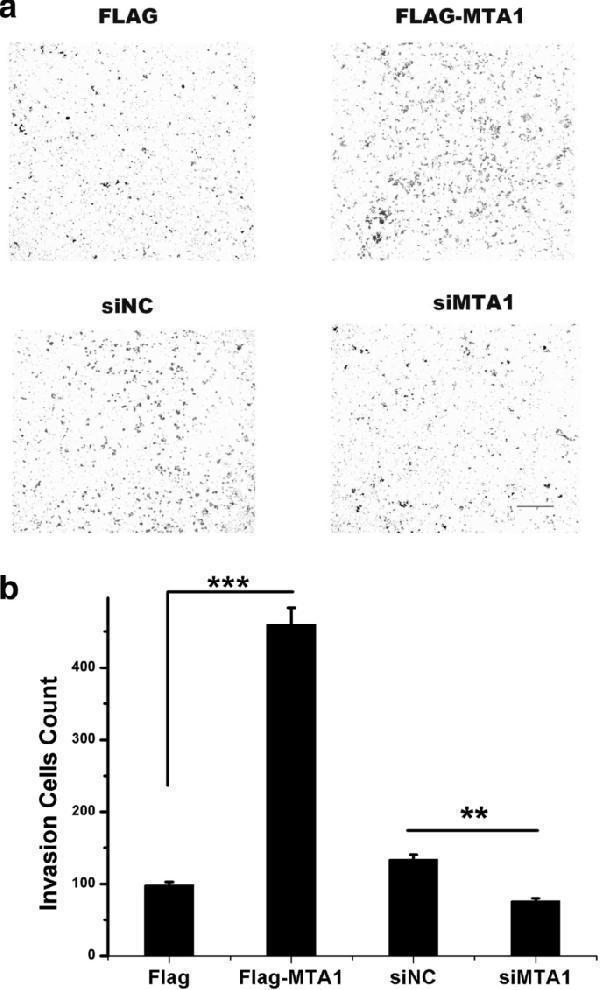
MTA1 enhances the invasion of A498 cells. a A498 cells were transfected with pcDNA3.1-Flag, Flag-MTA1, siNC, and si-MTA1. After 24 h, the transwell cell invasion assay using A498 cells was performed, and macrographs were taken under ×40 magnification. Scale bar: 50 µm. b Image J was used to count the transmigrated cells and Student’s t test to analyze differences. ** p < 0.01; *** p < 0.001
Index in PubMed under a CC BY license. PMID: 33059651
Click image to see more details
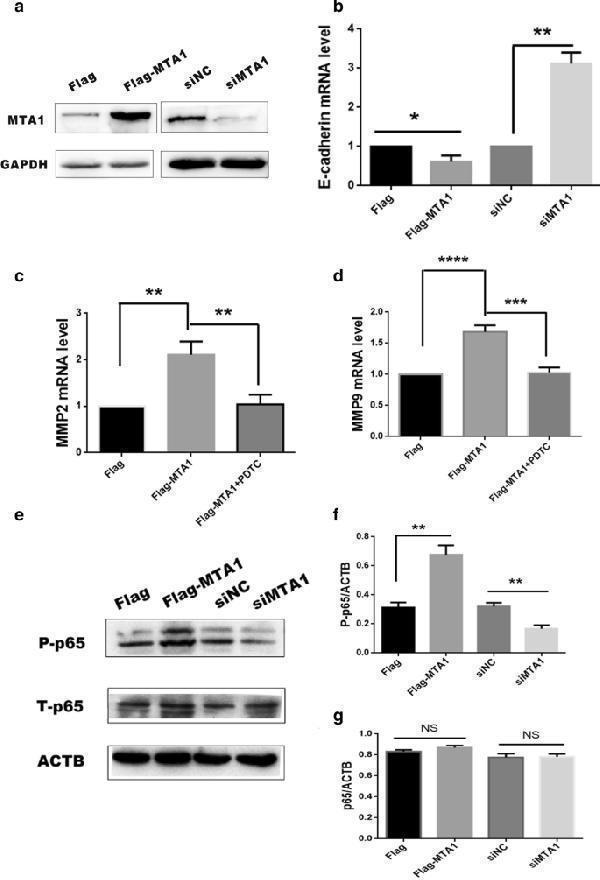
MTA1 regulated the expression of metastasis-related factors via the NFκB pathway. A498 cells were transfected with pcDNA3.1-Flag, Flag-MTA1, siNC, and si-MTA1. a Protein levels of MTA1; cells were collected for WB with MTA1 and GAPDH antibodies. The bands of over-expressed MTA1 were from Additional file : Fig. 2A and down-expressed MTA1 were from Additional file : Fig. 2B with arrow. b Cells were lysed and used in qRT-PCR assays to measure the E-cadherin mRNA expression. Statistical analysis was performed using Student’s t test. b , c A498 cells were transfected with pcDNA3.1-Flag and Flag-MTA1. After 36 h, the Flag-MTA1 group was treated with 10 nM PDTC for 12 h. Then cells were harvested for qRT-PCR evaluation to measure the mRNA expression of MMP2 ( b ) and MMP9 ( c ). Statistical analysis was performed using ANOVA. d A498 cells were transfected with pcDNA3.1-Flag, Flag-MTA1, siNC, and si-MTA1. After 48 h, cells were subjected to western blotting analysis using antibodies targeting p-p65, p65 and ACTB. The bands of p-p65, p65 and ACTB were from Additional file : Fig. 3. e, f Image J was used to calculate the gray scanned bands of p-p65 ( b ) and p65 (C). * p < 0.05; ** p < 0.01; *** p < 0.001, **** p < 0.0001; NS not significant
Index in PubMed under a CC BY license. PMID: 33059651
Click image to see more details
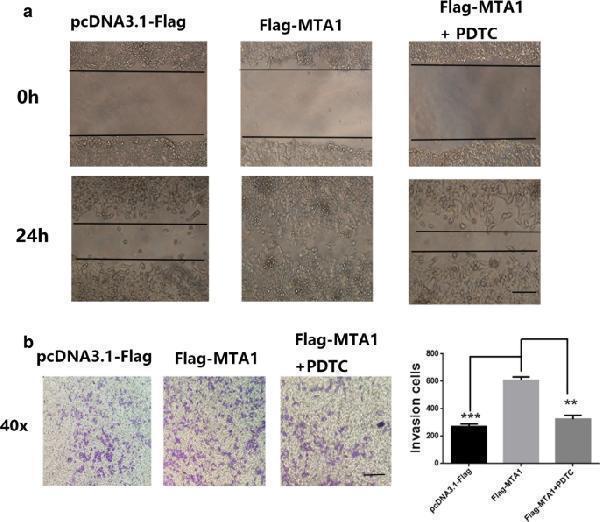
MTA1 regulated the migration and invasion of RCC cells via NF-κB. A498 cells were transfected with pcDNA3.1-Flag, Flag-MTA1, and Flag-MTA1 + PDTC (10 nM). a In the wound healing assay, MTA1 improved the migration of RCC cells, while the addition of the inhibitor PDTC blocked the effect of MTA1 on migration. Scale bar: 100×. b In the transwell assay, MTA1 markedly induced invasion of A498 cells, but compared to the MTA1 group, the invasion of MTA1 + PDTC A498 cells was lower. ** p < 0.01; *** p < 0.001; Scale bar: ×40
Index in PubMed under a CC BY license. PMID: 33059651
Click image to see more details
Anti-MTA1 antibody, PA1483, IHC(P)
IHC(P): Human Rectal Cancer Tissue
Click image to see more details
IHC analysis of MTA1 using anti-MTA1 antibody (PA1483).
MTA1 was detected in paraffin-embedded section of rat ovary tissues. Heat mediated antigen retrieval was performed in citrate buffer (pH6, epitope retrieval solution) for 20 mins. The tissue section was blocked with 10% goat serum. The tissue section was then incubated with 1μg/ml rabbit anti-MTA1Antibody (PA1483) overnight at 4°C. Biotinylated goat anti-rabbit IgG was used as secondary antibody and incubated for 30 minutes at 37°C. The tissue section was developed using Strepavidin-Biotin-Complex (SABC)(Catalog # SA1022) with DAB as the chromogen.
Click image to see more details
Anti-MTA1 antibody, PA1483, IHC(F)
IHC(F): Rat Ovary Tissue
Click image to see more details
IHC analysis of MTA1 using anti-MTA1 antibody (PA1483).
MTA1 was detected in paraffin-embedded section of rat ovary tissue. Heat mediated antigen retrieval was performed in citrate buffer (pH6, epitope retrieval solution) for 20 mins. The tissue section was blocked with 10% goat serum. The tissue section was then incubated with 1μg/ml rabbit anti-MTA1 Antibody (PA1483) overnight at 4°C. Biotinylated goat anti-rabbit IgG was used as secondary antibody and incubated for 30 minutes at 37°C. The tissue section was developed using Strepavidin-Biotin-Complex (SABC)(Catalog # SA1022) with DAB as the chromogen.
Click image to see more details
IHC analysis of MTA1 using anti-MTA1 antibody (PA1483).
MTA1 was detected in frozen section of mouse brain tissues. The tissue section was blocked with 10% goat serum. The tissue section was then incubated with 1μg/ml rabbit anti-MTA1 Antibody (PA1483) overnight at 4°C. Biotinylated goat anti-rabbit IgG was used as secondary antibody and incubated for 30 minutes at 37°C. The tissue section was developed using Strepavidin-Biotin-Complex (SABC)(Catalog # SA1022) with DAB as the chromogen.
Click image to see more details
IHC analysis of MTA1 using anti-MTA1 antibody (PA1483).
MTA1 was detected in paraffin-embedded section of mouse brain tissue. Heat mediated antigen retrieval was performed in EDTA buffer (pH8.0, epitope retrieval solution). The tissue section was blocked with 10% goat serum. The tissue section was then incubated with 1μg/ml rabbit anti-MTA1 Antibody (PA1483) overnight at 4°C. Biotinylated goat anti-rabbit IgG was used as secondary antibody and incubated for 30 minutes at 37°C. The tissue section was developed using Strepavidin-Biotin-Complex (SABC) (Catalog # SA1022) with DAB as the chromogen.
Click image to see more details
IHC analysis of MTA1 using anti-MTA1 antibody (PA1483).
MTA1 was detected in paraffin-embedded section of human ovarian cancer tissue. Heat mediated antigen retrieval was performed in EDTA buffer (pH8.0, epitope retrieval solution). The tissue section was blocked with 10% goat serum. The tissue section was then incubated with 1μg/ml rabbit anti-MTA1 Antibody (PA1483) overnight at 4°C. Biotinylated goat anti-rabbit IgG was used as secondary antibody and incubated for 30 minutes at 37°C. The tissue section was developed using Strepavidin-Biotin-Complex (SABC) (Catalog # SA1022) with DAB as the chromogen.
Click image to see more details
IHC analysis of MTA1 using anti-MTA1 antibody (PA1483).
MTA1 was detected in paraffin-embedded section of human pancrease cancer tissue. Heat mediated antigen retrieval was performed in EDTA buffer (pH8.0, epitope retrieval solution). The tissue section was blocked with 10% goat serum. The tissue section was then incubated with 1μg/ml rabbit anti-MTA1 Antibody (PA1483) overnight at 4°C. Biotinylated goat anti-rabbit IgG was used as secondary antibody and incubated for 30 minutes at 37°C. The tissue section was developed using Strepavidin-Biotin-Complex (SABC) (Catalog # SA1022) with DAB as the chromogen.
Specific Publications For Anti-MTA1 Antibody Picoband® (PA1483)
Loading publications
Recommended Resources
Here are featured tools and databases that you might find useful.
- Boster's Pathways Library
- Protein Databases
- Bioscience Research Protocol Resources
- Data Processing & Analysis Software
- Photo Editing Software
- Scientific Literature Resources
- Research Paper Management Tools
- Molecular Biology Software
- Primer Design Tools
- Bioinformatics Tools
- Phylogenetic Tree Analysis
Customer Reviews
Have you used Anti-MTA1 Antibody Picoband®?
Share your experimental results or join a short interview to earn up to $1,000 in product credits or other rewards.
0 Reviews For Anti-MTA1 Antibody Picoband®
Customer Q&As
Have a question?
Find answers in Q&As, reviews.
Can't find your answer?
Submit your question
1 Customer Q&As for Anti-MTA1 Antibody Picoband®
Question
We are currently using anti-MTA1 antibody PA1483 for rat tissue, and we are content with the WB results. The species of reactivity given in the datasheet says human, mouse, rat. Is it true that the antibody can work on dog tissues as well?
Verified Customer
Verified customer
Asked: 2019-11-18
Answer
The anti-MTA1 antibody (PA1483) has not been tested for cross reactivity specifically with dog tissues, but there is a good chance of cross reactivity. We have an innovator award program that if you test this antibody and show it works in dog you can get your next antibody for free. Please contact me if I can help you with anything.
Boster Scientific Support
Answered: 2019-11-18