Product Info Summary
| SKU: | A00584-1 |
|---|---|
| Size: | 100 μg/vial |
| Reactive Species: | Human, Mouse, Rat |
| Host: | Rabbit |
| Application: | Flow Cytometry, IHC, WB |
Customers Who Bought This Also Bought
Product info
Product Name
Anti-ULK1 Antibody Picoband®
SKU/Catalog Number
A00584-1
Size
100 μg/vial
Form
Lyophilized
Description
Boster Bio Anti-ULK1 Antibody Picoband® catalog # A00584-1. Tested in Flow Cytometry, IHC, WB applications. This antibody reacts with Human, Mouse, Rat. The brand Picoband indicates this is a premium antibody that guarantees superior quality, high affinity, and strong signals with minimal background in Western blot applications. Only our best-performing antibodies are designated as Picoband, ensuring unmatched performance.
Storage & Handling
Store at -20˚C for one year from date of receipt. After reconstitution, at 4˚C for one month. It can also be aliquotted and stored frozen at -20˚C for six months. Avoid repeated freeze-thaw cycles.
Cite This Product
Anti-ULK1 Antibody Picoband® (Boster Biological Technology, Pleasanton CA, USA, Catalog # A00584-1)
Host
Rabbit
Contents
Each vial contains 4mg Trehalose, 0.9mg NaCl, 0.2mg Na2HPO4, 0.05mg NaN3.
Clonality
Polyclonal
Isotype
Rabbit IgG
Immunogen
A synthetic peptide corresponding to a sequence at the C-terminus of human ULK1, which shares 81.8% amino acid (aa) sequence identity with both mouse and rat ULK1.
Cross-reactivity
No cross-reactivity with other proteins.
Reactive Species
A00584-1 is reactive to ULK1 in Human, Mouse, Rat
Observed Molecular Weight
120 kDa
Calculated molecular weight
112.6 kDa
Background of ULK1
ULK1 is an enzyme that in humans is encoded by the ULK1 gene. It is mapped to 12q24.33. Unc-51 like autophagy activating kinase (ULK1/2) are two similar isoforms of an enzyme that in humans are encoded by the ULK1/2 genes. It is specifically a kinase that is involved with autophagy, particularly in response to amino acid withdrawal. Not many studies have been done comparing the two isoforms, but some differences have been recorded.
Antibody Validation
Boster validates all antibodies on WB, IHC, ICC, Immunofluorescence, and ELISA with known positive control and negative samples to ensure specificity and high affinity, including thorough antibody incubations.
Application & Images
Applications
A00584-1 is guaranteed for Flow Cytometry, IHC, WB Boster Guarantee
Assay Dilutions Recommendation
The recommendations below provide a starting point for assay optimization. The actual working concentration varies and should be decided by the user.
Western blot, 0.25-0.5μg/ml, Human, Mouse, Rat
Immunohistochemistry (Paraffin-embedded Section), 0.5-1μg/ml, Human, Rat
Flow Cytometry (Fixed), 1-3μg/1x106 cells, Human
Positive Control
WB: human A549 whole cell, human THP-1 whole cell, rat brain tissue, mouse brain tissue
IHC: human lung cancer tissue, rat brain tissue
FCM: A549 cell
Validation Images & Assay Conditions
Click image to see more details
Western blot analysis of ULK1 using anti-ULK1 antibody (A00584-1).
Electrophoresis was performed on a 5-20% SDS-PAGE gel at 70V (Stacking gel) / 90V (Resolving gel) for 2-3 hours. The sample well of each lane was loaded with 50ug of sample under reducing conditions.
Lane 1: human A549 whole cell lysates,
Lane 2: human THP-1 whole cell lysates,
Lane 3: rat brain tissue lysates,
Lane 4: mouse brain tissue lysates.
After Electrophoresis, proteins were transferred to a Nitrocellulose membrane at 150mA for 50-90 minutes. Blocked the membrane with 5% Non-fat Milk/ TBS for 1.5 hour at RT. The membrane was incubated with rabbit anti-ULK1 antigen affinity purified polyclonal antibody (Catalog # A00584-1) at 0.5 μg/mL overnight at 4°C, then washed with TBS-0.1%Tween 3 times with 5 minutes each and probed with a goat anti-rabbit IgG-HRP secondary antibody at a dilution of 1:10000 for 1.5 hour at RT. The signal is developed using an Enhanced Chemiluminescent detection (ECL) kit (Catalog # EK1002) with Tanon 5200 system. A specific band was detected for ULK1 at approximately 120KD. The expected band size for ULK1 is at 120KD.
Click image to see more details
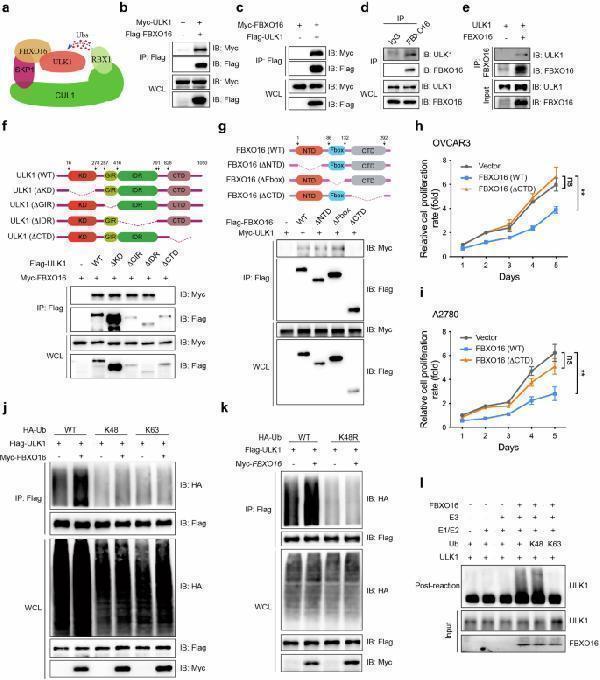
FBXO16 interacts with ULK1 and facilitates its K48 linked poly-ubiquitination. a Schematic presentation of predicted interaction between ULK1 and CUL1-SKP1-FBXO16 complex. Co-IP analysis with anti-Flag antibody to detect the interaction between Flag-FBXO16 and Myc-ULK1 ( b ), and Myc-FBXO16 and Flag-ULK1 ( c ) in HEK293T cells co-transfected with the indicated plasmids. d Lysates from OVCAR3 cells were subjected to immunoprecipitation analysis with anti-FBXO16 antibody, followed by immunoblotting analysis with anti-FBXO16 and anti-ULK1 antibodies, respectively. e Recombinant FBXO16 and ULK1 proteins were prepared in an in vitro transcription and translation system, immunoprecipitation analysis was performed using anti-FBXO16 antibody, immunoblot analysis was followed with anti-ULK1 antibody. Wild type (WT) and truncated mutant schematic structures of ULK1 ( f ) and FBXO16 ( g ) were presented (upper), and co-IP with Flag-antibody was conducted to visualize the interaction between FBXO16 with ULK1 truncations (lower), and ULK1 with FBXO16 truncated mutants (lower). OVCAR3 ( h ) and A2780 ( i ) cells were infected with lenti-virus to over-express FBXO16 (WT) and FBXO16 (∆CTD) proteins, and CCK8 assay was performed to detect the proliferation of both cells. Co-IP with anti-Flag antibody followed by immunoblot analysis (IB) to detect ULK1 ubiquitination affected by FBXO16 in HEK293T cells. WT, K48, and K63 mutant forms of HA-Ubs were used in ( j ), while WT and K48R mutant of HA-Ubs were used in ( k ). Similar results were obtained in three independent experiments. l Recombinant ULK1 and FBXO16 proteins were prepared in an in vitro transcription and translation system. In vitro ubiquitination assay was performed in the presence of E1, E2, FBXO16, ULK1, Ubs (WT, K48, K63), and immunoprecipitated CUL1-SKP1-RBX1 complex. The ubiquitination of ULK1 was examined by immunoblot analysis with anti-ULK1 antibody.
Index in PubMed under a CC BY license. PMID: 39384743
Click image to see more details
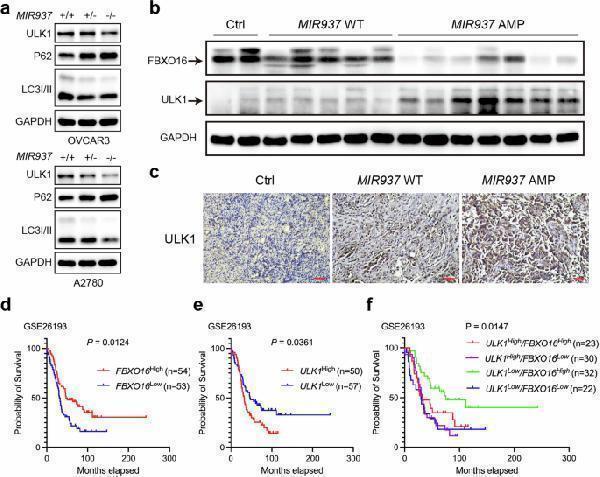
Clinical MIR937 amplification correlates with FBXO16 and ULK1 expression. a IB analysis of protein levels for ULK1, P62, LC3II/I in MIR937 +/+ , MIR937 +/− , and MIR937 −/− OVCAR3 (upper) and A2780 (lower) cells. GAPDH was used as loading control. b IB analysis for comparing FBXO16, ULK1 protein abundances in clinical OV with control samples. Ctrl: normal ovary, MIR937 WT: OV patient samples without amplification of MIR937 . MIR937 AMP: OV patient samples with MIR937 amplification. c Representative images for IHC analysis of ULK1 protein in OV patient samples or the normal control, Scale bar: 100 μm. Kaplan–Meier survival analysis of OV patients from GSE26193 dataset grouped by FBXO16 ( d ) and ULK1 ( e ) expression. f Kaplan–Meier survival analysis of OV patients grouped by both FBXO16 and ULK1 expression in GSE26193. Similar results were obtained in three independent experiments.
Index in PubMed under a CC BY license. PMID: 39384743
Click image to see more details
IHC analysis of ULK1 using anti-ULK1 antibody (A00584-1).
ULK1 was detected in paraffin-embedded section of human lung cancer tissue. Heat mediated antigen retrieval was performed in EDTA buffer (pH8.0, epitope retrieval solution). The tissue section was blocked with 10% goat serum. The tissue section was then incubated with 1μg/ml rabbit anti-ULK1 Antibody (A00584-1) overnight at 4°C. Biotinylated goat anti-rabbit IgG was used as secondary antibody and incubated for 30 minutes at 37°C. The tissue section was developed using Strepavidin-Biotin-Complex (SABC) (Catalog # SA1022) with DAB as the chromogen.
Click image to see more details
IHC analysis of ULK1 using anti-ULK1 antibody (A00584-1).
ULK1 was detected in paraffin-embedded section of rat brain tissue. Heat mediated antigen retrieval was performed in EDTA buffer (pH8.0, epitope retrieval solution). The tissue section was blocked with 10% goat serum. The tissue section was then incubated with 1μg/ml rabbit anti-ULK1 Antibody (A00584-1) overnight at 4°C. Biotinylated goat anti-rabbit IgG was used as secondary antibody and incubated for 30 minutes at 37°C. The tissue section was developed using Strepavidin-Biotin-Complex (SABC) (Catalog # SA1022) with DAB as the chromogen.
Click image to see more details
Flow Cytometry analysis of A549 cells using anti-ULK1 antibody (A00584-1).
Overlay histogram showing A549 cells stained with A00584-1 (Blue line).To facilitate intracellular staining, cells were fixed with 4% paraformaldehyde and permeabilized with permeabilization buffer. The cells were blocked with 10% normal goat serum. And then incubated with rabbit anti-ULK1 Antibody (A00584-1,1μg/1x106 cells) for 30 min at 20°C. DyLight®488 conjugated goat anti-rabbit IgG (BA1127, 5-10μg/1x106 cells) was used as secondary antibody for 30 minutes at 20°C. Isotype control antibody (Green line) was rabbit IgG (1μg/1x106) used under the same conditions. Unlabelled sample without incubation with primary antibody and secondary antibody (Red line) was used as a blank control.
Specific Publications For Anti-ULK1 Antibody Picoband® (A00584-1)
Loading publications
Recommended Resources
Here are featured tools and databases that you might find useful.
- Boster's Pathways Library
- Protein Databases
- Bioscience Research Protocol Resources
- Data Processing & Analysis Software
- Photo Editing Software
- Scientific Literature Resources
- Research Paper Management Tools
- Molecular Biology Software
- Primer Design Tools
- Bioinformatics Tools
- Phylogenetic Tree Analysis
Customer Reviews
Have you used Anti-ULK1 Antibody Picoband®?
Share your experimental results or join a short interview to earn up to $1,000 in product credits or other rewards.
0 Reviews For Anti-ULK1 Antibody Picoband®
Customer Q&As
Have a question?
Find answers in Q&As, reviews.
Can't find your answer?
Submit your question