



Click image to see more details
-
-

-
-
-
+2
Product Info Summary
| SKU: | PB9856 |
|---|---|
| Size: | 100 μg/vial |
| Reactive Species: | Human |
| Host: | Rabbit |
| Application: | IHC, WB |
Customers Who Bought This Also Bought

Product info
Product Name
Anti-Cathepsin K/CTSK Antibody Picoband®
SKU/Catalog Number
PB9856
Size
100 μg/vial
Form
Lyophilized
Description
Boster Bio Anti-Cathepsin K/CTSK Antibody Picoband® catalog # PB9856. Tested in IHC, WB applications. This antibody reacts with Human. The brand Picoband indicates this is a premium antibody that guarantees superior quality, high affinity, and strong signals with minimal background in Western blot applications. Only our best-performing antibodies are designated as Picoband, ensuring unmatched performance.
Storage & Handling
Store at -20˚C for one year from date of receipt. After reconstitution, at 4˚C for one month. It can also be aliquotted and stored frozen at -20˚C for six months. Avoid repeated freeze-thaw cycles.
Cite This Product
Anti-Cathepsin K/CTSK Antibody Picoband® (Boster Biological Technology, Pleasanton CA, USA, Catalog # PB9856)
Host
Rabbit
Contents
Each vial contains antibody formulated with stabilizing components, 0.9 mg NaCl, 0.2 mg Na2HPO4, and 0.05 mg NaN3.
*This antibody is supplied in a stabilized formulation.
Compatibility with conjugation reactions depends on the chemistry of the conjugation method used.
For conjugation methods that are not compatible with the stabilizing components present in this formulation, a carrier-free antibody format is required.
Clonality
Polyclonal
Isotype
Rabbit IgG
Immunogen
E. coli-derived human Cathepsin K recombinant protein (Position: A115-M329). Human Cathepsin K shares 86.9% and 88.8% amino acid (aa) sequence identity with mouse and rat Cathepsin K, respectively.
Cross-reactivity
No cross-reactivity with other proteins.
Reactive Species
PB9856 is reactive to CTSK in Human
Observed Molecular Weight
45 kDa
Calculated molecular weight
37.0 kDa
Background of CTSK
Cathepsin K, abbreviated CTSK, is an enzyme that in humans is encoded by the CTSK gene. It is mapped to 1q21. The protein encoded by this gene is a lysosomal cysteine protease involved in bone remodeling and resorption. And this protein, which is a member of the peptidase C1 protein family, is expressed predominantly in osteoclasts. Additionally, the enzyme's ability to catabolize elastin, collagen, and gelatin allow it to break down bone and cartilage. This catabolic activity is also partially responsible for the loss of lung elasticity and recoil inemphysema. Cathepsin K inhibitors, such as odanacatib, show great potential in the treatment of osteoporosis. Cathepsin K is degraded by Cathepsin S, called Controlled Cathepsin Cannibalism.
Antibody Validation
Boster validates all antibodies on WB, IHC, ICC, Immunofluorescence, and ELISA with known positive control and negative samples to ensure specificity and high affinity, including thorough antibody incubations.
Application & Images
Applications
PB9856 is guaranteed for IHC, WB Boster Guarantee
Recommend Dilution
| Application | Dilution | Species |
|---|---|---|
| Immunohistochemistry (Paraffin-embedded Section) | 0.5-1μg/ml | Human |
| Western blot | 0.1-0.5μg/ml | Human |
Tested application
Suggested blocking solution with 5% non-fat milk or BSA; (*)Recommended protein loading: 20-40 µg per lane
Use TE buffer pH 9.0 for antigen retrieval; (*) citrate buffer pH 6.0 is an alternative.
Validation Images & Assay Conditions
Click image to see more details
Western blot analysis of Cathepsin K using anti-Cathepsin K antibody (PB9856).
Electrophoresis was performed on a 5-20% SDS-PAGE gel at 70V (Stacking gel) / 90V (Resolving gel) for 2-3 hours. The sample well of each lane was loaded with 30 ug of sample under reducing conditions.
Lane 1: HELA whole cell lysates,
Lane 2: 22RV1 whole cell lysates.
After electrophoresis, proteins were transferred to a nitrocellulose membrane at 150 mA for 50-90 minutes. Blocked the membrane with 5% non-fat milk/TBS for 1.5 hour at RT. The membrane was incubated with rabbit anti-Cathepsin K antigen affinity purified polyclonal antibody (Catalog # PB9856) at 0.5 μg/mL overnight at 4°C, then washed with TBS-0.1%Tween 3 times with 5 minutes each and probed with a goat anti-rabbit IgG-HRP secondary antibody at a dilution of 1:5000 for 1.5 hour at RT. The signal is developed using an Enhanced Chemiluminescent detection (ECL) kit (Catalog # EK1002) with Tanon 5200 system. A specific band was detected for Cathepsin K at approximately 45 kDa. The expected band size for Cathepsin K is at 40 kDa.
Click image to see more details
IHC analysis of Cathepsin K using anti-Cathepsin K antibody (PB9856).
Cathepsin K was detected in a paraffin-embedded section of human osteosarcoma tissue. Heat mediated antigen retrieval was performed in EDTA buffer (pH 8.0, epitope retrieval solution). The tissue section was blocked with 10% goat serum. The tissue section was then incubated with 1 μg/ml rabbit anti-Cathepsin K Antibody (PB9856) overnight at 4°C. Biotinylated goat anti-rabbit IgG was used as secondary antibody and incubated for 30 minutes at 37°C. The tissue section was developed using Strepavidin-Biotin-Complex (SABC) (Catalog # SA1022) with DAB as the chromogen.
Click image to see more details
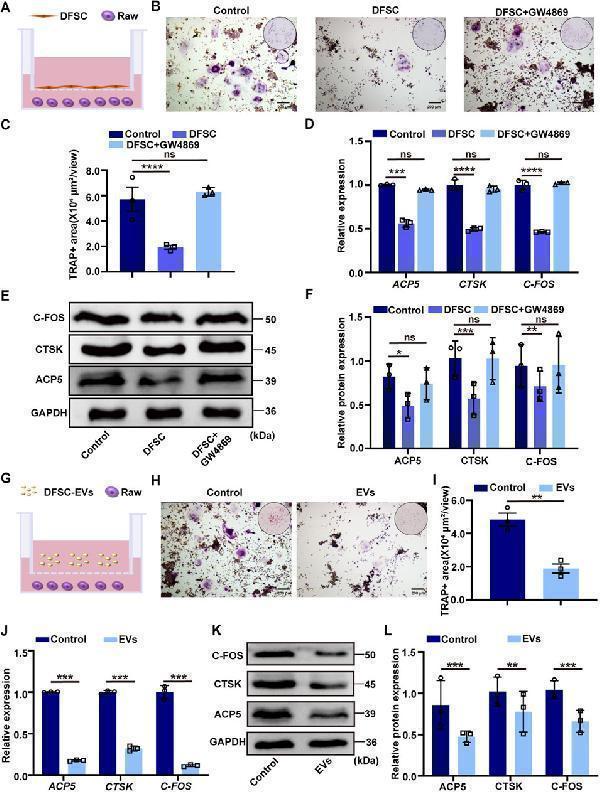
DFSC-EVs regulated tooth eruption by inhibiting osteoclast differentiation. (A) Schematic illustration of RAW264.7 and DFSC co-culture system. (B) Representative images of TRAP staining. Scale bar = 200 μm. (C) Quantitative analysis of TRAP-positive area. (D) The mRNA level of ACP5 , CTSK and CFOS in RAW264.7 cultured with DFSC. (E) The protein level of ACP5, CTSK and CFOS in RAW264.7 cultured with DFSC. (F) Western blotting quantification. (G) Schematic illustration of RAW264.7 and DFSC-EVs co-culture system. (H) Representative images of TRAP staining. Scale bar = 200 μm. (I) Quantitative analysis of TRAP-positive area. (J) The mRNA level of ACP5 , CTSK and CFOS in RAW264.7 cultured with DFSC-EVs. (K) The protein level of ACP5, CTSK and CFOS in RAW264.7 cultured with DFSC-EVs. (L) Western blotting quantification. ns, not significant. * p < 0.05, ** p < 0.01, *** p < 0.001, **** p < 0.0001. n = 3.
Index in PubMed under a CC BY license. PMID: 39834384
Click image to see more details
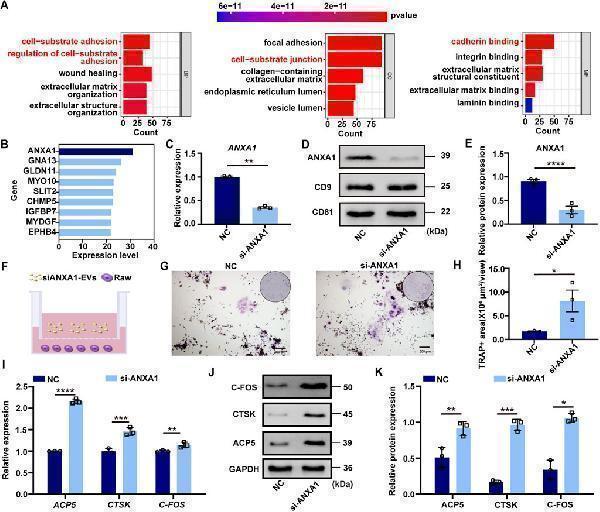
ANXA1 was the core factor of DFSC-EVs regulating osteoclast differentiation. (A) Gene ontology enrichment analysis of DFSC-EVs protein profiles. (B) The top proteins of Cadherin related to regulating osteoblast differentiation based on expression level. (C) The mRNA level of ANXA1 . (D) The protein level of ANXA1. (E) Western blotting quantification. (F) Schematic illustration of RAW264.7 and siANXA1-EVs co-culture system. (G) Representative images of TRAP staining. Scale bar = 200 μm. (H) Quantitative analysis of TRAP-positive area. (I) The mRNA level of ACP5 , CTSK and CFOS in RAW264.7 cultured with siANXA1-EVs. (J) The protein level of ACP5, CTSK and CFOS in RAW264.7 cultured with siANXA1-EVs. (K) Western blotting quantification. * p < 0.05, ** p < 0.01, *** p < 0.001, **** p < 0.0001. n = 3.
Index in PubMed under a CC BY license. PMID: 39834384
Click image to see more details
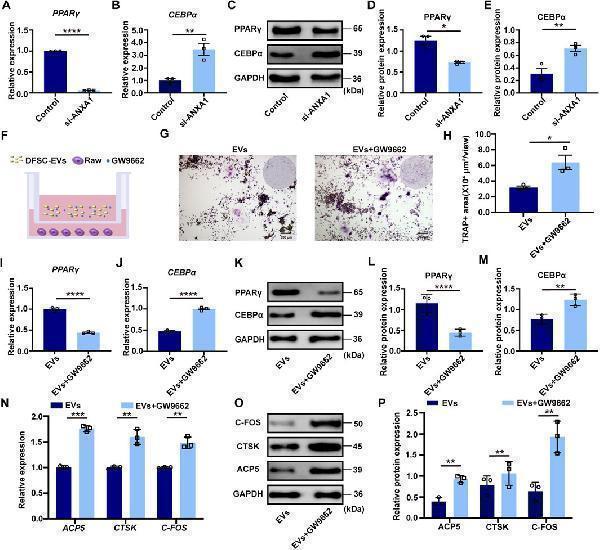
ANXA1 mediated PPARγ-CEBPα pathway to regulate osteoclast differentiation (A) The mRNA level of PPARγ in RAW264.7 cultured with siANXA1-EVs. (B) The mRNA level of CEBPα in RAW264.7 cultured with siANXA1-EVs. (C) The protein level of PPARγ and CEBPα in RAW264.7 cultured with siANXA1-EVs. (D) Quantitative analysis of PPARγ protein expression. (E) Quantitative analysis of CEBPα protein expression. (F) Schematic illustration of PPARγ inhibited RAW264.7 and DFSC-EVs co-culture system. (G) Representative images of TRAP staining. Scale bar = 200 μm. (H) Quantitative analysis of TRAP-positive area. (I) PPARγ inhibited RAW264.7 construction. (J) The mRNA level of CEBPα in PPARγ inhibited RAW264.7. (K) The protein level of PPARγ and CEBPα in PPARγ inhibited RAW264.7. (L) Quantitative analysis of PPARγ protein expression. (M) Quantitative analysis of CEBPα protein expression. (N) The mRNA level of ACP5 , CTSK and CFOS in PPARγ inhibited RAW264.7. (O) The protein level of ACP5, CTSK and CFOS in PPARγ inhibited RAW264.7. (P) Western blotting quantification. * p < 0.05, ** p < 0.01, *** p < 0.001, **** p < 0.0001. n = 3.
Index in PubMed under a CC BY license. PMID: 39834384
Click image to see more details
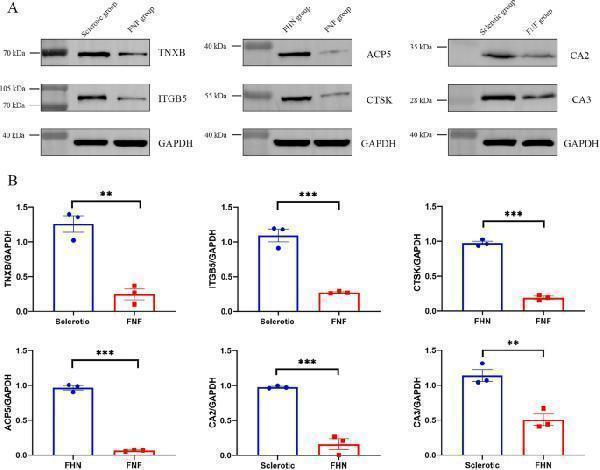
Western blot validation of proteomic data. ( A ) Elevated levels of ITGB5, TNXB , CA II, CA III were observed in the peri-implant sclerosis samples, while elevated levels of ACP5 and CTSK were observed in femoral head necrosis samples. ( B ) The ratio of TIGAR/GAPDH intensities in Western blot. GAPDH was used as a loading control, quantified and normalized to GAPDH using ImageJ. All experiments were performed in triplicate, * indicates significant expression level change compared to the control group, *P < 0.05, **P < 0.01. ***P < 0.001.
Index in PubMed under a CC BY license. PMID: 38851808
Specific Publications For Anti-Cathepsin K/CTSK Antibody Picoband® (PB9856)
Loading publications
Recommended Resources
Here are featured tools and databases that you might find useful.
- Boster's Pathways Library
- Protein Databases
- Bioscience Research Protocol Resources
- Data Processing & Analysis Software
- Photo Editing Software
- Scientific Literature Resources
- Research Paper Management Tools
- Molecular Biology Software
- Primer Design Tools
- Bioinformatics Tools
- Phylogenetic Tree Analysis
Customer Reviews
Have you used Anti-Cathepsin K/CTSK Antibody Picoband®?
Share your experimental results or join a short interview to earn up to $1,000 in product credits or other rewards.
0 Reviews For Anti-Cathepsin K/CTSK Antibody Picoband®
Customer Q&As
Have a question?
Find answers in Q&As, reviews.
Can't find your answer?
Submit your question
3 Customer Q&As for Anti-Cathepsin K/CTSK Antibody Picoband®
Question
Can you help my question with product PB9856, anti-Cathepsin K/CTSK antibody. I was wondering if it would be possible to conjugate this antibody with biotin. I would need it to be without BSA or sodium azide. I am planning on using a buffer exchange of sodium azide with PBS only. Would there be problems for me to conjugate the antibody and store it in -20 degrees in small aliquots?
Verified Customer
Verified customer
Asked: 2019-07-11
Answer
We do not recommend storing this antibody with PBS buffer only in -20 degrees. If you want to store it in -20 degrees it is best to add some cryoprotectant like glycerol. If you want carrier free PB9856 anti-Cathepsin K/CTSK antibody, we can provide it to you in a special formula with trehalose and/or glycerol. These molecules will not interfere with conjugation chemistry and provide a good level of protection for the antibody from degradation. Please be sure to specify this in your purchase order.
Boster Scientific Support
Answered: 2019-07-11
Question
Would anti-Cathepsin K/CTSK antibody PB9856 work on dog IHC with bone?
N. Li
Verified customer
Asked: 2018-03-16
Answer
Our lab technicians have not tested anti-Cathepsin K/CTSK antibody PB9856 on dog. You can run a BLAST between dog and the immunogen sequence of anti-Cathepsin K/CTSK antibody PB9856 to see if they may cross-react. If the sequence homology is close, then you can perform a pilot test. Keep in mind that since we have not validated dog samples, this use of the antibody is not covered by our guarantee. However we have an innovator award program that if you test this antibody and show it works in dog bone in IHC, you can get your next antibody for free.
Boster Scientific Support
Answered: 2018-03-16
Question
We are currently using anti-Cathepsin K/CTSK antibody PB9856 for human tissue, and we are well pleased with the IHC results. The species of reactivity given in the datasheet says human. Is it true that the antibody can work on feline tissues as well?
C. Zhang
Verified customer
Asked: 2017-11-22
Answer
The anti-Cathepsin K/CTSK antibody (PB9856) has not been tested for cross reactivity specifically with feline tissues, though there is a good chance of cross reactivity. We have an innovator award program that if you test this antibody and show it works in feline you can get your next antibody for free. Please contact me if I can help you with anything.
Boster Scientific Support
Answered: 2017-11-22

