This website uses cookies to ensure you get the best experience on our website.


- Table of Contents
Designing an IHC experiment for CD207? The guide has the expected staining pattern, antigen retrieval and fixation, antibodies backed by real IHC images, the tissue controls to run alongside, and protocols taken from published papers.
Open the CD207 IHC Guide
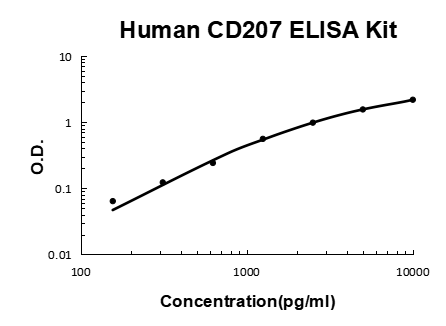
Facts about C-type lectin domain family 4 member K.

Binds to sulfated as well as mannosylated glycans, keratan sulfate (KS) and beta-glucans. Facilitates uptake of antigens and is involved in the routing and/or processing of antigen for presentation to T cells.
| Human | |
|---|---|
| Gene Name: | CD207 |
| Uniprot: | Q9UJ71 |
| Entrez: | 50489 |

| Belongs to: |
|---|
| No superfamily |

CD207 antigen; CD207 antigen, langerin; CD207 molecule, langerin; CD207; CLEC4KLangerhans cell specific c-type lectin; C-type lectin domain family 4 member K; C-type lectin domain family 4, member K; Langerin
Mass (kDA):
36.725 kDA

| Human | |
|---|---|
| Location: | 2p13.3 |
| Sequence: | 2; NC_000002.12 (70825248..70860787, complement) |
Exclusively expressed by Langerhans cells. Expressed in astrocytoma and malignant ependymoma, but not in normal brain tissues.
Membrane; Single-pass type II membrane protein. Found in Birbeck granules (BGs), which are organelles consisting of superimposed and zippered membranes.




PMID: 10661407 by Valladeau J., et al. Langerin, a novel C-type lectin specific to Langerhans cells, is an endocytic receptor that induces the formation of Birbeck granules.
PMID: 12626394 by Stambach N.S., et al. Characterization of carbohydrate recognition by langerin, a C-type lectin of Langerhans cells.