This website uses cookies to ensure you get the best experience on our website.


- Table of Contents
FROM RESEARCH QUESTION TO MODEL
Develop a custom zebrafish knockout, patient-variant knock-in, tagged-protein or reporter model around your research question, with specialist design input and project-specific validation agreed during scoping.
Discuss Your ProjectReceive a $200 bundle discount directly on your quote when you combine custom zebrafish model development with custom zebrafish antibody development.
A custom zebrafish model is a line of fish engineered around one specific biological question, rather than a general-purpose strain taken off the shelf.
That question might be “what happens when this gene is gone?”, “does this exact patient mutation cause the phenotype?”, or “where and when is this protein made?” Each one calls for a different genetic change, and each change has to be designed, introduced, confirmed in the germline and checked for the effect you intended.
In practice, a custom zebrafish model usually takes one of four forms:
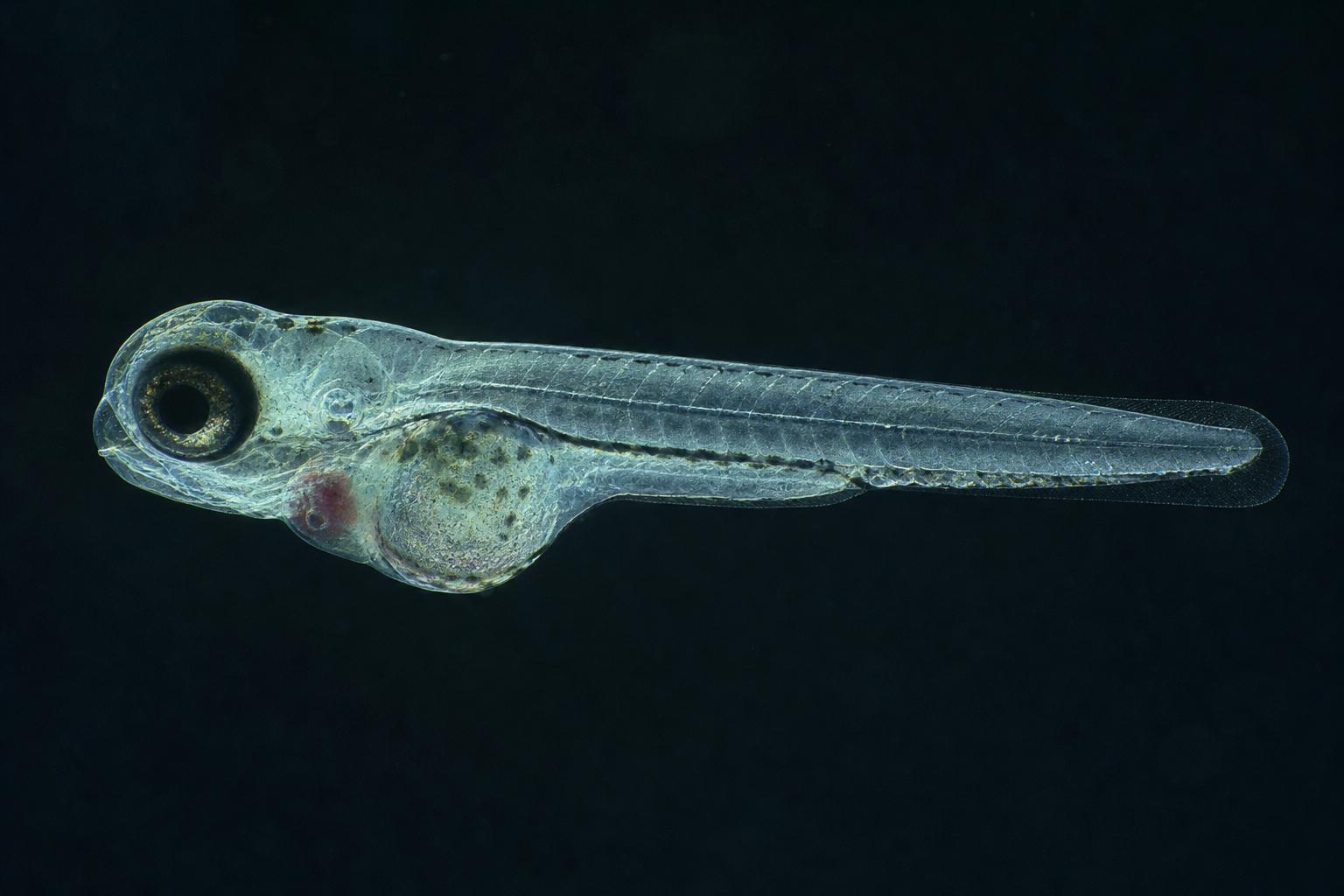
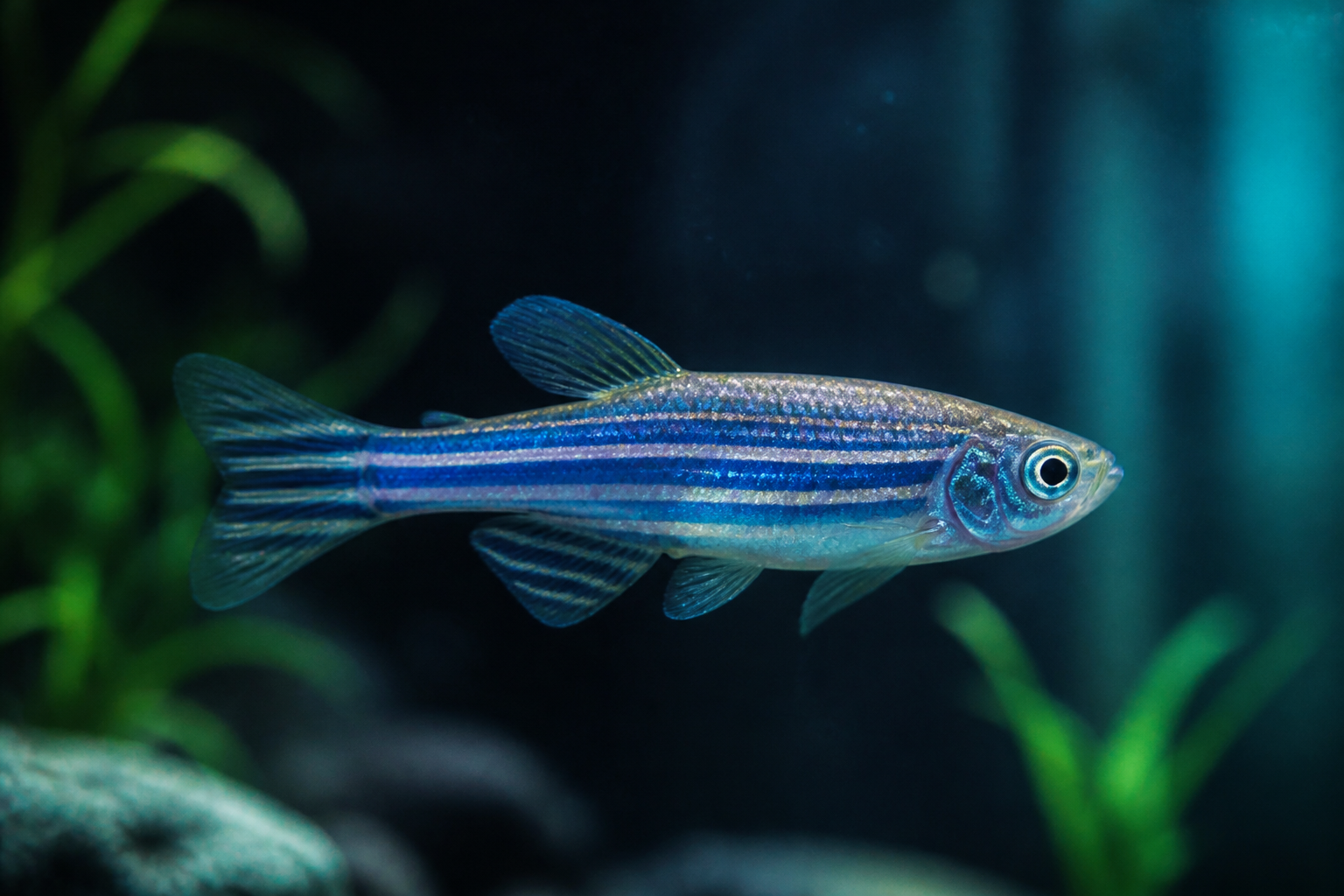
Zebrafish suit this kind of work for practical reasons. Embryos develop outside the mother and are transparent, so you can watch organs form in living animals. A single pair lays large clutches, which gives you the numbers for screening, rescue and drug experiments. Many human disease genes have a zebrafish counterpart, so a well-built mutation can reproduce something meaningful about the human condition.
Early design choices can determine whether a model answers the intended question. Allele selection, paralog function and the evidence needed to assess gene disruption should be considered before model development begins. This page walks through those choices so you can brief a project with confidence.
Zebrafish as a model organism earns its place when a question needs a living vertebrate, precise genetic control and useful numbers all at once.
Zebrafish model organisms, meaning the defined mutant, knock-in and reporter lines built in this species, are valuable because the biology is easy to observe and the genetics are easy to change. Whether a lab writes it as zebrafish or zebra fish, the reasons it is chosen as a model organism are consistent.
Embryos and young larvae are clear, so heart, vasculature, neural tissue and fluorescent reporters can be imaged in the intact, living animal without sectioning.
A single mating often yields well over a hundred embryos, and major organs form within the first days. That supports controls, replicates and rescue arms in one experiment.
Most human genes, including most known disease genes, have at least one zebrafish counterpart, so a defined mutation can test a mechanism that matters to human biology.
Guide RNAs and Cas protein are injected into one-cell embryos, and Tol2 transposase integrates transgenes. The toolkit is mature and widely published.
Larvae fit in multi-well plates, compounds can be added to the water, and imaging or behavior can be recorded for many animals at once.
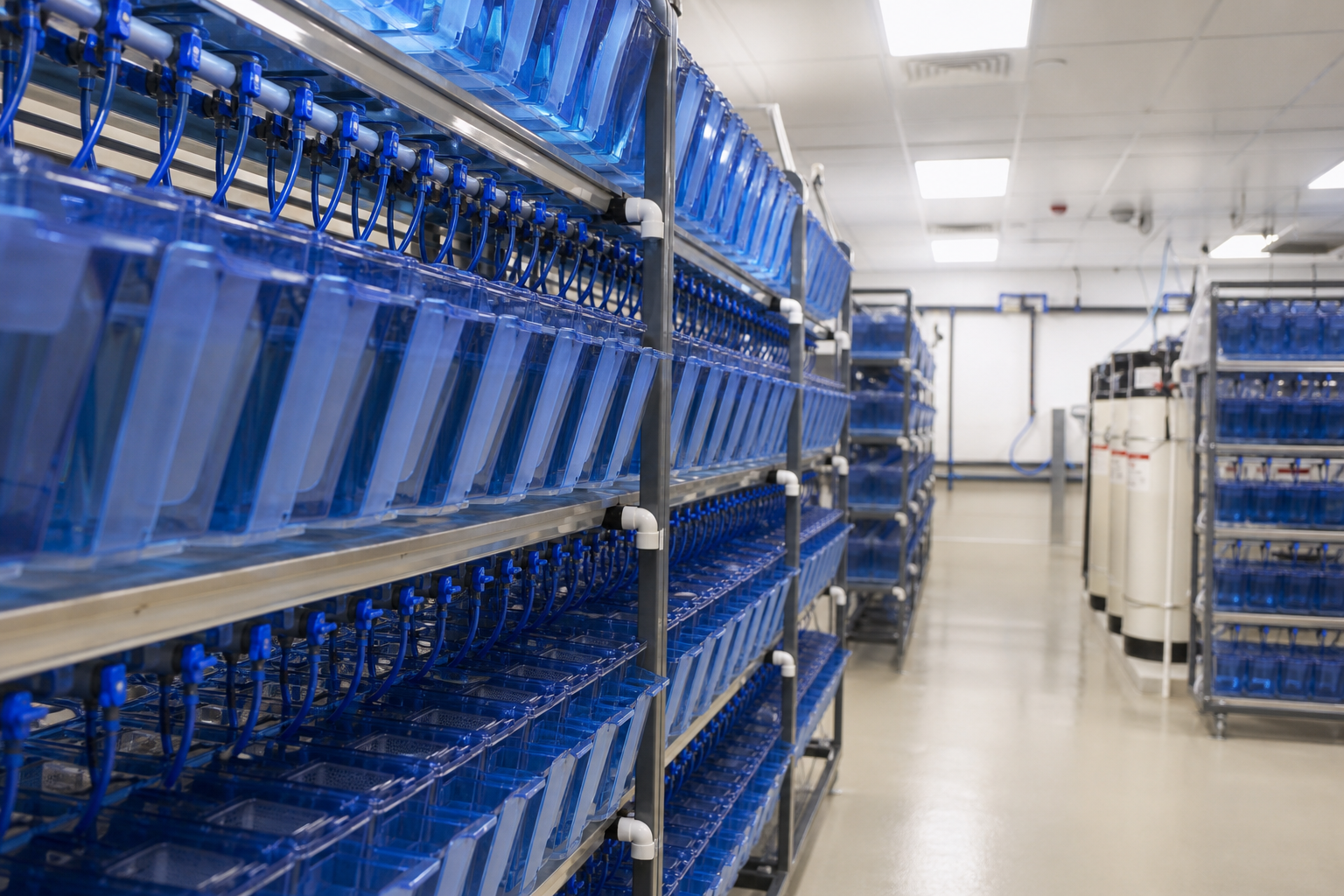
Large numbers of animals can be housed on rack systems, so a stable line can be expanded for experiments that would be hard to size in a larger vertebrate.
Matching the model format to the application, whether discovery, mechanism of action, toxicology or efficacy, keeps the project small enough to finish and specific enough to be convincing.
| Model format | Discovery | Mechanism of action | Toxicology | Efficacy |
|---|---|---|---|---|
| Gene-edited line (knockout, knock-in) | Test whether a candidate gene matters for a phenotype. | Ask whether a compound still works when its putative target is absent. | Learn whether losing the target alone produces developmental or organ liabilities. | Test whether a treatment reverses a mutant phenotype. |
| Transgenic reporter or expression line | Identify cells showing activity of the selected regulatory sequence or reporter. | Follow a signaling or cell-state readout live as a treatment is applied. | Watch a labeled tissue, such as heart or liver, for damage after exposure. | Quantify treatment effects through a fluorescent readout. |
| Xenograft model | See how human cells proliferate, migrate or invade in a living host. | Observe drug effects on tumor cells and their surroundings in a transparent larva. | Compare effects on the human cells with effects on the host animal. | Measure change in tumor burden in treated versus control larvae. |
| Disease-phenotype model | Screen for modifiers or additional candidate genes. | Link a variant to the cellular pathway that fails. | Check whether the disease background changes sensitivity to a compound. | Run phenotype-based compound testing against a defined readout. |
Xenografts are normally performed in larvae because the adaptive immune system has not yet matured, which lets human cells survive in the host. If a xenograft design fits your question, raise it at scoping so it can be planned alongside any gene-edited lines.
The most useful decision you will make is not which gene to edit but which kind of edit answers your question with the least ambiguity.
| Model type | What changes in the fish | Question it answers | Main design consideration |
|---|---|---|---|
| Knockout allele | A small insertion or deletion, or a larger deletion, that disrupts the coding sequence. | What happens when the gene is lost? | Confirm that protein is actually absent and check paralogs. |
| Patient-variant knock-in | A single-base or short change is written into the endogenous gene. | Is this exact variant enough to cause the phenotype? | Lower editing efficiency, so more screening; sequence-verify every founder. |
| Epitope or fluorescent tag knock-in | A tag is inserted in frame at the endogenous locus. | Where and when is the tagged protein detected, and can the tag support interaction studies? | Tag position can disturb function; choose terminus and linker with care. |
| Transgenic reporter or expression line | A construct with a chosen promoter is integrated into the genome, commonly using Tol2 transposase. | Which cells express the gene, or what does overexpression do? | Integration site and copy number affect expression; keep several founders. |
| Conditional or inducible allele | A gene is edited or expressed only in a chosen tissue or at a chosen time. | What does the gene do in one tissue when a full knockout is lethal? | More genetic elements and more generations to combine. |
| F0 crispant | Guide RNAs and Cas9 are injected and the injected animals are analyzed directly. | Which of many candidate genes shows a phenotype worth pursuing? | Often mosaic, with editing outcomes that can vary between animals. F0 screening does not establish a stable, sequence-defined line; heritable alleles require confirmation in subsequent generations. |
F0 screening can help prioritize candidate genes when a suitable early readout is available. Findings may need confirmation in a stable line.
When you already know the gene and need clean genetics for rescue, drug testing or publication, skip the screen and build the defined allele.
Describe your question to our team and the model type, number of alleles and sequence of steps get worked out together before any fish are injected.
Seven decisions, made in order, turn a research question into a line specification. Settling them before injection is cheaper than discovering them after founders have been raised.
| Decision | What to settle | Typical options |
|---|---|---|
| 1. Target gene | Which zebrafish gene or genes correspond to your human gene, which transcripts exist, and whether paralogs share its expression and function. | One paralog, both paralogs, or a defined combination. |
| 2. Variant | Whether the question is loss of function or the effect of one specific change, and whether the affected residue is conserved in zebrafish. | Frameshift knockout, domain or exon deletion, point-variant knock-in. |
| 3. Reporter | Whether you need to see expression or protein behavior, and from which regulatory sequence. | Promoter-driven transgene, endogenous fluorescent or epitope-tag knock-in; fluorophore color and localization chosen to fit lines you will cross to. |
| 4. Tissue | Whether the gene acts everywhere or in one cell type, and whether a whole-animal knockout would be lethal. | Constitutive allele, tissue-specific or inducible allele, tissue-specific rescue. |
| 5. Phenotype | What you expect to see, at which developmental stage, and how penetrant it should be. | Morphology, survival, behavior, imaging, molecular marker. The stage chosen decides when you can score it. |
| 6. Control groups | What each comparison is meant to rule out. | Wild-type siblings from the same clutch, heterozygotes, a second independent allele, non-targeting controls for crispants, a rescue arm. |
| 7. Endpoints | Which readouts are decided before the experiment, how many animals each needs, and how they will be quantified. | Pre-specified quantitative scores such as heart rate, tumor fluorescence, locomotor distance or protein level. |
As an illustration, a team studying a suspected epilepsy gene might choose a frameshift knockout of the single zebrafish ortholog, score larval locomotor behavior at a fixed stage against wild-type siblings, and add a rescue arm with wild-type mRNA. Each choice in that example maps to one row above, and each one can be changed before the first injection.
No single method is best. The right approach for a custom zebrafish model depends on whether you need loss of function, a defined variant, a reporter, or control over where and when a gene acts.
| Approach | How it works | Appropriate when | Watch for |
|---|---|---|---|
| CRISPR/Cas knockout | Cas protein and guide RNAs cut the target, and imprecise repair leaves small insertions or deletions. | You need a loss-of-function allele quickly, or an F0 crispant screen of several candidate genes. | Residual mRNA, alternative start sites, partly functional truncated protein, genetic compensation. |
| Large deletion with paired guides | Two guides remove an exon, a domain or most of the gene. | A frameshift risks leaving a functional product, or you want to remove the whole coding region. | Genotyping is more involved; deletion size must be confirmed by sequencing. |
| CRISPR knock-in | A repair template guides precise insertion of a variant, tag or reporter at the endogenous locus. | You need a patient variant, an epitope or fluorescent tag, or an endogenous reporter. | Lower efficiency, more founders to screen, and junctions that must be verified by sequencing. |
| Transgenesis (Tol2) | A construct flanked by Tol2 sites is co-injected with transposase and integrates into the genome. | You want a promoter-driven reporter, overexpression, a human variant expressed in fish, or a rescue construct. | Position effects, copy-number variation and silencing; keep several founders. |
| Inducible and conditional systems | Gal4/UAS, Cre/lox with or without tamoxifen-inducible Cre, heat-shock promoters or similar elements restrict action to a tissue or time. | A full knockout is lethal, or the gene must be removed or expressed at a chosen stage or in one cell type. | More elements to combine, leaky expression and extra generations. |
| Chemical mutagenesis | A mutagen such as ENU creates random point mutations, which are then identified by forward screening or targeted screening (TILLING). | You want an unbiased screen or an allelic series, rather than one pre-defined change. | Many background mutations that need outcrossing; rarely the route for a defined custom model. |
Start with a CRISPR knockout, and consider a larger deletion if a small frameshift might leave residual function.
Use knock-in for changes that must sit in the endogenous gene, and transgenesis when a promoter-driven construct answers the question.
Add an inducible or conditional element when a constitutive allele would be lethal or would blur which tissue matters.
Transient knockdown with antisense reagents is not a substitute for a stable allele. Mutants and knockdowns can disagree, so a defined, sequence-confirmed line is the stronger basis for conclusions. The method we recommend for your project is settled during scoping.
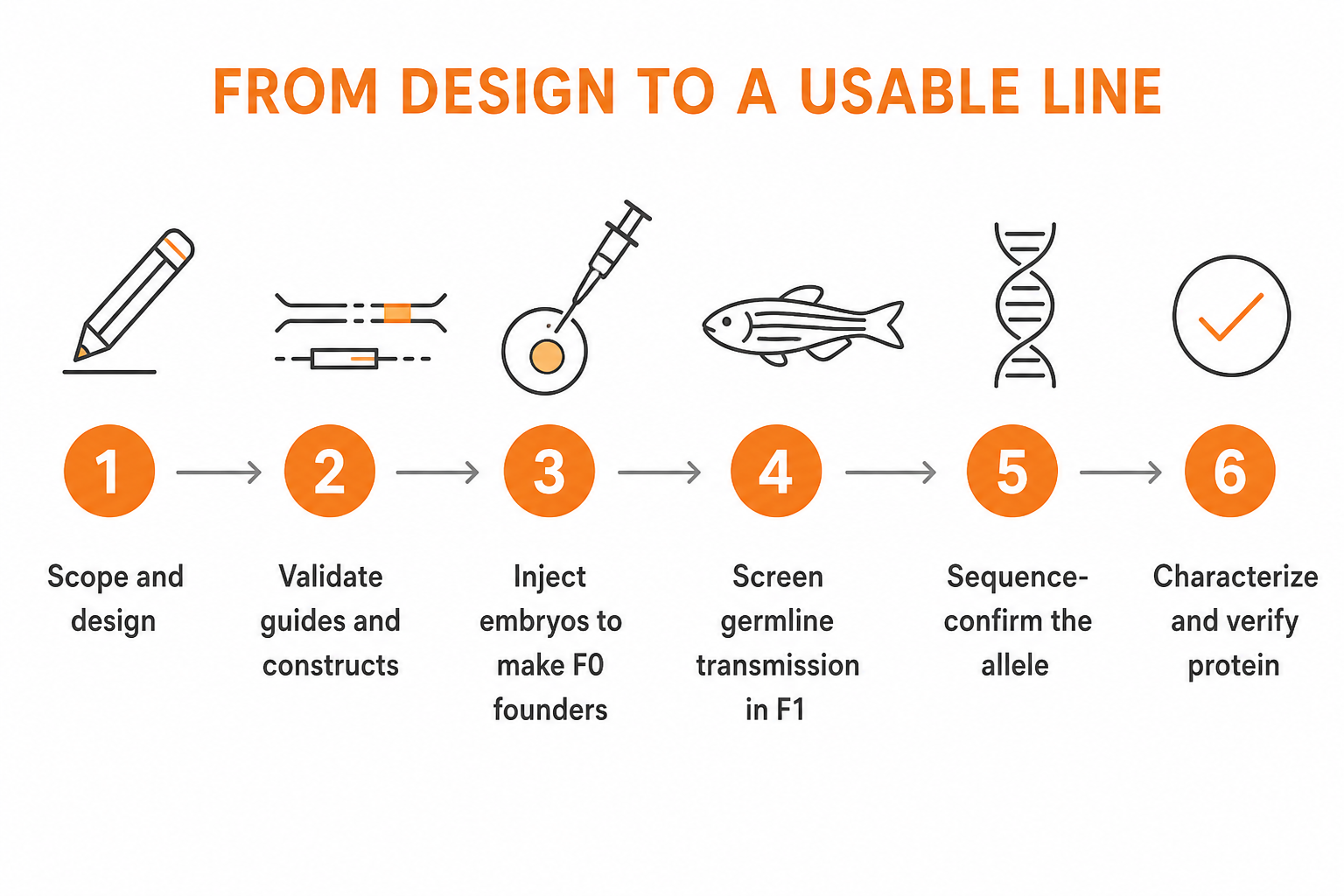
A stable line is built across generations. Knowing what happens at each stage helps you plan experiments, animal space and funding around it.
We confirm the gene, the paralog situation, the allele type and the controls. Target sites are chosen to disrupt every relevant transcript or to place a variant or tag precisely.
Guide RNAs are tested for cutting activity before they are committed to a founder cross. Knock-in templates and transgene constructs are sequence-checked.
Embryos are injected at the one-cell stage. Injected animals are mosaic, so they are raised to adulthood as potential founders. Zebrafish reach maturity in roughly three months.
Founders are outcrossed and their offspring genotyped to learn which founders pass the intended change on, and which alleles they carry.
The exact sequence of the allele is established in the F1 generation, so you receive a line defined by sequence rather than by a guess at the lesion.
Phenotype and, where it matters, protein level are checked. What is delivered, such as genotyped founders or an established heterozygous line, is agreed at scoping.
Exact durations depend on the gene, the allele type and how many founders must be screened. We give you a stage-by-stage plan during scoping rather than a single headline number.
These design considerations can affect model interpretation and are best addressed early.
Teleost fish went through an additional genome duplication, so many human genes have two zebrafish counterparts. If the paralogs share tissues and function, mutating one may show nothing. Decide up front whether to target one, both, or a defined combination.
A frameshift that creates an early stop codon is the usual route to loss of function, but where it sits in the gene matters. Alternative start sites, exon skipping and truncated proteins that retain activity all need to be considered when picking the target.
Mutant transcripts can differ in abundance or splicing. Some mutations also trigger compensatory changes in related genes, which can alter the phenotype. Differences between mutants and transient knockdowns should be investigated rather than attributed to a single mechanism.
Zebrafish eggs carry maternal mRNA and protein that can mask an early phenotype in zygotic mutants. If your gene acts in the first hours of development, ask whether maternal-zygotic mutants are needed.
Guides are selected to limit off-target sites, and founders are outcrossed so unrelated changes are diluted over generations. Wild-type siblings from the same clutch are an important comparison, alongside controls addressing genetic background and allele-specific effects.
If homozygous mutants do not survive to reproductive maturity, the line is generally maintained through heterozygous carriers. Alternative designs may be considered when the study requires later-stage or tissue-specific analysis.
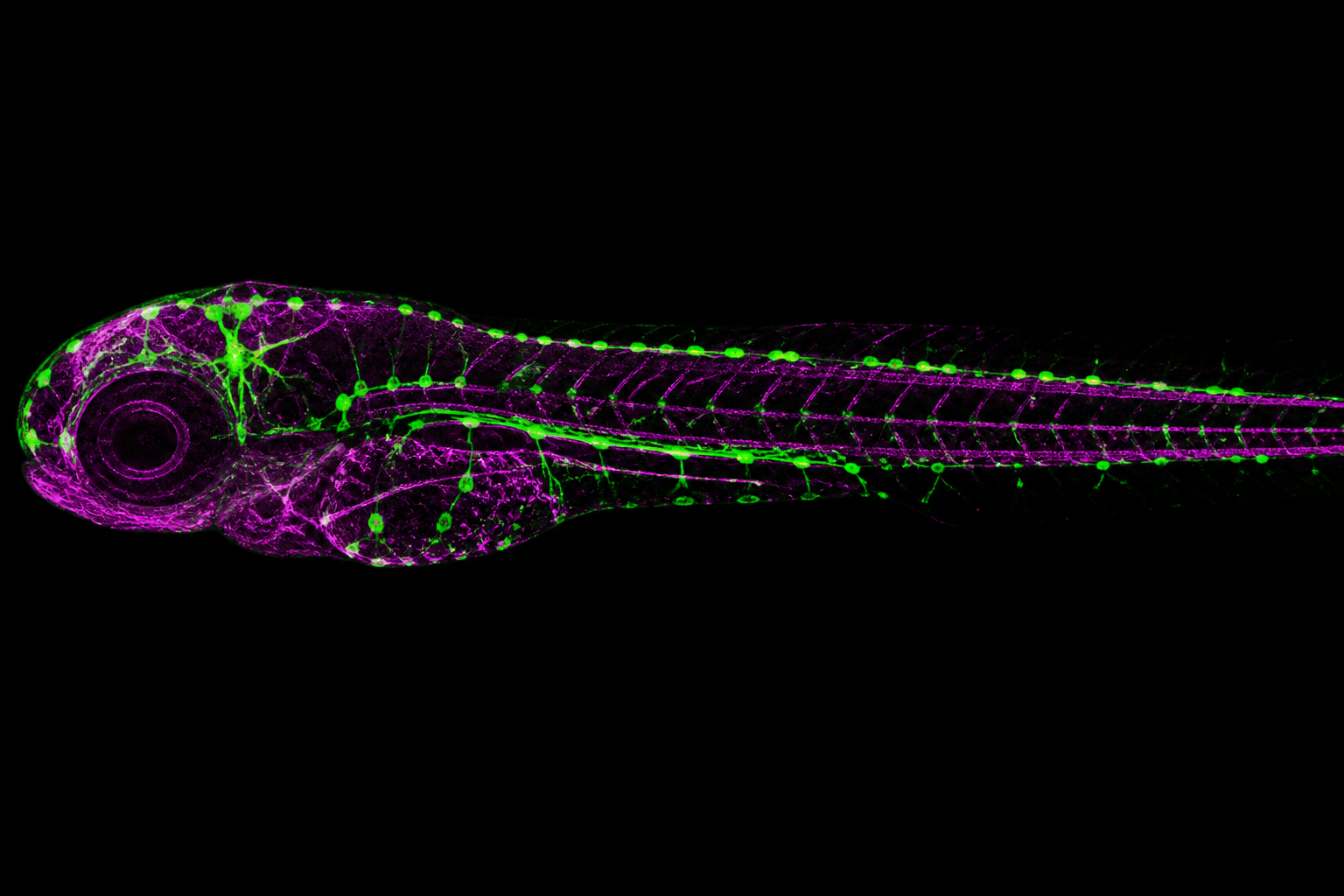
Sequencing proves the DNA changed. It does not prove the protein is gone, truncated or tagged where you expect.
A suitably validated antibody can support assessment of protein abundance, apparent molecular size or localization. Whether a tag or patient variant preserves or changes biological function requires assays matched to the project.
Timing helps, too. Founders take months to raise, and that is the ideal window to produce the antibody, so the reagent is ready when homozygous animals arrive.
Combine our custom zebrafish model service with custom zebrafish antibody development to receive a $200 bundle discount deducted directly from your combined-service quote. This is an immediate quote discount, not a credit for future use.
A disruptive DNA edit does not, by itself, establish loss of gene function. Mutant transcripts may persist without producing a functional protein, while some alleles can retain activity through alternative splicing, translation initiation or partially functional protein products. Validation should therefore be selected for the allele and the biological question.
| Layer | Method | What it shows | What it cannot show |
|---|---|---|---|
| DNA | Sequencing of the allele in F1 animals, with genotyping assays for routine use. | The exact lesion, and that it is heritable. | Whether protein is absent, truncated or functional. |
| Transcript | qPCR and RT-PCR with primers placed across and outside the lesion, comparing mutants with siblings. | Whether mRNA is reduced, spliced differently or still made, and whether decay is occurring. | Whether a stable, active protein remains. |
| Protein | Western blot and immunostaining with a zebrafish-specific antibody; mass spectrometry where suitable. | Evidence of changes in protein abundance, apparent molecular size or localization, within the assay’s sensitivity and specificity limits. | Whether changes in the protein explain the phenotype. Antibody specificity requires appropriate validation. A confirmed protein-null sample can provide a useful negative control when available. |
| Function | Phenotyping against wild-type siblings with pre-specified, quantitative endpoints. | Whether the animal differs in the way the question predicts. | That the difference comes from the intended change rather than a background mutation. |
| Specificity | Rescue by wild-type mRNA or a transgene, and comparison of a second independent allele where possible. | Supports a causal link between disruption of the target gene and the phenotype, especially when rescue findings agree with an independent allele and appropriate controls. | Rescue can be partial, and some genes are hard to restore at the right dose or in the right tissue. |
Model fidelity adds one more question: does the fish reproduce the human mechanism, the human phenotype and the human response to treatment closely enough for the claim you want to make? Deciding which of those matters for your project, and what evidence would convince a reviewer, belongs in the scoping conversation.
A custom model is most persuasive when its readouts are chosen for the disease, not borrowed from a general zebrafish protocol.
Zebrafish rarely reproduce a whole human syndrome. What they do well is model a defined cellular or organ-level mechanism and give you a measurable phenotype to test against. The table lists common disease areas, a typical custom model for each and examples of phenotype-specific readouts.
| Disease area | Typical custom model | Phenotype-specific readouts |
|---|---|---|
| Neurodevelopmental disorders | Loss-of-function or variant lines in zebrafish orthologs of risk genes, often with neuronal reporters. | Larval locomotor and startle behavior, sleep-wake patterns, seizure-like activity, brain and head size, neuron counts, synapse staining. |
| Oncology | Transgenic oncogene or tumor-suppressor lines, and xenografts of human cells in larvae. | Tumor onset, fluorescence-based tumor burden, proliferation, invasion or metastasis foci, response to compounds. |
| Cardiovascular disease | Cardiac reporter lines and mutations in cardiomyopathy, arrhythmia or vascular genes. | Heart rate and rhythm, chamber size and contractility, blood flow, vessel patterning, pericardial edema, regeneration after injury. |
| Metabolic disease | Lines with altered lipid, glucose or liver metabolism, and reporters for pancreatic beta cells or hepatocytes. | Lipid staining, glucose measures, beta-cell number, liver size and steatosis, growth and survival. |
| Rare genetic disorders | Patient-variant knock-ins and knockouts of the single causal gene, tested with rescue by the human or zebrafish sequence. | Gene-specific morphology, survival, enzyme activity or biomarkers, and reversal of the phenotype by a candidate compound. |
| Developmental biology | Lineage and cell-state reporters, conditional alleles and tagged proteins. | Time-lapse imaging of cell migration, patterning markers, organ size and shape, tracing of derived cell types. |
Whatever the area, decide the readouts first and make them quantitative. Many of them, such as where a protein sits in a tissue, are only credible with a validated reagent, which is where a custom zebrafish antibody and the model support each other.
One coordinated project: zebrafish gene-editing and disease-modeling specialists for the model, and a team that already makes antibodies for zebrafish researchers for the validation.
For years we have made custom antibodies for zebrafish researchers, and we have loved the work. Those projects put us in regular conversation with the people who know the fish best, including many experts in gene editing and zebrafish disease modeling. We now collaborate with those experts to provide this custom zebrafish model service.
For your project, that gives you three things:
A model is only as good as the evidence that it behaves the way you think it does. We care about that last step as much as the first injection.
During scoping, you are welcome to ask which collaborators would work on your gene or disease area and what validation evidence would be delivered for your line.
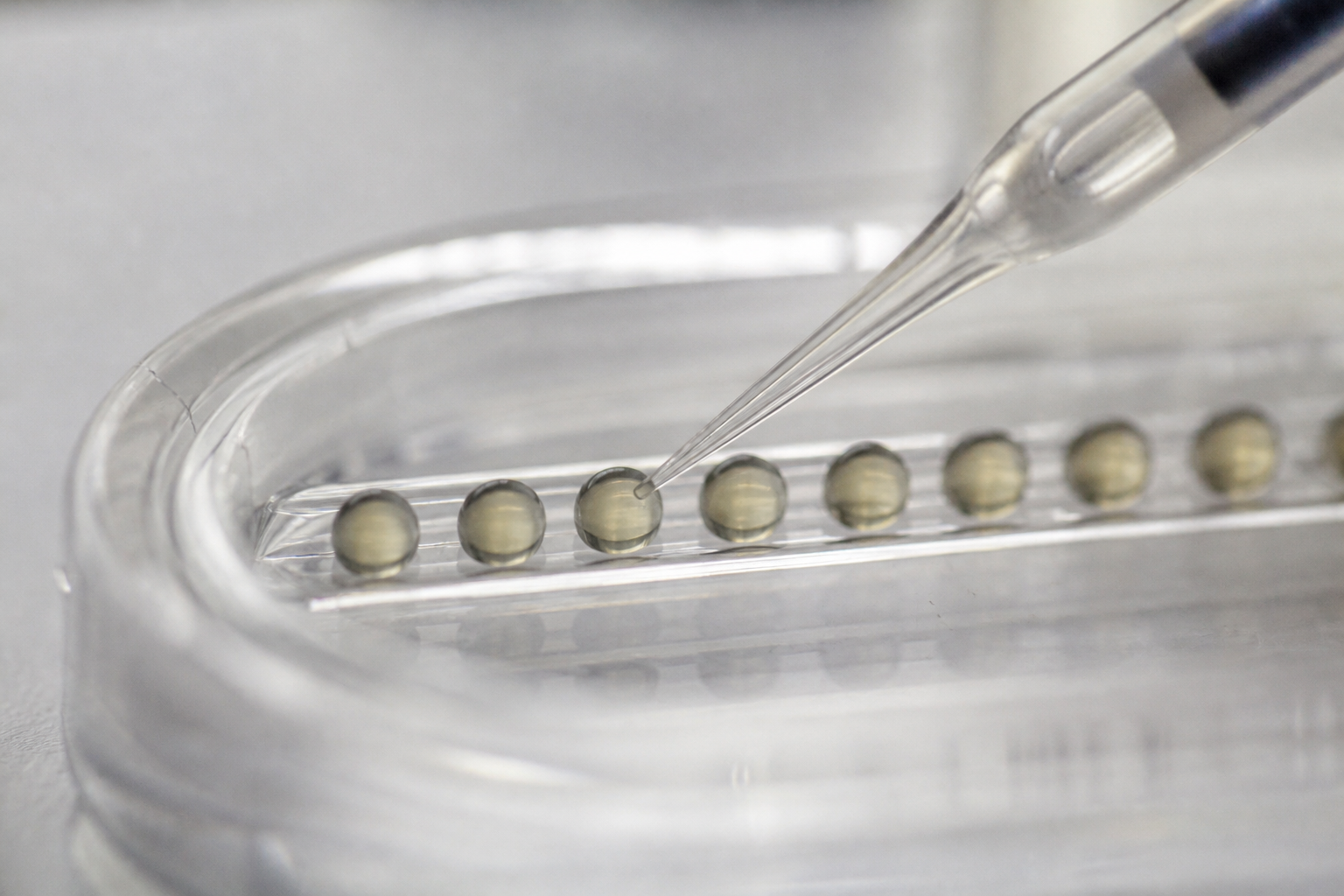
Before commissioning anything, search the zebrafish community resources. Reusing a validated allele is faster and cheaper, and we would rather you know that now.
ZFIN and the zebrafish stock centers list many existing mutant and transgenic lines. Check whether a line already matches your gene and allele, and how its loss of function was validated. If it was confirmed only by phenotype or by transcript, ask whether you need stronger evidence.
You do not need a finished design. A short brief covering the points below is enough to start a useful scoping conversation.
If you plan to verify your model with a zebrafish antibody, mention it in your brief. Combining model development with custom zebrafish antibody development qualifies the project for a $200 bundle discount applied directly to the combined-service quote.
Zebrafish embryos develop outside the mother and are transparent, so organs and fluorescent reporters can be followed in the living animal. A single pair produces large clutches, which supports screening, rescue and drug experiments, and most human disease genes have a zebrafish counterpart. Gene editing and transgenesis are well established in the species, which makes it practical to build a defined line around one question.
It depends on the model type. F0 crispants can be analyzed in the injected generation, within days. A stable line needs founders raised to adulthood, which takes roughly three months for zebrafish to reach sexual maturity, followed by outcrossing and confirmation of the allele in the next generation. Plan in months rather than weeks for any stable line.
A knockout asks what happens when the gene is lost. A knock-in of a patient variant asks whether that exact change is sufficient to cause the phenotype. If you are unsure, a loss-of-function allele is usually the faster first model, and a variant knock-in can follow once you know what phenotype to look for.
F0 crispants are useful for fast screening of candidate genes, but they are mosaic and cannot be maintained. A stable, sequence-confirmed line is the better choice for detailed phenotyping, rescue experiments, drug testing and anything you plan to publish as a defined allele.
Many human genes have two zebrafish counterparts because of an ancient genome duplication in the teleost lineage. A custom model can target one paralog, both, or a defined combination. The right choice depends on whether the paralogs are expressed in the same tissues and can compensate for each other.
Sequencing confirms the DNA change, but a mutation can still leave mRNA or a partly functional protein behind. Validation therefore adds qPCR or RT-PCR across the lesion, protein-level assays such as western blot or immunostaining with a zebrafish-specific antibody, phenotyping against wild-type siblings, and where possible a rescue experiment.
Yes. Search ZFIN and the zebrafish stock centers first. If a validated allele already matches your question, using it saves time. A custom zebrafish model makes sense when the allele, variant, tag or reporter you need does not exist, or existing lines are not validated at the protein level.
When you combine custom zebrafish model development with custom zebrafish antibody development, $200 is deducted directly from your combined-service quote. This is a $200 bundle discount on the quoted project, not an account credit or a credit for future use.
Tell us the gene, the change you want and the experiment it has to support. We will help you choose the model type, plan the generations, and decide how to prove the result, with a zebrafish antibody in the plan if you want one.
Combine model development with custom zebrafish antibody development for a $200 bundle discount, deducted directly from your combined-service quote.