This website uses cookies to ensure you get the best experience on our website.


- Table of Contents
Assay miniaturization, pilot and primary screens, and hit confirmation with counter-screens, delivered through Boster and its partner labs.
Request a quoteAll services are for research use only. They are not for diagnostic, clinical or therapeutic use, and are performed as non-GLP studies.
High-throughput screening (HTS) tests a compound collection against a biological target or cell system in microplates to find molecules that produce a measurable effect. Boster Bio and its partner labs deliver the core of a screening program: assay miniaturization, a pilot screen, the primary screen, and hit confirmation with counter-screens.
Some projects arrive with a validated assay that only needs to be scaled. Others arrive with a target and a hypothesis, and the assay has to be built and proven before any library plate is screened. Both start with the same goal: a short list of hits that reproduce and are worth a chemist's time.
HTS sits after target validation and before hit-to-lead chemistry. Everything in a campaign, from assay design to counter-screening, exists to keep that hit list honest.
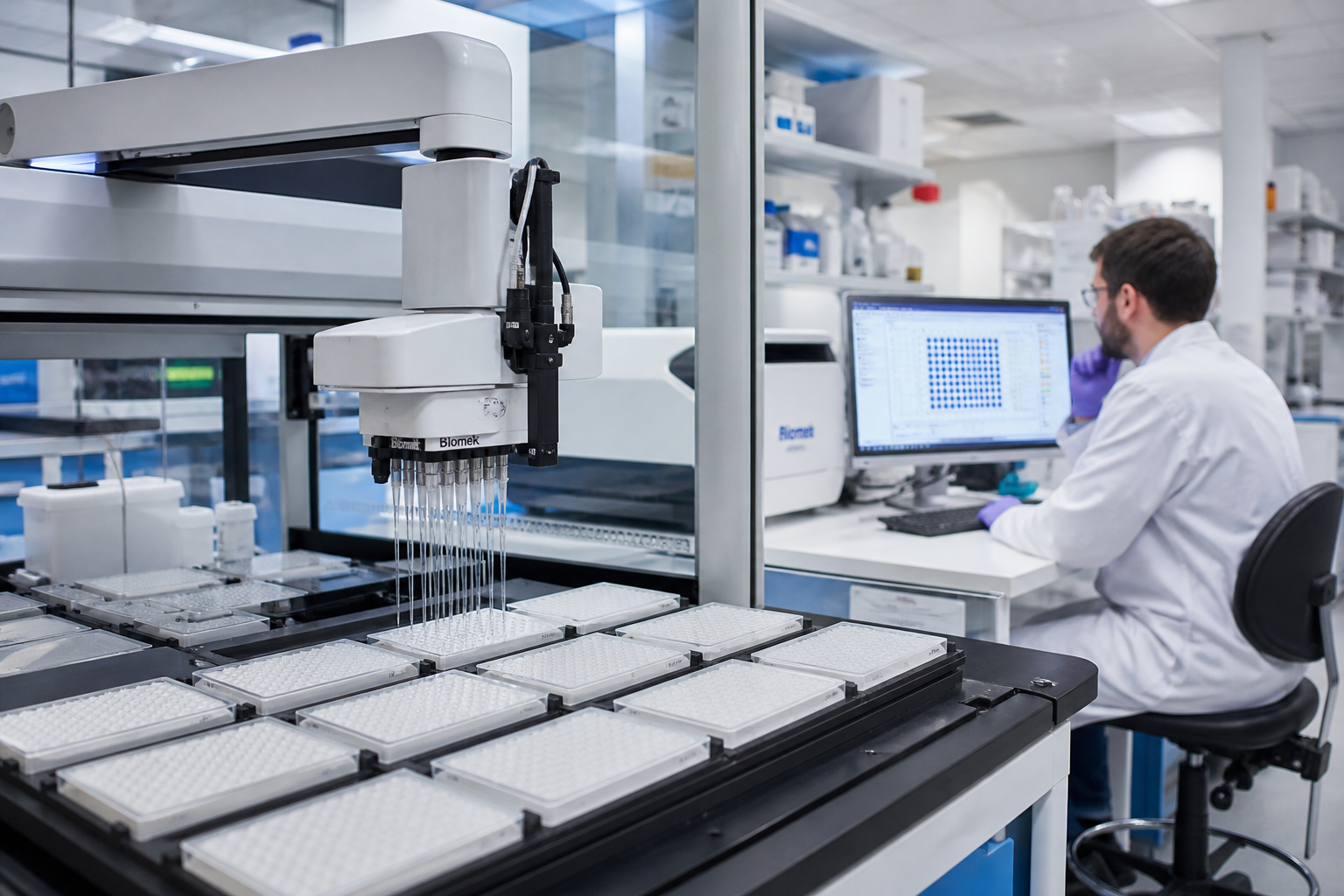
The assay format is chosen before the first plate is screened, and it decides what the hit list can tell you. A large library and fast automation cannot rescue an assay that asks the wrong question.
Purified protein, enzyme or receptor fragment in a defined buffer. Best when the mechanism is known and you need a direct readout of binding or catalytic activity. Low cost per data point and easy to miniaturize.
Living cells add membrane context, full signaling cascades and compound permeability. Use them when the target's biology depends on the cell: receptors, transcription or pathway-level effects.
Compounds are tested for a functional or morphological outcome without assuming one mechanism up front. Useful when the target is unknown or efficacy comes first. Available on request.
The right format depends on modality, how robust the assay is likely to be at scale, and the readout you need: a yes/no hit call, a potency value or a kinetic profile. We work through these trade-offs with you when scoping the project. For metabolic programs, Boster's compound screening services cover donor-derived adipose tissue models.
A validated assay is moved onto automation. Compounds are dispensed into microplates alongside controls, plate readers record a fluorescence, luminescence, absorbance or imaging signal for every well, and software flags statistical outliers as putative hits. Those hits are then retested, dose-responded and counter-screened before they are reported as confirmed.
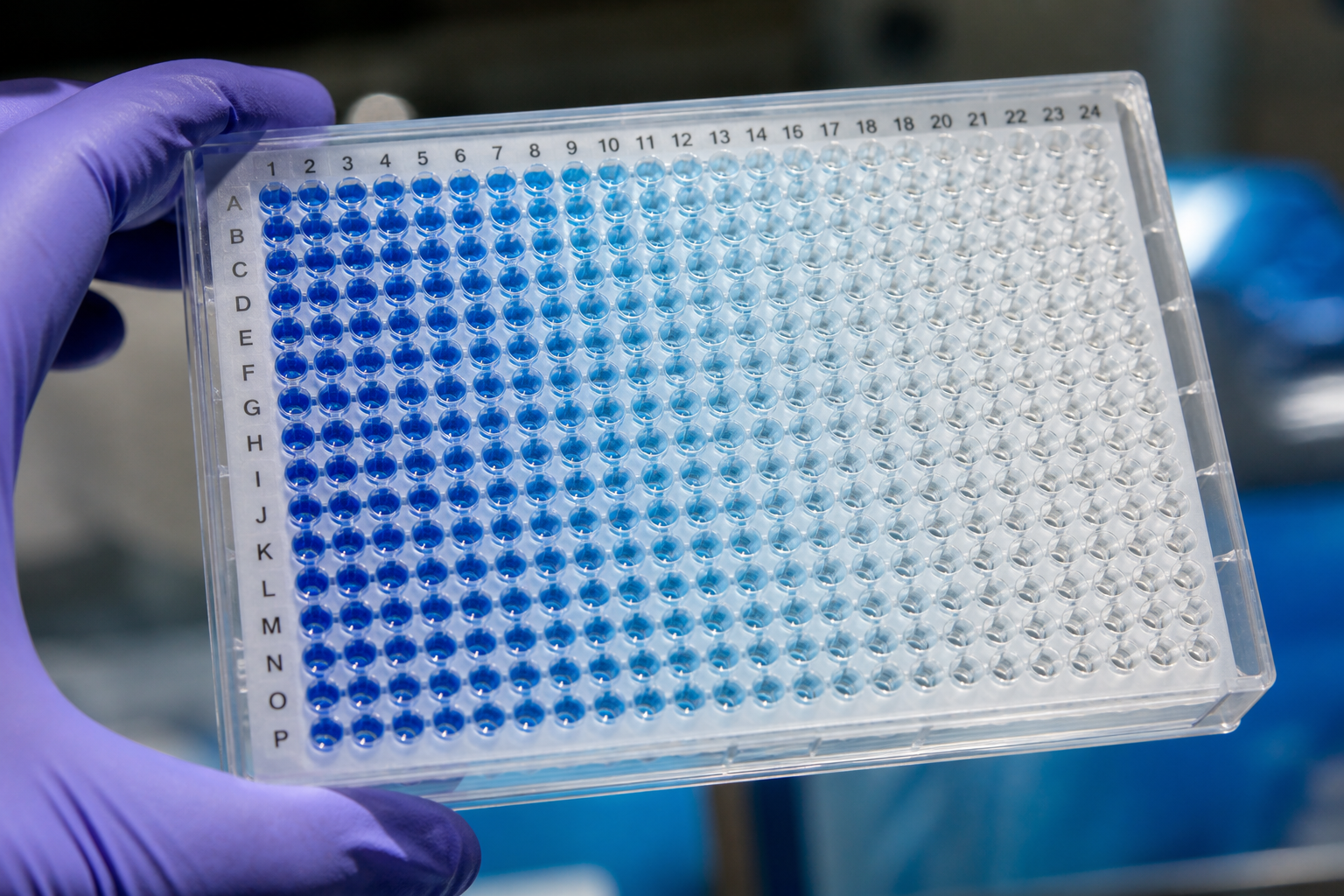
Many projects start without an assay that is ready for automation. The work then begins with the target's biology, a detection chemistry, and proof that the assay holds up at small volumes and automated timing. Boster's assay services cover this groundwork, and ELISA-format readouts can be built through our ELISA assay development services.
Confirm the target can be expressed, purified or stably transfected, and that it gives a measurable signal.
Tune reagent concentrations, incubation times, buffer and detection settings to maximize signal over background.
Scale the assay from 96-well volumes into 384- or 1536-well plates without losing signal quality. Many assays need rework at this step.
Move the protocol onto automated liquid handling and plate reading, then re-validate under those conditions.
Run replicate plates to confirm the assay meets agreed statistical thresholds before it is cleared for the library.
Rushing any of these steps is a common cause of an unusable hit list: too many artifacts, or a signal window too narrow to trust.
The library sets the limit on what a screen can find. You can screen your own compound collection or discuss library options with us; availability is confirmed at quote.
Broad chemical space across unrelated scaffolds. The usual choice for a novel or poorly characterized target.
Compounds enriched for a target class such as kinases, GPCRs or proteases, which can raise hit rates when the mechanism is known.
Approved or clinically tested drugs screened for a new indication, so any hit arrives with existing safety and pharmacokinetic data.
Small, low-molecular-weight compounds screened at high concentration to find weak but tractable starting points. Available on request.

Library size is not library quality. Poor diversity, degraded stock plates or heavy structural overlap can make a large collection underperform a smaller, curated one. When we scope a screen, we review compound purity, stock-plate age and scaffold overlap with you, so the hits are not one scaffold found a dozen times.

Automation makes the throughput possible, but the platform has to fit the assay. Plates move between liquid handlers, incubators and readers on a fixed schedule, and an assay that cannot tolerate that timing will fail however sound the biology.
Well format trades throughput against volume per well. 96-well plates give more working volume and suit assay development. 384-well plates hold four times as many wells with tighter tolerances. 1536-well plates, the usual entry point to ultra high-throughput screening, cut volumes to a few microliters and need very precise liquid handling and a wide, stable signal window. Format and readout are chosen per assay and confirmed at quote.
| Readout technology | What it measures | Typical use |
|---|---|---|
| Fluorescence intensity / polarization | Light emitted or depolarized by a labeled molecule | Binding and enzymatic assays |
| Luminescence | Light from a chemical or enzymatic reaction | Reporter-gene and ATP-based viability assays |
| Absorbance | Light absorbed by a colored product | Simple colorimetric enzyme assays |
| High-content imaging | Cell morphology, localization, or population-level features | Phenotypic and mechanism-of-action screens |
| Label-free biosensing | Mass or refractive-index change on binding | Direct target engagement without a tag |
A primary hit list is a set of candidates. Many will not survive retesting, and confirmation is how you find the ones that do.
Confirmation removes the hits that were never real, so chemists spend their time on compounds worth the effort.
The core service ends with a confirmed hit list and the data behind it. The hand-off package is built so your chemistry team can start triage without re-running basic checks:
Further follow-up assays are available on request and scoped separately.

Each stage is checked against statistical criteria agreed before screening starts, not judged afterwards by whether the hits look right.
| Metric | What it tells you | Typical acceptance bar |
|---|---|---|
| Z-prime (Z′) | Separation between positive and negative controls, accounting for variability | 0.5 or higher for a robust assay |
| Signal window | Raw difference between full-signal and no-signal conditions | Wide enough to tolerate normal plate-to-plate drift |
| Coefficient of variation (CV) | Consistency of replicate wells within a plate | Typically under 10–20%, alongside Z′ of 0.5 or higher |
| Plate uniformity | Absence of systematic edge, row, or column effects | No detectable spatial bias after correction |
| Hit reproducibility | Fraction of primary hits that confirm on retest | Reported as measured |
At the end of a campaign you receive the raw and normalized plate data, the hit-calling logic used, dose-response curves for confirmed hits, counter-screen results, and a written summary of what worked, what didn't and what the data supports. That lets your team check, and reproduce, the result.
Screening a full library before the assay has proven itself at scale is an expensive mistake. A staged plan keeps spending in line with what is known at each point.
Your validated assay, or one built through the assay development steps above, passes the agreed quality criteria before any library compound is used.
A subset of the library, sized at quote, runs through the full automated workflow to confirm Z′, plate uniformity and a sensible hit rate.
The selected library is screened once the pilot clears its quality bar, with the same statistical checks applied plate by plate.
Hits are retested, dose-responded and counter-screened, and the data package comes with a recommendation on which hits merit chemistry follow-up.
Each stage ends in a go, adjust or stop decision, so budget goes only to work the data supports.
Every project starts with a scoping call and a written quote.
Send us your target, assay status and library plans, and we will come back with a pilot plan and quote.
Request a quote